Friday, May 25, 2007

Illegal Immigration : A Middle Eastern Connection?

A different (and scary) side to the immigration issue: a Middle Eastern and often Islamist connection.

I tend to fall somewhere in the middle on the immigration issue so don't think this is a typical take on illegal (read: Latino) immigration. It is not. This is about national security.

There is an article series getting attention all over. The focus is on illegal immigration, visas (sometimes fake, other times not), and those of Arab and/or Muslim background (both non-violent Muslims and militant Islamists).

Todd Bensman wrote the articles. They are a must- and good-read:


I suggest you paste them into a word document and print them out for a hard-copy version to read. Most will want to keep these for some time or pass them on to someone unsuspecting of what is going on.

*** Updated 27 May 2007 ***
A continuation of the same topic:


In an interview the author Todd Bensam did with Hugh Hewitt last week, he stated there would be further articles and some dealing with some rather surprising aspects.

Saturday, May 19, 2007

Scruton on Vernon, Roger, and Living with Gypsies

In the chapter "How I Discovered my Name," Roger Scruton recalls one moment most young boys can understand:

I was a timid child, who keenly felt the double injury of red hair and a sissy name. The critical moment came aged 10, during the last year at primary school. A large boy called Herman, whose misfortune was also contained in a name, and who, therefore, became the school bully by way of compelling us to respect him, kicked me as I sat down for morning assembly, launching into a diatribe against red hair with every word of which I fully concurred. I gave him to understand that, had it been possible to vote for the abolition of red hair, I would have been first to raise my hand. To my dismay, however, Herman was not satisfied with this general apology for my condition, and indicated that I must meet him in the playground during break, so that my head could be bashed in and the problem of red hair solved for good and all.

"There's no helping it," said my friend Brian (the only one in the playground who was more timid than I). "He's after you. If not today then tomorrow. Best to get it over with." News of the impending fight spread rapidly through the school and at the appointed hour the spectators gathered into a ring. Brian pushed me forward and my antagonist strode out from the crowd with flaring nostrils, fists up and big lips parted in a sneer. I closed my eyes, shielded my face with my left hand, and stretched my right arm out to protect myself. Herman came forward at a run, with blood-curdling shrieks and flailing arms. I stood rooted to the spot, the sounds of Herman's war-dance filling my ears, my outstretched fist trembling in the air before me. After what seemed like an age, there was a staggering blow to my knuckles. I opened my eyes to discover Herman recoiling backwards, lips split open and blood pouring over his chin. With a howl of dismay he pirouetted through the crowd and fled to the headmaster's office to report my crime.

It seemed unjust at the time that I should be caned and Herman comforted. But it added to a reputation that had already spread through the school as quickly as the newest cigarette card, and I resolved at once to exploit my eminence as the conqueror of Herman. I went from gang to gang in the playground, escorted by Brian (now promoted to first lieutenant), and informing my respectful listeners that henceforth I was not Vernon but Roger, that all uses of my former name, which had been no more than a disguise adopted for secret service reasons, would be as severely punished as remarks about red hair. Obedience was immediate and universal, and henceforth I was Roger to everyone, including my family, who were told that the choice was simple: either they ceased to call me Vernon, or I went to live with the Gypsies. (12-13)

Scruton's memoirs are worth reading and even if you do not share his political or philosophical or even (current?) theological views, you will be rewarded for the time spent reading this true artist of the English language. The book is Gentle Regrets and you can get it here.

Scruton and Stealing the Heart

"Pay attention to this man. He is one of the brightest minds around."

Some years ago, actually it was 1 Oct 1993 while I was at a conference celebrating the 40th anniversary of the publication of Russell Kirk's The Conservative Mind (which itself was an event worth remembering and recounting in detail some day), I first heard Roger Scruton speak. As he was being introduced, the gentleman next to me turned and said, "Pay attention to this man. He is one of the brightest minds around."

As Scruton gave his talk, mostly on Kirk, his work, and the influence it has had, I realized Scruton was someone I should get to know. With the passing of the years, I have. One book that I have waited some time for Scruton to write is a memoirs of sorts. Not an autobiography but a vignette of the events in his life that have influenced him to think and be the way he is. That book is here: Gentle Regrets.

I first heard about it through an on-line excerpt published on the Catholic Education Resource center site. In "Stealing from Churches," Scruton reflects upon the impact two different types of Catholics had on him:

Two people stand out among the many who have illuminated for me the path to Rome — a path that I never took. One enjoyed wealth and social standing. The other lived at the bottom of society, impoverished, oppressed, but serene.

Monsignor Gilbey and Basia are these two. Scruton describes these two and their Church with a passage from Radl:

God is offended by nothing and bears everything, even crucifixion; he loves humanity boundlessly and helps in the manner of a disarmed man: he teaches, leads, praises, gives examples, chides and warns. How does he practise this method? He sends good people into the world, who are a model to those around them ...

and then closes the chapter with:

The apostolic church is a church of the heart. When you steal from it you steal the heart. Hence the theft is easy; and amends are long and hard.

The more I read of this book, the more I see how "amends are long and hard."

Get the book and read the whole thing.

Thursday, May 17, 2007

Thomas Howard and Lead, Kindly Light

I just finished Thomas Howard's Lead, Kindly Light, a short memoir about his spiritual journey to the Catholic Church. The link to the amazon page leads to some good comments about the book. Here are a few of the many passages I found myself re-reading and thinking about over and over:

Protestantism was not, whatever else I might have wished to say about it, a picture of things that would have been at all recognizable to the apostles, nor to the generation that followed them. The faithful from Pentecost on were certainly aware of a great babel of voices among the Christians [...] . But the faithful were also aware that there was a body that could speak into the chaos and declare with serene and final authority what the Faith that had been taught by the apostles was. Clearly we modern non-Catholics were living in a scheme of things altogether unimaginable to the Twelve Apostles and the Fathers of the Church. (39)

In speaking of the "deepest mysteries of the Church," Howard writes:

But of course the great paradox is that she is more than in time: she is eternal, and the vicissitudes both of history and of one's own private life do not change her substance. A Catholic in first-century Smyrna, a Frankish peasant in sixth-century Merovingian France, a seventeenth-century countess in Seville, Madame de Maintenon, and I all live with our turbulent or tranquil surroundings finding their center in that which does not change. The Mass is there. The Apostolic See is there. The Magisterium is there. The clergy, high and low, good and wicked, are there. The prayers of the Church are there. War and peace are there. Doom threatens in the form of Attila, or the Black Death, or Modernism, or infidelity. But Our Lord's words about the gates of Hell stand unqualified by the threats. (97-8)

And towards the end of the book, Howard discusses his coming into the Church as one of the two decisions in his life (the other being his marriage) about which he has never had second thoughts:

I may say that every yearning, aspiration, hope, and desire that marked my life as a most earnest Protestant Evangelical, and then as an Anglican, has been fulfilled a thousand times over. I have come home. I have dropped anchor. I have taken my place in the Church of the apostles, Fathers, confessors, martyrs, bishops, saints, and all the Catholic faithful. I have nothing to "protest." (103-4)

Get and read the book. It is worth your time.

As I get ready to teach a little more on Newman's own "Lead, Kindly Light," a poem some of my students are memorizing (and yes, they know the proper title is "Pillar of the Cloud"), I am the better for having read Howard's short book, seeing the trust and hope of a contemporary Christian, the trust and hope we should all have in being led by the Light of Truth:

Lead, Kindly Light, amid the encircling gloom
Lead Thou me on!
The night is dark, and I am far from home—
Lead Thou me on!
Keep Thou my feet; I do not ask to see
The distant scene—one step enough for me.

I was not ever thus, nor pray'd that Thou
Shouldst lead me on.
I loved to choose and see my path, but now
Lead Thou me on!
I loved the garish day, and, spite of fears,
Pride ruled my will: remember not past years.


So long Thy power hath blest me, sure it still
Will lead me on,
O'er moor and fen, o'er crag and torrent, till
The night is gone;
And with the morn those angel faces smile
Which I have loved long since, and lost awhile.

Now onto Roger Scruton's Gentle Regrets.

Scary Thought: "Was Osama Right?"

Bernard Lewis's latest is a must-read. In "Was Osama Right?" Lewis discusses the difference between the then-Soviet response to Islamist terror and the American response:

A few examples may suffice. During the troubles in Lebanon in the 1970s and '80s, there were many attacks on American installations and individuals--notably the attack on the Marine barracks in Beirut in 1983, followed by a prompt withdrawal, and a whole series of kidnappings of Americans, both official and private, as well as of Europeans. There was only one attack on Soviet citizens, when one diplomat was killed and several others kidnapped. The Soviet response through their local agents was swift, and directed against the family of the leader of the kidnappers. The kidnapped Russians were promptly released, and after that there were no attacks on Soviet citizens or installations throughout the period of the Lebanese troubles.

[...]

The more immediate, more dangerous enemy was the Soviet Union, already ruling a number of Muslim countries, and daily increasing its influence and presence in others. It was therefore natural to seek and accept American help. As Osama bin Laden explained, in this final phase of the millennial struggle, the world of the unbelievers was divided between two superpowers. The first task was to deal with the more deadly and more dangerous of the two, the Soviet Union. After that, dealing with the pampered and degenerate Americans would be easy.

Then, after noting the sad American response to terrorist attacks over the past couple decades and the eventual surprise of actually responding with force after 9/11, Lewis closes with the scary thought that those who are calling for an end to this war, to these battles--at least on our part--may end up proving that Osama bin Laden was right about at least one thing: America has not the heart and will to fight a protracted war:

From the writings and the speeches of Osama bin Laden and his colleagues, it is clear that they expected this second task, dealing with America, would be comparatively simple and easy. This perception was certainly encouraged and so it seemed, confirmed by the American response to a whole series of attacks--on the World Trade Center in New York and on U.S. troops in Mogadishu in 1993, on the U.S. military office in Riyadh in 1995, on the American embassies in Kenya and Tanzania in 1998, on the USS Cole in Yemen in 2000--all of which evoked only angry words, sometimes accompanied by the dispatch of expensive missiles to remote and uninhabited places.

Stage One of the jihad was to drive the infidels from the lands of Islam; Stage Two--to bring the war into the enemy camp, and the attacks of 9/11 were clearly intended to be the opening salvo of this stage. The response to 9/11, so completely out of accord with previous American practice, came as a shock, and it is noteworthy that there has been no successful attack on American soil since then. The U.S. actions in Afghanistan and in Iraq indicated that there had been a major change in the U.S., and that some revision of their assessment, and of the policies based on that assessment, was necessary.

More recent developments, and notably the public discourse inside the U.S., are persuading increasing numbers of Islamist radicals that their first assessment was correct after all, and that they need only to press a little harder to achieve final victory. It is not yet clear whether they are right or wrong in this view. If they are right, the consequences--both for Islam and for America--will be deep, wide and lasting.

Go read the whole thing.

Saturday, May 12, 2007

Literary Meme: What Are You Reading?

Was over at Right Reason trying to find out the latest with regards to Dr. Francis Beckwith's decision to return to the Catholic Church and I found this:

I don't usually do "memes," but I like this one:

1. Grab the nearest book.

2. Open it to page 161.

3. Find the fifth full sentence.

4. Post the text of the sentence along with these instructions.

5. Don't search around and look for the coolest book you can find. Do what's actually next to you.

I have two books side by side. So here are both:

"For he looked every minute of a hundred years old!" (Leon Bloy, The Woman Who Was Poor)

and

"'But I must take it off over there.'" (dialogue from "Drinks in Helsinki" in Roger Scruton's Gentle Regrets)

And as Maxwell Goss says at Right Reason:

"Feel free to post your own sentences in the comments, readers .... It'll be fun to see what y'all are reading." You can do so below by clicking the comments.

Thursday, May 10, 2007

Stabat Mater -1-

Who composed the music to this? I have been trying to figure out for quite some time what piece this is: what, who, which CD? Let me know via comments box or email.

Monday, April 23, 2007

Country Music and Why

Here are just a few reasons why I listen to the music that I do. (It might take a moment to load, but it is worth watching; just a few minutes of your time. Somtimes, there is a short commercial before the video clip. Enjoy.)

Sunday, April 15, 2007

Love Triumphs: The Easter Octave and the Liturgy of the Redemption Fills the World


When on the Cross my Heart was sweating in the wine-press, when all strength had already been surrendered and only the emptiness and the impotence still suffered; when all it could yield, drop by drop, was “I can’t any more,” and “I hardly have the will”;


when all blood had abandoned the Heart and all spirit the soul: then it was only nothingness that bled, only the water of perfect exhaustion that still flowed when the lance bored in (visibly into the Heart of flesh, and invisibly into soul, spirit and God): in me God himself became exhausted. The Inexhaustible was exhausted. Life was lived out. Love was loved out.

Life was lived out.

Love was loved out.

This was my victory. In the Cross was Easter.

In death the grave of the world was burst open.

In the leap into the void was the ascension to heaven.

Now I fill the world, and at last every soul lives from my dying.

You do not bear the judgment, but the grace. … Your participation in the redemption (your status as co-redeemers, we might say) is but an analogy, an expression of my love. But it is real: I myself make it real and valid. I make up for your failure and bring it to plenitude. … Taste with me the futility of the redemption. It is from such stuff that the Father has always wrought his grace. There is a judgment; in the Father’s hand there is a balance. In the one scale there lies the heavy and oppressive futility of it all. In the other, a buoyant, mounting hope. And, as the first scale falls, the judgment is decided. Hope mounts up and my Kingdom triumphs; a soaring escape.


Let us look steadfastly to the blood of Christ, and see how precious that blood is to God, which, having been shed for our salvation, has set the grace of repentance before the whole world.

--Pope St Clement, First Epistle to the Corinthians


***Considering the event of today, you might want to watch/listen to/pray with "Divine Mercy and How This Effects Your Thinking," a program that features Fr. Benedict Groeschel and a dear friend, Br. Michael Gaitley, MIC.***

Saturday, April 14, 2007

The Resurrected Christ, the Wellspring, & the Liturgy

Now, in the hour when the economy of salvation reaches its climax, it is Jesus himself who opens “paradise” (Lk 23:43), the garden of life, to men who are straying far from God. He can do so because the source, the wellspring, is now here.

Christ is risen; he is truly risen! Now everything begins.


On this day of birth the river of life becomes LITURGY as it spreads out from the tomb and reaches us in the incorruptible body of Christ.

[T]he risen Christ [is] the inexhaustible wellspring of the liturgy. […] He is united to the Father and radiates the glory of God from his own body; being united to the wellspring he gives life (see Jn 5:20-21 and 26-27). The river of life can now flow forth from the throne of God and from the throne of the Lamb. The liturgy has been born; the Resurrection of Jesus is its first manifestation.


The Resurrection of Jesus is not in the past, for if it were Jesus would not have conquered our death. […] [T]he death of Jesus was by its nature the death of death. But the event wherein death was put to death cannot belong to the past, for then death would not have been conquered. […] The hour on which the desire of Jesus was focused “has come, and we are in it” forever; the event that is the Cross and Resurrection does not pass away.

More than that, it is the only true event in all of history. All other events are dead and will always be dead; this one alone remains.

The hour in which the Word with a loud cry handed over his Breath of love so that men might live is no longer in the past; it is, it abides, it lives on through history and sustains it.

This unprecedented power that the river of life exercises in the humanity of the risen Christ—that is the liturgy! In it all the promises of the Father find their fulfillment (Acts 13:32). Since that moment the communion of the Blessed Trinity has ceaselessly been spreading throughout our world and flooding our time with its fullness. Henceforth the economy of salvation takes the form of liturgy.

--Fr. Jean Corbon, OP, The Wellspring of Worship

Friday, April 13, 2007

He Makes All Things New Again

And he who sat upon the throne said, "Behold, I make all things new."
(Rev. 21.5)


He has brought total newness by bringing himself.
--Saint Irenaeus, Adversus Haereses

He was going to inherit a world already made,
And yet he was going to remake it entirely.
--Charles Peguy

Thursday, April 12, 2007

This Tree is my eternal salvation ...

This Tree is my eternal salvation. It is my nourishment and my banquet. Amidst its roots I cast my own roots deep: beneath its boughs I grow and expand, revelling in its sigh as in the wind itself. Flying from the burning heat, I have pitched my tent in its shadow, and have found a resting-place of dewy freshness. I flower with its flowers; its fruits bring perfect joy--fruits which have been preserved for me since time's beginning, and which now I freely eat. This Tree is a food, sweet food, for my hunger, and a fountain for my thirst; it is a clothing for my nakedness; its leaves are the breath of life. Away with the fig-tree, from this time on! If I fear God, this is my protection; if I stumble, this is my support; it is the prize for which I fight and the reward of my victory. This is my straitened path, my narrow way; this is the stairway of Jacob, where angels pass up and down, and where the Lord in very truth standing at the head.

This Tree, vast as heaven itself, rises from earth to the skies, a plant immortal, set firm in the midst of heaven and earth, base of all that is, foundation of the universe, support of this world of men, binding-force of all creation, holding within itself all the- mysterious essence of man. Secured with the unseen clamps of the spirit, so that, adjusted to the Divine, it may never bend or warp, with foot resting firm on earth it towers to the topmost skies, and spans with its allembracing arms the boundless gulf of space between.

He was All, and in all, filling it with himself; stripped naked for battle against the powers of the air. . .

With him two thieves were extended, bearing within themselves the marks of those two peoples, the marks of those two types of mind. . .

When this cosmic combat came to an end ... the heavens shook; almost, the stars fell from the skies; the light of the sun was extinguished for a time; rocks were split asunder; the entire world was all but shattered ... But great Jesus breathed forth his divine Soul, saying: "Father, into Thy hand I commend my spirit." And lo, even while all things shuddered and heaved in earthquake, reeling for fear, his divine Soul ascended, giving life and strength to all; and again creation was still, as if this divine Crucifixion and Extension had everywhere unfolded and spread, penetrating all things, through all, and in all.

O Thou who art alone among the alone, and all in all! Let the heavens hold thy Godhead; and paradise, thy soul; and earth, thy blood. For the Indivisible has become divided, so that all might be saved, and the world below might not remain ignorant of the coming of God....


We beseech thee now, Lord God,
Christ, eternal King of souls:
stretch forth thy mighty hands over thy sacred Church,
and over a holy people for ever thine.


-Ancient Paschal Homily, 51
(aka Pseudo-Chrysostom, Sermon VI for Holy Week)

Wednesday, April 11, 2007

Feeling the Light of the Risen Son

Lord, I believe, help thou mine unbelief.

I needed blood to tell me the truth,
the touch of blood. Even
my sight of the dark crust of it round the nailholes
didn't thrust its meaning all the way through to that manifold knot in me
that willed to possess all knowledge, refusing to loosen
unless that insistence won the battle I fought with life.

But when my hand led by His hand's firm clasp
entered the unhealed wound, my fingers encountering
rib-bone and pulsing heat, what I felt was not
scalding pain, shame for my obstinate need,
but light, light straming into me, over me, filling the room
as if I had lived till then in a cold cave, and now
coming forth for the first time, the knot that bound me unravelling,
I witnessed all things quicken to color, to form,
my question not answered but given its part
in a vast unfolding design lit by a risen sun.


--Denise Levertov, "St. Thomas Didymus"

Dominus Meus et Deus Meus : My Lord and My God

Thomas, you have plunged your finger into my open Heart.
--Hans Urs von Balthasar
The wound of the body also reveals the spiritual wound. ...
Let us look through the visible wound to the invisible wound of love.

--St. Bonaventure, Mystical Vine


Where did I triumph if not on the Cross? Are you as blind as the Jews and the pagans to think that Golgotha was my downfall and my failure? … Look: this is my secret, and there is no other in heaven or on earth: My Cross is salvation, my Death is victory, my Darkness is light. At that time, when I hung in torment and dread rushed into my soul because of the forsakenness, rejectedness, uselessness of my suffering, and all was gloomy, and only the seething rage of that mass of teeth hissed up mockingly at me, while heaven kept silence, shut tight as the mouth of a scoffer (but through the open gates of my hands and feet my blood bubbled out in spurts, and with each throb my Heart became more desolate, strength poured out from me in streams and there remained only faintness, death’s fatigue, infinite failure), and at last I neared that mysterious and final spot on the very edge of being, and then—the fall into the void, the capsizing into the bottomless abyss, the vertigo, the finale, the un-becoming: that colossal death which only I have died. Through my death this has been spared you, and no one will ever experience what it really means to die: This was my victory.

Haven’t I told you that if the grain of seed falls into the ground and dies it bears much fruit?

Of whom was I thinking when, as a freezing child, I lay in the crib, if not of you? Of what did I speak in the splendor of Tabor with Moses and Elias, if not of my suffering for you? For whom did I ask the Father for signs, if not for you? For whose sake did I stumble my way through fourteen endless stations, if not for yours? And my divinity and the embrace of my Father: for whom did I leave these if not for you? You want to follow me? You want to be called my disciples? Then let that mind be yours which animated me: being God in my very substance, I did not cling to my equality with God, but rather emptied and annulled myself. I took on the figure of a slave, becoming wholly like men and descending below myself in men’s everyday appearance, in bondage unto death, unto death on the Cross.

For to be God was not enough for me. … I wanted to prove my divinity to you in no way other than by letting go of it in order to become your slave.

[T]he most divine thing about God (and to show this was my whole concern): God was free enough to give himself up. … This was his self-sufficiency: that he began to hunger and to thirst and that, in the person of his members, he suffered every sort of poverty and disgrace and imprisonment and nakedness and disease. This, my brothers, was his victory: that I was able to defeat even my divinity and that in the slave’s form I was able to manifest the Lord, and in sin’s likeness the essence of love. That, being outside of God, I knew how to be in God. That I became all in everything I was not.

Understand what it means to give oneself away. To strip oneself of one’s freedom out of freedom; and out of love, no longer to be free or to be lord over oneself; no longer to be able to determine where the journey will take you; to surrender oneself, to deliver oneself over to the series of consequences that carry us off in a direction we did not want—where to? You leap down from a high cliff. The leap is freely made, and yet, the moment you leap, gravity leaps upon you, and you tumble exactly like a dead stone to the very bottom of the gorge. This is how I decided to give myself. To give myself right out of my hand. To whom? It did not matter. To sin, to the world, to all of you, to the devil, to the Church, to the kingdom of Heaven, to the Father … I wanted to be the one given away par excellence. The corpse over which the vultures gather. The Consumed, the Eaten, the Drunk, the Spilled, the Poured Out. The Plaything. The Worn Out. The one squeezed to the very dregs. The one trod upon to infinity. The one run over. The one thinned to air. The one liquified into an ocean. The Dissolved. This was the plan; this was the will of the Father. By fulfilling it through obedience (the fulfillment itself was obedience), I have filled the world from heaven down to hell, and every knee must bend before me, and all tongues must confess me. Now I am all in all, and this is why the death which poured me out is my victory. My descent, my vertiginous collapse, my going under (under myself) into everything that was foreign and contrary to God—down into the underworld: this was the ascent of this world into me, into God. My victory.

Thomas, you have plunged your finger into my open Heart.


The wound of the body also reveals the spiritual wound. ...
Let us look through the visible wound to the invisible wound of love.

--St. Bonaventure

Tuesday, April 10, 2007

Event of Emmaus: Word and Sacrament

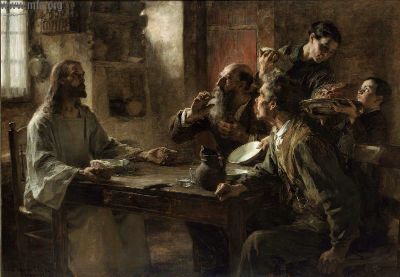
[H]ere too he [Christ] remains unrecognizable to the accustomed eye. … [H]e sets the hearts of the two wanderers aflame by his interpretation of the Scriptures and by breaking bread he opens their eyes. This is a reference to the two basic elements in early Christian worship, which consisted of the liturgy of the word (the reading and expounding of Scripture) and the eucharistic breaking of bread. In this way the evangelist makes it clear that the encounter with the risen Christ lies on a quite new plane; he tries to describe the indescribable in terms of the liturgical facts. He thereby provides both a theology of the resurrection and a theology of the liturgy: one encounters the risen Christ in the word and in the sacrament; divine service is the fashion in which he becomes touchable to us and recognizable as the living Christ. And conversely, the liturgy is based on the mystery of Easter; it is to be understood as the Lord’s approach to us. In it he becomes our travelling companion, sets our dull hearts aflame and opens our sealed eyes. He still walks with us, still finds us worried and downhearted, and still has the power to make us see.

Experience of the risen Christ is something other than a meeting with a historical man, and it must certainly not be traced back to conversations at table and recollections which would have finally crystallized in the idea that he still lived and went about his business. Such an interpretation reduces what happened to the purely human level and robs it of its specific quality. The resurrection narratives are something other and more than disguised liturgical scenes; they make visible the founding event on which all Christian liturgy rests. They testify to an approach which did not rise from the hearts of the disciples but came to them from outside, convinced them against their doubts and made them certain that the Lord had truly risen. He who lay in the grave is no longer there; he—really he himself—lives. He who had been transposed into the other world of God showed himself powerful enough to make it palpably clear that he himself stood opposite them again, that in him the power of love had really proved itself stronger than the power of death.

The comfortable attempt to spare oneself the belief in the mystery of God’s mighty actions in this world and yet at the same time to have the satisfaction of remaining on the foundation of the biblical message leads nowhere; it measures up neither to the honesty of reason nor to the claims of faith. One cannot have both the Christian faith and “religion within the bounds of pure reason”; a choice is unavoidable. He who believes will see more and more clearly, it is true, how rational it is to have faith in the love that has conquered death.

--Joseph Ratzinger (Pope Benedict XVI)

Top icon written by Sister Marie-Paul. Bottom icon by Nicholas Papas.

Monday, April 09, 2007

A Love Stronger Than Death: ALITHOS ANESTI!

“Love is strong as death” (Song of Sol. 8.6). … [L]ove demands infinity, indestructibility; indeed it is, so to speak, a call for infinity. But it is also a fact that this cry of love’s cannot be satisfied, that it demands infinity but cannot grant it; that it claims eternity but in fact is included in the world of death, in its loneliness and its power of destruction. Only from this angle can one understand what “resurrection” means. It is the greater strength of love in face of death.

For [man], since he has no continuance in himself, survival, from a purely human point of view, can only become possible through his continuing to exist in another.

[O]nly one could truly give lasting stability: he who is, who does not come into existence and pass away again but abides in the midst of transience: the God of the living, who does not hold just the shadow and echo of my being, whose ideas are not just copies of reality. … In him I can stand as more than a shadow; in him I am truly closer to myself than I should be if I just tried to stay by myself.

[O]nly where someone values love more highly than life, that is, only where someone is ready to put life second to love, for the sake of love, can love be stronger and more than death. … If the power of love for another were so strong anywhere that it could keep alive not just his memory, the shadow of his “I”, but that person himself, then a new stage in life would have been reached. … [This new realm] would signify the end of the sovereignty of bios, which is at the same time the sovereignty of death; it would open up the realm which the Greek Bible calls “zoe” that is, definitive life, which has left behind the rule of death. … It would no longer be evolution but decision and gift in one.

[A]s man has no permanence in himself his survival could only brought about by his living on in another. … [O]nly the love which takes up the beloved in itself, into its own being, could make possible this existence in the other. … Jesus’ total love for men, which leads him to the cross, is perfected in total stepping-over to the Father and therein becomes stronger than death, because in this it is at the same time total “being held” by him.

[I]mmortality always proceeds from love, never out of the autarchy of that which is sufficient to itself. … [T]his principle, properly understood, also applies even to God as he is seen by the Christian faith. … [W]hat is revolutionary about the Christian view of the world and of God … is that it learns to understand the “absolute” as absolute “relativity”, as relatio subsistens.

[L]ove found immortality, and immortality proceeds from love alone. … [H]e who has love for all has founded immortality for all. That is precisely the meaning of the biblical statement that his resurrection is our life. … [I]f he has risen, then we have too, for then love is stronger than death; if he has not risen, then we have not either, for then the situation is still that death has the last word, nothing else. … [E]ither love is stronger than death or it is not. … This also means, it is true, that our own love, left to itself, is not sufficient to overcome death; taken in itself it would have to remain an unanswered cry. It means that only his love, coinciding with God’s own power of life and love, can found our immortality.

It goes without saying that the life of him who has risen from the dead in not once again bios, the bio-logical form of our mortal life inside history; it is zoe, new, different, definitive life; life which has stepped beyond the mortal realm of bios and history, a realm which has here been surpassed by a greater power. … [T]his new life begot itself in history and had to do so, because after all it is there for history, and the Christian message is basically nothing else than the transmission of the testimony that love has here broken through death and thus transformed fundamentally the situation of all of us.
--Joseph Ratzinger (Pope Benedict XVI)

Top icon written by Joanna Ferencz.

Sunday, April 08, 2007

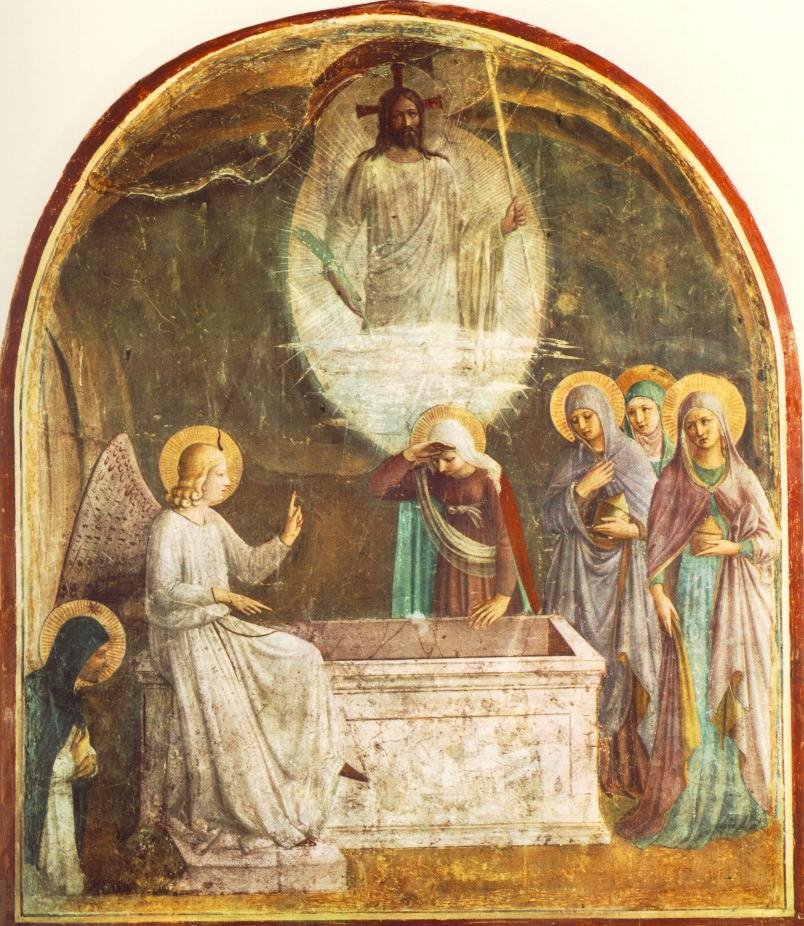
Empty Tomb


When Mary Magdalen came to the tomb and did not find the Lord's body, she thought it had been taken away and so informed the disciples.


After they came and saw the tomb, they too believed what Mary had told them. The text then says: "The disciples went back home," and it adds: "but Mary wept and remained standing outside the tomb."


We should reflect on Mary's attitude and the great love she felt for Christ; for though the disciples had left the tomb, she remained. She was still seeking the one she had not found, and while she sought she wept; burning with the fire of love, she longed for him who she thought had been taken away. And so it happened that the woman who stayed behind to seek Christ was the only one to see him. For perseverance is essential to any good deed, as the voice of truth tell us: "Whoever perseveres to the end will be saved."
--St. Gregory the Great

The Risen SON: Easter Sunday

Christos Anesti!

"I did not make you for the dungeon." In this Easter hour let us ask the Lord to visit the dungeons of this world; ... Let us ask him to enter into the spiritual prisons of this age, into the darkness of our lack of truth, revealing himself as the Victor who tears down the gates and says to us, "I, your God, have become your Son. Come out! I have not created you to be in prison for ever. I did not make you for the dungeon." In his play No Exit Jean Paul Sartre portrays man as a being who is hopelessly trapped. He sums up his gloomy picture of man in the words, "Hell is other people". This being so, hell is everywhere, and there is no exit, the doors are everywhere closed.

Christ, however, says to us, "I, your God, have become your Son. Come out!" Now the exact opposite is true: heaven is other people. Christ summons us to find heaven in him, to discover him in others and thus to be heaven to each other. He calls us to let heaven shine into this world, to build heaven here. Jesus stretches out his hand to us in his Easter message, in the mystery of the sacraments, so that Easter may be now, so that the light of heaven may shine forth in this world and the doors may be opened. Let us take his hand! Amen.

--Joseph Ratzinger (Pope BenedictXVI)

Alithos Anesti!

CHRISTOS ANESTI! Christ Is Risen

Only since Easter can we really utter the first article of faith; only on the basis of Easter is this profession rich and full of consolation: I believe in God, the Father Almighty. For it is only from the Lamb that we know that God is really Father, really Almighty.


This greatest festival of the Church's year encourages us, by looking at him who was slain and is risen, to discover the place where heaven is opened. If we comprehend the message of the Resurrection, we recognize that heaven is not completely sealed off above the earth. Then--gently and yet with immense power--something of the light of God penetrates our life. Then we shall feel the surge of joy ....
--Joseph Ratzinger (Pope BenedictXVI)

Christos Anesti!

The "Sun" Is Rising

The light shines in the darkness, and the darkness has not overcome it. (Jn 1:5)


Easter is concerned with something unimaginable. Initially the event of Easter comes to us solely through the word, not through the senses. So it is all the more important for us to be won over by the immensity of this word. Since, however, we can only think by employing sense images, the faith of the Church has always translated the Easter message into symbols which point to things that the word cannot express. The symbol of light ... plays a special part; the praise of the Paschal candle--a symbol of life in the midst of the darkened church--is actually a praise of him who proved victor over death. Thus the event of long ago is translated into our present time: where light conquers darkness, something of the Resurrection takes place.

--Joseph Ratzinger (Pope BenedictXVI)

Arise from the Dead


Awake, O sleeper, and arise from the dead, and Christ shall give you light. I have not created you to be in prison forever. I did not make you for the dungeon.
--Epiphanius

Saturday, April 07, 2007

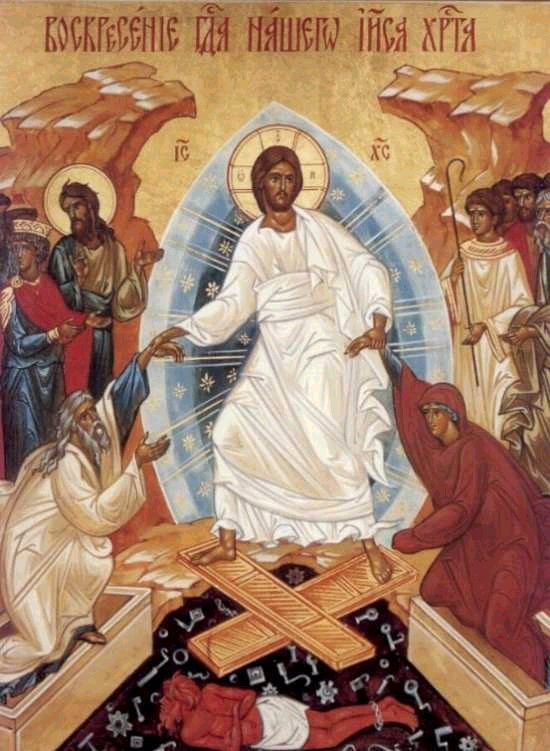
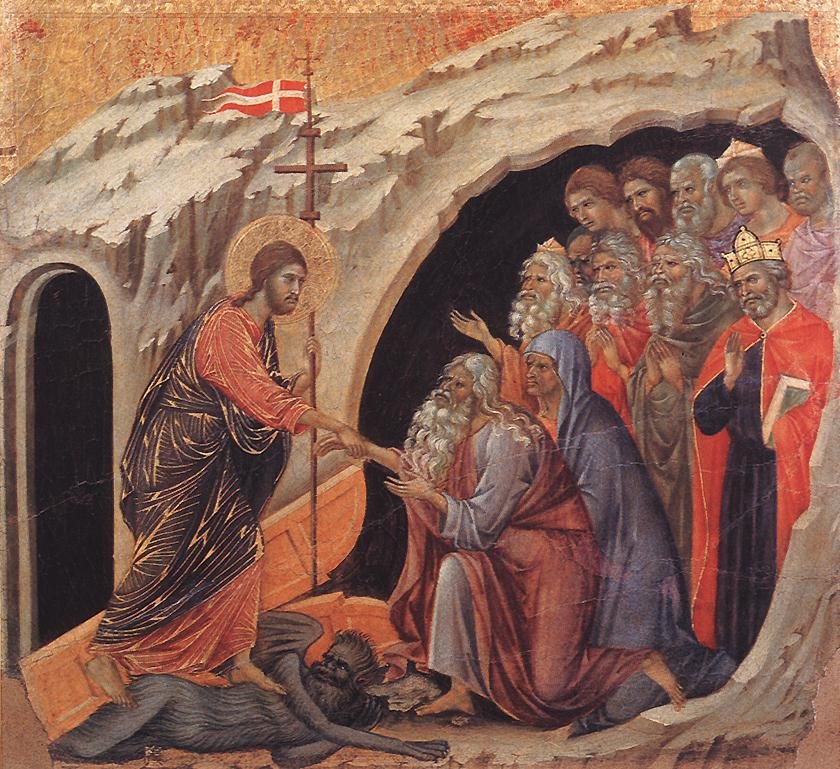
Descent into Hell

The light shines in the darkness, and the darkness has not overcome it. (Jn 1:5)


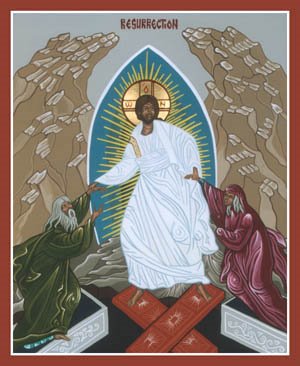
For the East the image of Redemption is the descent into Hades: the bursting open of the eternally-closed gate, when Christ stretches out his hand to the first Adam who, hardly trusting his eyes, sees the Easter light in the darkness of death.


He Descended into Hell

The icon ... represents as it were the mysterious inner dimension of the event of Easter which is indicated by a few words of Scripture and which we profess in the Creed when we say, "He descended into hell". In the perspective of the icon, this is an affirmation concerning Jesus' victory. The icon shows him having shattered the bolt of this world, having torn its gates from their hinges. It depicts him as the "stronger man" who has opened and penetrated the domain of the "strong man". It portrays him as the Victor, having burst through the supposedly impregnable fortress of death, such that death is now no longer a place of no return; its doors lie open. Christ, in the aura of his wounded love, stands in this doorway, addresses the still somnolent Adam and takes him by the hand to lead him forth. The liturgy of Holy Saturday circles around this event.
--Joseph Ratzinger (Pope BenedictXVI)

He brings consolation to this place of desolation, he brings warmth to this place of infernal cold.

Christ's suffering, the greatest one could conceive, was like that of the damned who cannot be damned any more. That is, his suffering went to the length of infernal punishment ... He alone through such a death entered into glory. He wanted to experience the poena sensus like the damned in Hell for the glorifying of his Father, and so as to show that one should obey the Father even to the utmost torture. That means: praising and glorifying God in every possible way for our justification--which is what Christ has done.

Friday, April 06, 2007

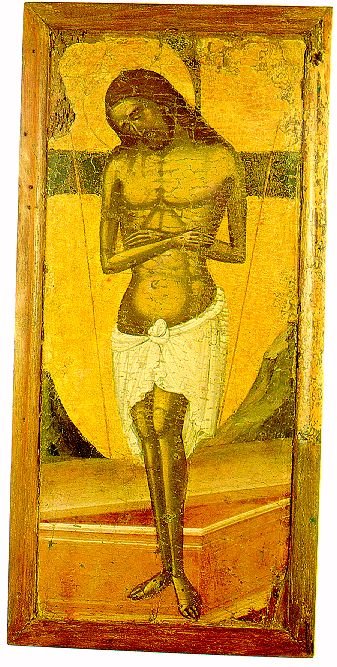
Entombment of Christ

This is what is known as a first-class funeral.
The solicitous ones seem to be chiefly intellectuals.
With solemn gestures they flourish gravecloths,
making a liturgy,
absorbing themselves in its dignity.
Nothing indicates they expect a resurrection.


The corpse is swathed according to custom.
Only the face cannot be subdued.
All suffering stares from that head.
Impossible to wrap it in a great and festive forgetting.


So already his unquiet image haunts heads and hearts.
Already the spirit is freed.
Already the Easter question takes shape...

But silently.
For tomorrow is only Holy Saturday.
The day when God is dead,
and the Church holds her breath.
The strange day that separates life and death

in order to join them in a marriage beyond all human thought.
The day which leads through hell,
and, after all the paths of the world,
into a pathless existence.

--Hans Urs von Balthasar

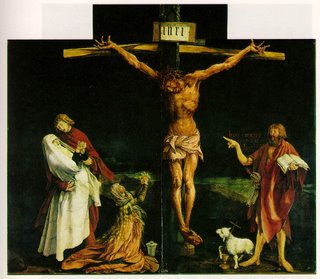
The Deposition of Christ

Jesus is taken down from the cross and his mother--accepting the pain that his Son bore for the sake of the world--is there to receive him in her bosom. Each of the seven swords which transfixed the heart of the mother was Mary's renewed assent to her Son's sufferings. It is beyond human comprehension that a person should say "yes" to everything, even to the most harrowing pain.

In her unconditional "yes" Mary becomes the "redeemed earth," capable of receiving on her lap the dead body of the Redeemer. This scene wrapped in silence reveals that Christ's Passion was not suffered in vain: Mary in this moment of weariness and infinite sorrow, represents humanity who accepts with gratitutde heaven's blessings. In the end her Son's body is not buried ina cold and inanimate matter ("matter" comes from the Latin word mater meaning "mother") but it is placed in the maternal and fruitful bosom of Mary, a prototype of incarnate love which finds its culmination in Mary. The Pieta therefore is not a fleeting image of sorrow but one engraved forever in human history: a mysterious image portraying maternal fecundity enshrouding the dead Son's body--the source of a new fecundity for the mother.

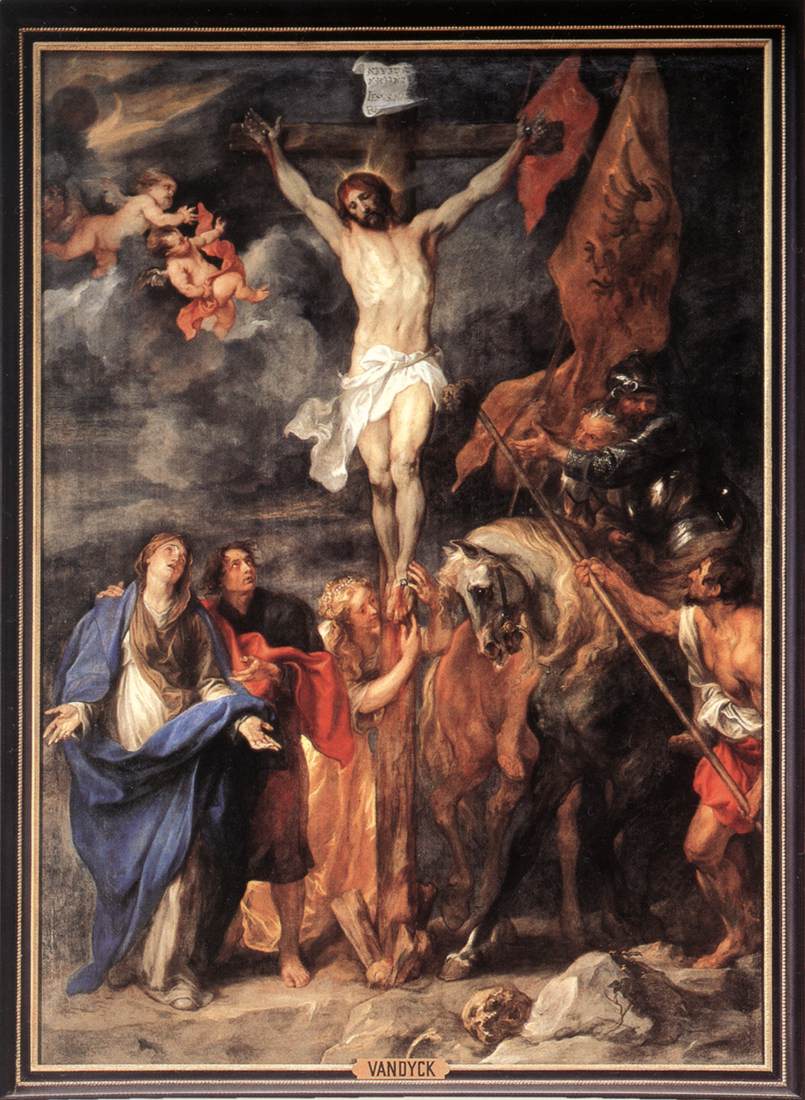
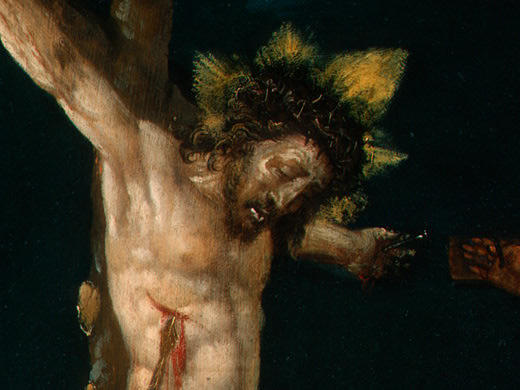
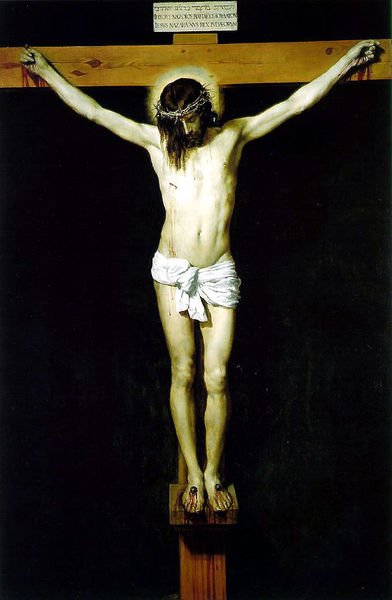
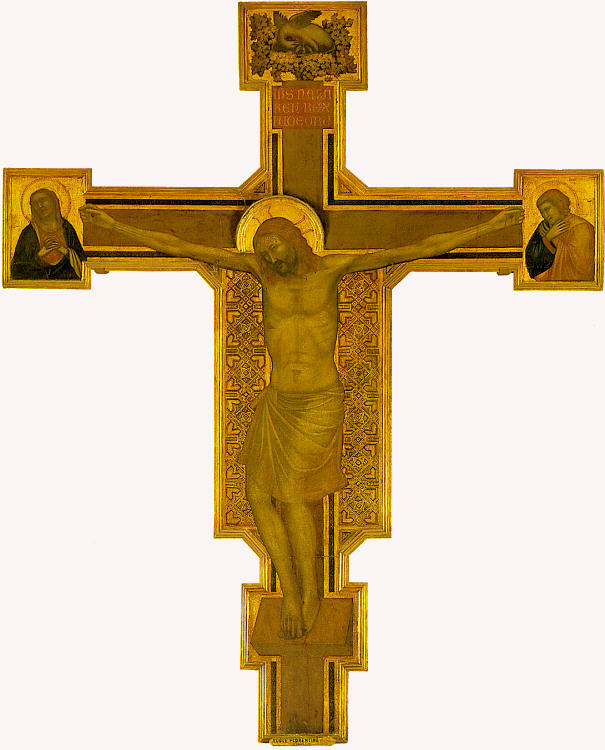
Christ on the Cross ... Some Thoughts

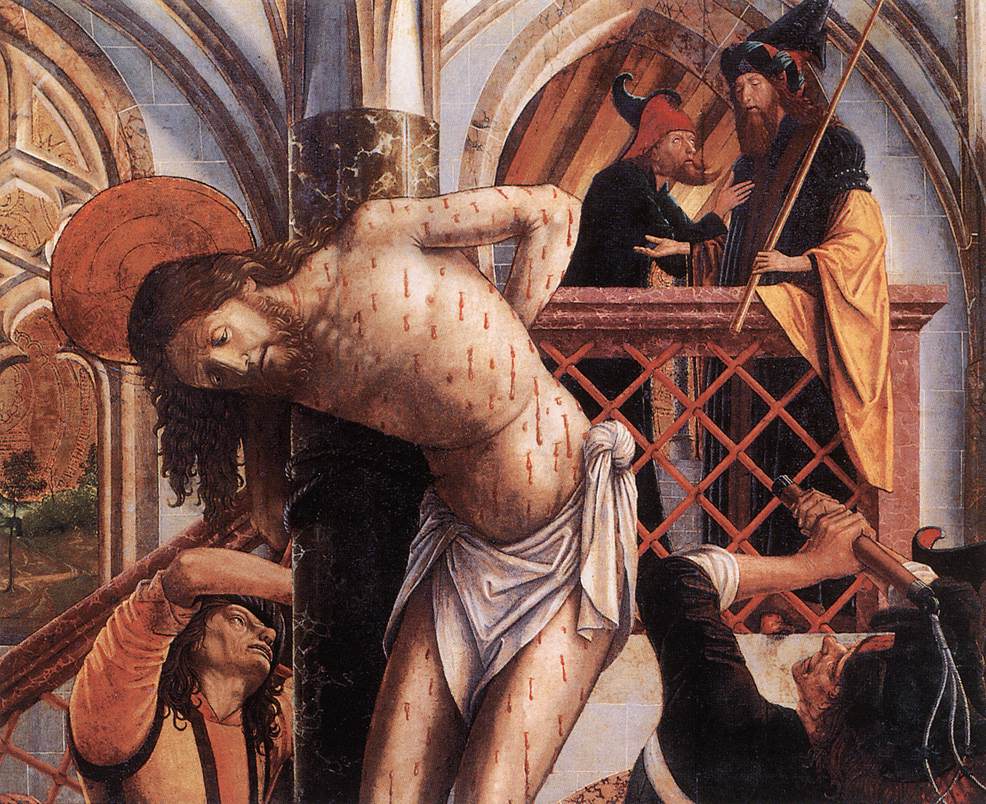
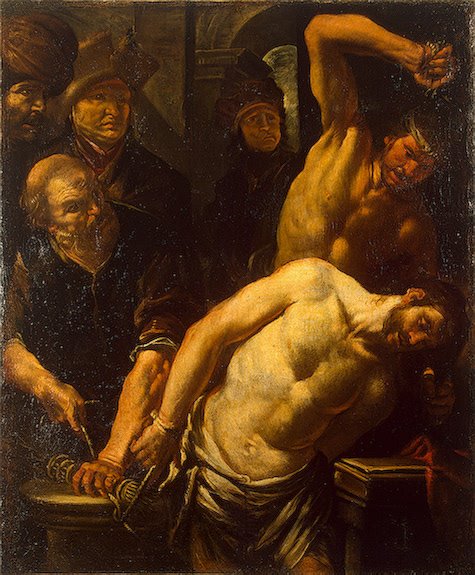
The entire life of Christ is with a view to "his hour." The hour of Jesus is the hour when he fully accomplishes his mission, which is to glorify the Father and save us. It is for this reason that he came. "Behold why I have come to this hour, Father, glorify your name." (John 12:27-28) "Father, the hour has come. Glorify your Son that your Son might glorify you." He came to glorify the Father and to save us. It is the mystery of the Cross which unites this contemplative gaze (glorifying the Father) with the apostolic work par excellence (saving us). It is the will of the Father that this be realized by means of the suffering of the Cross, and the suffering of the Agony where there is sadness (there is no true suffering without the interior sadness of the soul, Therese tells us), sadness such that Jesus could have died from it, "My soul is sad to the point of death." This sadness-- which takes hold of Christ's entire soul-is sadness caused by the weight of sin, by the horror of sin whereby man turns from God and turns in on himself: the sin of personal pride and/or the sin of collective pride (symbolized by the tower of Babel). The mystery of the Cross begins with the Agony and continues to Golgotha. Between the two there is the scourging at the pillar, the carrying of the cross, and the various forms of suffering that Jesus experienced because of the Crucifixion.

Why did God, in his wisdom, wish to unite, in the mystery of the Cross, love in its greatest, most powerful and purest aspect with suffering, with sadness? It is because of the wisdom of the Cross that the Little Flower [St. Therese] unites so closely and constantly love and suffering in an extremely practical and simple fashion. ... Why does the Father--who sends his Son to glorify and save us--establish a connection between love and suffering, extreme suffering, that is, suffering which leads to and implies death. Why does the Father unite love and the deadly sadness of the Agony? Why is this? It would have been more normal to unite love with joy, with success. Jesus would have been capable of succeeding. He would have been able to bring salvation to humanity with the triumphal entry into Jerusalem, or with the amazing procession shown in Chapter six of John's gospel, when Jesus is followed by a crowd of 5,000 men, not including the women and children. Salvation could have been given there. Indeed, none of these things are extrinsic to salvation, but they are not Jesus' "hour," the moment for which he came. His hour is an act of love realized by means of the sadness of the Agony, the suffering of the Cross and the offering of his earthly life, in obedience to the Father.

Let us understand that the Cross, with all the suffering it entails, is a passage whose end is joy. Its end is not sadness, its end is not suffering (that is why suffering does not finalize). Its end is love that blossoms in joy. This blossoming is the mystery of the Resurrection. "If Christ is not risen, vain is our faith" (1 Cor. 15:17). Exteriorly, the Cross is a failure, the most horrible failure that ever existed on earth: amongst the 12 disciples of Jesus there is a traitor, one whom Jesus chose to be his successor who betrays him, and the others flee...save one. Only one of 12, John, is present at the Cross. What would be said of a Novice Master who had formed 12 novices amongst whom only one remained faithful? We would pity him: "Poor novice master. What an idiot; he understood nothing." Exteriorly, the Cross is a horrible failure, and the devil is convinced it is his great victory. In reality, the Cross is the victory of love, a hidden victory: the grain of wheat must fall to the earth to bear much fruit. Here, one touches the fruitfulness of love-- not only love, but the fruitfulness of love. So that there be this fruitfulness of love, we must pass through the Cross, a difficult passage which Jesus indicates for us, but only a passage, whose end is the Resurrection.

Stabat Mater: At the Cross

[N.B. the Latin texts don't coincide, stanza-wise, with this English translation. I have to fix it. For reasons of time, I just pasted it as I found it. Give me some time.]

Stabat mater dolorosa
iuxta Crucem lacrimosa,
dum pendebat Filius.


At the Cross her station keeping,
stood the mournful Mother weeping,
close to Jesus to the last.


Cuius animam gementem,
contristatam et dolentem
pertransivit gladius.

Through her heart, His sorrow sharing,
all His bitter anguish bearing,
now at length the sword has passed.


O quam tristis et afflicta
fuit illa benedicta,
mater Unigeniti!

O how sad and sore distressed
was that Mother, highly blest,
of the sole-begotten One.


Quae maerebat et dolebat,
pia Mater, dum videbat
nati poenas inclyti.

Christ above in torment hangs,
she beneath beholds the pangs
of her dying glorious Son.


Quis est homo qui non fleret,
matrem Christi si videret
in tanto supplicio?

Is there one who would not weep,
whelmed in miseries so deep,
Christ's dear Mother to behold?


Quis non posset contristari
Christi Matrem contemplari
dolentem cum Filio?

Can the human heart refrain
from partaking in her pain,
in that Mother's pain untold?


Pro peccatis suae gentis
vidit Iesum in tormentis,
et flagellis subditum.

Bruised, derided, cursed, defiled,
she beheld her tender Child
All with scourges rent:


Vidit suum dulcem Natum
moriendo desolatum,
dum emisit spiritum.

For the sins of His own nation,
saw Him hang in desolation,
Till His spirit forth He sent.


Eia, Mater, fons amoris
me sentire vim doloris
fac, ut tecum lugeam.

O thou Mother! fount of love!
Touch my spirit from above,
make my heart with thine accord:


Fac, ut ardeat cor meum
in amando Christum Deum
ut sibi complaceam.

Make me feel as thou hast felt;
make my soul to glow and melt
with the love of Christ my Lord.


Sancta Mater, istud agas,
crucifixi fige plagas
cordi meo valide.

Holy Mother! pierce me through,
in my heart each wound renew
of my Savior crucified:


Tui Nati vulnerati,
tam dignati pro me pati,
poenas mecum divide.

Let me share with thee His pain,
who for all my sins was slain,
who for me in torments died.


Fac me tecum pie flere,
crucifixo condolere,
donec ego vixero.

Let me mingle tears with thee,
mourning Him who mourned for me,
all the days that I may live:


Iuxta Crucem tecum stare,
et me tibi sociare
in planctu desidero.

By the Cross with thee to stay,
there with thee to weep and pray,
is all I ask of thee to give.


Virgo virginum praeclara,
mihi iam non sis amara,
fac me tecum plangere.

Virgin of all virgins blest!,
Listen to my fond request:
let me share thy grief divine;


Fac, ut portem Christi mortem,
passionis fac consortem,
et plagas recolere.

Let me, to my latest breath,
in my body bear the death
of that dying Son of thine.


Fac me plagis vulnerari,
fac me Cruce inebriari,
et cruore Filii.

Wounded with His every wound,
steep my soul till it hath swooned,
in His very Blood away;


Flammis ne urar succensus,
per te, Virgo, sim defensus
in die iudicii.

Be to me, O Virgin, nigh,
lest in flames I burn and die,
in His awful Judgment Day.


Christe, cum sit hinc exire,
da per Matrem me venire
ad palmam victoriae.

Christ, when Thou shalt call me hence,
by Thy Mother my defense,
by Thy Cross my victory;


Quando corpus morietur,
fac, ut animae donetur
paradisi gloria. Amen.

When my body dies,
let my soul be granted
the glory of Paradise. Amen.

"Woman, Behold, Your Son"

We must constantly return to this last gaze that Jesus fixes upon Mary, His Mother. The Infant Jesus' first gaze upon His Mother remains in silence. The Infant Jesus' first smile for His Mother existed, yet we know nothing about it. What the Gospel does give us is this last look which is doubtless accompanied by a smile, the smile of Christ Crucified, wherein Jesus conveys all His love, looking at Mary and saying to her: "Woman." Under the motion of the Holy Spirit, we must hold this name in great esteem. We must not become accustomed to it. Rather, we must see what is so astonishing in it. This final gaze of a beloved son upon his mother--especially when that Beloved Son is God!--consists in His calling her: "Woman."

Let us understand that Christ is not using this term in the sense that is generally used when refferring to "man" or "woman." It is much deeper. Is it true that Christ uses the conventional term. Perhaps this is precisely becaue Mary at the Cross is the Woman par excellence. She is the Woman as God has seen her in all her strength, the Woman par excellence. She is the New Woman, entirely relative to Jesus in His Mystery par excellence: the mystery of the Cross. She is the one who suffers with Jesus. She is the one who lives the same mystery that Jesus lives, who lives it with Him. She is so closely united with the Heart of Jesus that she endures everything He endures at the Cross, with and in Him. They are "one" as Jesus is "one" with the Father. We can say that Mary is "one" with Jesus at the Cross and that she brings to completion what is lacking in His Passion. [Cf. Col. 1:24] Of course, nothing is lacking as far as intensity of love is concerned; however, there is a lack as far as extension is concerned. And it is the proper role of woman to enable love to assume everything. This is perhaps the mystery of woman: to enable love to take hold of everything--that is, body and sensitivity, intelligence and will--and to render this love fruitful, to allow this love to become the source of another love, another life. Perhaps this is the ultimate secret.

--Fr. Marie-Dominique Philippe, OP

Stealing Heaven: Christ and the Two Thieves


The good thief is a found sheep. ...

The one thief joined in the mockery with cutting scorn born of his own desperate plight. "Are you not the Christ? Save yourself and us!" Luke tells us that he "railed" against Jesus. ... In his dying he turned, and it seems he turned definitively, against the light.

Not so with the other one. The other thief rebuked the first, we are told. "Do you not fear God, since you are under the same sentence of condemnation? And we indeed justly; for we are receiving the due reward of our deeds; but this man has done nothing wrong." Painfully twisting his neck, he looked toward Jesus. "Jesus," he said, "remember me when you come into your kingdom." And Jesus said to him, "Truly, I say to you, today you will be with me in paradise." In his dying, the second thief turned toward the light.

On the Cross: Dictations from a State of "Hell"


The wages of sin is death. The death on the Cross now represents this wage. Death is the reward and result of my sin. Every sin leads to death. But who will see the connection? Who has any idea how much of what is positive is destroyed in men through sin? ...

[Stretching out her arms] Now the crown of thorns is put in place; now the nails are hammered in, and with every blow sins are hammered into the soul and body of the Lord. The crown is formed from existing sins, those I intend to commit or those I am not finished with. The nails are formed of those of the past, the forgotten ones, those one no longer wishes to acknowledge or remember. [Sighing] Ah, and he made up for it all. For everything, everything. For everyone.

When the nails penetrate, they burst into the body of Christ all at once. Imagine that all the sins of my whole life, even those of mere thought, become present and penetrate into me through my hands and feet. They penetrate through an unimaginiable painful recognition. And the sins of the crown do no penetrate but make their mark. And the more painful it is and the more tired one is, so much the more still follows after. Don't you see it?

This monstrous shame. Now one has to receive for every sin the wage that is called death. Imagine someone who would want to make reparation in his living flesh for everything, for example, for every murder. Every murderous intention as well. He would become mincemeat. Even taking on just one small category of sin would already be totally unthinkable. But the Lord bears all sins and, so, all the kinds of death one could think of. And he bears it not as victim, as blows from without; he does not merely offer his body but hands over his whole being. He bears every sin from within as if he himself had committed it, with all its shame. A shame that now does not admit of repentance. Repentance and confession belong together in a unity that originates from the Cross, beyond the Cross. On the Cross, the Lord only reaches the insight into the heinousness of sin.

This Son who has handed over his divinity, his whole spirit to the Father, in order to be only man, is that man who lived without experiencing sin otherwise than in others. But because he now wants to be only the Son of Man, the exemplar of man, he has to experience every sin in the same way men would if ...

There is nothing ever so intimate that does not now undergo profanation. Every possible form of love is wounded in every possible way. And the Son has here to discover himself with his pure soul: in the midst of the most secret malice. As if someone finds himself doing what he had sworn to himself he would never do. The Son feels the same abhorrence for every sin, but he does not repel it as something foreign; he allows it to settle on himself. There is no way of deadening the impact. One sin more or less does not matter to a sinner; he would not mind taking on one for another person occasionally. His conscience is blunted. But the Lord feels every sin with his whole soul and body. In his death he dies all deaths. He leaves no sin behind as something finished with. Each one causes his death. The sin that is intended, the sin that is willed, the sin committed, everything always up to the limit where repentance begins, up to total abhorrence. And by going the way of terrible, perfect recognition (by means of his purity) he opens for us the way to repentance and confession. He himself is now unable to confess; he has no time left. Everything clashes so monstrously together that in grasping one thing, he always grasps everything else with it.

And all this in obedience! What can that mean: "Into your hands I commend my spirit"? ... There are still more parts that have to die ... I thirst. ... Adieu.

--Adrienne von Speyr

Stabat Mater -3-
Stabat Mater -2-

Stabat Mater -1-