I grew up in the Arab world in the late 1950s and early 1960s, and anti-Americanism was the standard political language – even for those pining for American visas and green cards. Precious few took this seriously. The attraction to the glamorous, distant society was too strong in the Beirut of my boyhood.
[...]
No Turkish malady is caused by America, and no cure can come courtesy of the Americans. The Turks giving vent to anti-Americanism are doing a parody of Europe: They were led to believe that the Europe spurning them, and turning down their membership in its club, is given to anti-Americanism, so they took to the same fad. Turkish anti-Americanism is no doubt fueled by the resentment within Turkey of the American war in Iraq that gave protection and liberty to the Kurds. No apology is owed the Turks; indeed, it is they who must reconsider their intolerance of minorities. If the Turks were comfortable with the abnormality of Iraq under Saddam Hussein, it is they who have a problem.
And if there is enthusiasm for Barack Obama on foreign shores, his rise to fame and power must be a tribute to the land that has made this possible. Where else would a boy of marginality and relative poverty find his way to the peak of political life? Certainly not in his father's Kenya, where the tribal origins of the Obamas would have determined young Barack's life-chances. In an Arab world hemmed in by pedigree, where rulers bequeath power to their sons and the lot of the sons is invariably that of the fathers, the tale of Obama is fantasy.
[...]
Meanwhile, a maligned American president now returns from a Europe at peace with American leadership. In France, Germany and Italy, center-right governments are eager to proclaim their identification with American power. Jacques Chirac is gone. Now there is Nicolas Sarkozy, who offered a poetic tribute last November to the American soldiers who fell on French soil, before a joint session of the U.S. Congress. "The children of my generation," he said, "understood that those young Americans, 20 years old, were true heroes to whom they owed the fact that they were free people and not slaves. France will never forget the sacrifice of your children."
The great battle over the Iraq war has subsided, and Europeans who ponder the burning grounds of the Islamic world know the distinction between fashionable anti-Americanism and the international order underpinned by American power. George W. Bush may have been indifferent to political protocol, but he held the line when it truly mattered, and the Europeans have come to understand that appeasement of dictators and brigands begets its own troubles.
It is one thing to rail against the Pax Americana. But after the pollsters are gone, the truth of our contemporary order of states endures. We live in a world held by American power – and benevolence. Nothing prettier, or more just, looms over the horizon.
Monday, June 23, 2008
Ajami and Anti-American Hype


Weigel on Church Latin : Sic et Non
Will this Benedictine reform-of-the-reform mean that every Catholic parish will soon have at least one Sunday celebration of mass in Latin, using the Missal of John XXIII? It seems unlikely, not least because very few priests today are competent Latinists. But in those places where the Latin mass of 1962 is celebrated reverently and without nostalgic accretions (lace-bedecked older vestments, for example), it will be a source of spiritual nourishment for the minority that prefers this way of worship, even as it introduces a new generation to what will be, for them, a new form of liturgy. In international settings, the use of this rite in Latin may help revive that ancient tongue as a common Catholic language for common worship--no small matter in an increasingly diverse and pluralistic church. Among scholars and parish clergy alike, the more widespread celebration of mass according to the Missal of John XXIII may prove to be the reformist magnet that Benedict XVI wants it to be, encouraging those who are already at work re-sacralizing the liturgy.
And the net result, over time? Almost certainly not "Latin days are here again" in every Catholic parish but rather a more reverent, more prayerful celebration of mass according to a reformed missal of 1970--and according to what the Second Vatican Council actually prescribed.
Sunday, June 22, 2008
Finally! Schall on Sokolowski's latest : Phenomenology of the Human Person
Get the book."The kind of life that incorporates intelligence clarifies what life is. We are, therefore, special, after all, in the way we are 'selves.' These are all issues in the philosophy of being. There is no such thing as epistemology separated from metaphysics." -- Robert Sokolowski [1]
[...]
The book is nothing less than a masterpiece of philosophical clarity and depth of understanding. The book draws on a lifetime devoted to teaching, writing, conversing, and meditating on the great issues and minds--Plato, Aristotle, Augustine, Aquinas, Machiavelli, Hobbes, and particularly Edmund Husserl, though not neglecting the moderns before and after him. The great questions are asked: "How do we know?" "What is it we know?" "Why do we know?"
Sokolowski does not think that the task of the philosopher is only to ask questions but also to give as clear and basic, yes, as truthful an answer to them as possible. The purpose of philosophy, as he often says, is to "make distinctions" whereby we can finally understand what is. Fully to understand something is to know its truth. It is also to speak this same truth to others, to listen to others speaking of it. All the while we know that we are not gods. The gods know the truth; we human beings only seek it, love it. But our seeking is not a form of skepticism that denies any possibility of knowing anything. Rather it is a step by step verification of what we do know. Our ignorance comes from too much light, not from no light at all. "Truth is the conformity of the mind with reality," as Aquinas often said. This book explains this sentence.
[...]
On finishing this remarkable book, my judicious advice to all past and present students of philosophy, or theology, or any thing else for that matter, is simply to drop everything. Read this book! It is a free education in everything you ever wanted to know but never found out where to go to find it. Indeed, it is an education in what you wanted to know even if you did not know you wanted to know it. This book comes as close as any that I know to putting everything together in a concise, intelligible way.
[...]
If there is any one problem with which the book is most concerned, it is the so-called epistemological problem. That is, how is it that we can know reality and not our own "image" of reality? How is it that we know that we know and at the same time know that what we know really exists? Sokolowski is at pains to show where this epistemological problem came from in the history of philosophy. He presents a careful thesis about how one is to explain what a philosopher wants to articulate but, in the process, often ends up making things worse. The way we know "things" and not "representations" of things is in some ways the most fundamental problem of particularly modern philosophy.
[...]
Yet, it is a surprise. It is this "surprise" that each of us is, in our very being, an "agent," that is, an actor in the world that we did not cause to be. Truth, Aquinas said, exists in the "mind." But it is in the mind affirming what is there, what is not in its own mind. Something is there besides ourselves, but we can know it and in knowing it, also know our own knowing and its ways. But knowing involves truth. We all must begin here. This is what Sokolowski's penetrating book is about. This is a book of our time, a time that needs to know that it can know the truth—and that it can also lie to itself if it doesn't.
Ours is a time that needs to know that time is itself under the sway of being, of the metaphysics that begins in wonder and seeks to know the why of things, including the things of itself and those with whom it converses. The human person is an "agent of truth." This is what we are. Something "new" is at the "margin of the world." The something new is indeed "me" who, with all who come to be in their time, stands at the world's "edge" affirming, as Plato said, of what is that it is, of what is not, that it is not. The world itself cannot do this for itself. It needs an "agent of truth" within it.
Friday, June 20, 2008
Laffer and JFK : The Wonders of the Market
Economist Arthur Laffer to graduates of Mercer University:
Pursuing your dream of prospering will benefit everyone . . . When I graduated from Yale University, we had a serious commencement speaker not like the one you are stuck with today. The commencement speaker was President John F. Kennedy. And the point I'm making today is the same point he made all those years ago. He said, "No American is ever made better off by pulling a fellow American down, and all of us are made better off whenever any one of us is made better off." He concluded by using the analogy that "a rising tide raises all boats."
Never forget or be ashamed of the fact that pursuing your own self interest furthers everyone's interest. Without you, the poor would be poorer.
Thursday, June 19, 2008
Don't Like Being Grounded? Sue Your Father
A 12-year-old Quebec girl who felt so strongly about her end-of-year school trip that she took her father to court after he forbade her from going is at the centre of a case that challenges the authority of parental discipline.
The dispute between father and daughter began when he cut off her Internet access over her misuse. When she continued to find a way to use the Internet, he told his daughter she couldn't go on the three-day school trip.
The girl's mother allowed her to go on the trip, but because the school wouldn't allow the girl to go unless both parents consented, the girl, with the mother's support took legal action against her father.
According to Ms. Beaudoin, the judge ruled that denying the trip was unduly severe punishment.The father, who is appealing the decision, was "devastated" by the ruling, and is refusing to take his daughter back "because he has no authority over her."
Monday, June 16, 2008
The War in Iraq : Bush Did Not Lie
"Bush never lied to us about Iraq"
Touring Vietnam in 1965, Michigan Gov. George Romney proclaimed American involvement there "morally right and necessary." Two years later, however, Romney -- then seeking the Republican presidential nomination -- not only recanted his support for the war but claimed that he had been hoodwinked."When I came back from Vietnam, I had just had the greatest brainwashing that anybody can get," Romney told a Detroit TV reporter who asked the candidate how he reconciled his shifting views.
Romney (father of Mitt) had visited Vietnam with nine other governors, all of whom denied that they had been duped by their government. With this one remark, his presidential hopes were dashed.
The memory of this gaffe reverberates in the contemporary rhetoric of many Democrats, who, when attacking the Bush administration's case for war against Saddam Hussein, employ essentially the same argument. In 2006, John F. Kerry explained the Senate's 77-23 passage of the Iraq war resolution this way: "We were misled. We were given evidence that was not true." On the campaign trail, Hillary Rodham Clinton dodged blame for her pro-war vote by claiming that "the mistakes were made by this president, who misled this country and this Congress."
Nearly every prominent Democrat in the country has repeated some version of this charge, and the notion that the Bush administration deceived the American people has become the accepted narrative of how we went to war.
Yet in spite of all the accusations of White House "manipulation" -- that it pressured intelligence analysts into connecting Hussein and Al Qaeda and concocted evidence about weapons of mass destruction -- administration critics continually demonstrate an inability to distinguish making claims based on flawed intelligence from knowingly propagating falsehoods.
In 2004, the Senate Intelligence Committee unanimously approved a report acknowledging that it "did not find any evidence that administration officials attempted to coerce, influence or pressure analysts to change their judgments." The following year, the bipartisan Robb-Silberman report similarly found "no indication that the intelligence community distorted the evidence regarding Iraq's weapons of mass destruction."
Contrast those conclusions with the Senate Intelligence Committee report issued June 5, the production of which excluded Republican staffers and which only two GOP senators endorsed. In a news release announcing the report, committee Chairman John D. Rockefeller IV got in this familiar shot: "Sadly, the Bush administration led the nation into war under false pretenses."
Yet Rockefeller's highly partisan report does not substantiate its most explosive claims. Rockefeller, for instance, charges that "top administration officials made repeated statements that falsely linked Iraq and Al Qaeda as a single threat and insinuated that Iraq played a role in 9/11." Yet what did his report actually find? That Iraq-Al Qaeda links were "substantiated by intelligence information." The same goes for claims about Hussein's possession of biological and chemical weapons, as well as his alleged operation of a nuclear weapons program.
Four years on from the first Senate Intelligence Committee report, war critics, old and newfangled, still don't get that a lie is an act of deliberate, not unwitting, deception. If Democrats wish to contend they were "misled" into war, they should vent their spleen at the CIA.
In 2003, top Senate Democrats -- not just Rockefeller but also Carl Levin, Clinton, Kerry and others -- sounded just as alarmist. Conveniently, this month's report, titled "Whether Public Statements Regarding Iraq by U.S. Government Officials Were Substantiated by Intelligence Information," includes only statements by the executive branch. Had it scrutinized public statements of Democrats on the Intelligence, Foreign Relations and Armed Services committees -- who have access to the same intelligence information as the president and his chief advisors -- many senators would be unable to distinguish their own words from what they today characterize as warmongering.
This may sound like ancient history, but it matters. After Sept. 11, President Bush did not want to risk allowing Hussein, who had twice invaded neighboring nations, murdered more than 1 million Iraqis and stood in violation of 16 U.N. Security Council resolutions, to remain in possession of what he believed were stocks of chemical and biological warheads and a nuclear weapons program. By glossing over this history, the Democrats' lies-led-to-war narrative provides false comfort in a world of significant dangers.
"I no longer believe that it was necessary for us to get involved in South Vietnam to stop communist aggression in Southeast Asia," Romney elaborated in that infamous 1967 interview. That was an intellectually justifiable view then, just as it is intellectually justifiable for erstwhile Iraq war supporters to say -- given the way it's turned out -- that they don't think the effort has been worth it. But predicating such a reversal on the unsubstantiated allegation that one was lied to is cowardly and dishonest.
A journalist who accompanied Romney on his 1965 foray to Vietnam remarked that if the governor had indeed been brainwashed, it was not because of American propaganda but because he had "brought so light a load to the laundromat." Given the similarity between Romney's explanation and the protestations of Democrats 40 years later, one wonders why the news media aren't saying the same thing today.
Thursday, June 12, 2008
Fr. Norris Clarke, SJ ... RIP
Fordham University has a page for people to comment.
Friday, June 06, 2008
D-Day : Honoring "the Boys of Pointe du Hoc"
"Remarks at the U.S. Ranger Monument"
Pointe du Hoc, France
June 6, 1984
Worth viewing, especially today: "President Ronald Reagan's Speech at Point-du-Hoc, Normandy"
Monday, May 26, 2008
Memorial Day
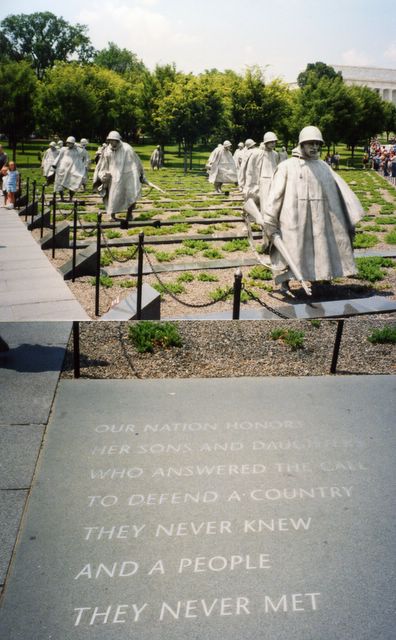
"OUR NATION HONORS
HER SONS AND DAUGHTERS
WHO ANSWERED THE CALL
TO DEFEND A COUNTRY
THEY NEVER KNEW
AND A PEOPLE
THEY NEVER MET."
KOREAN WAR MEMORIAL

Memorial Day : The Price of Freedom: Some Gave All
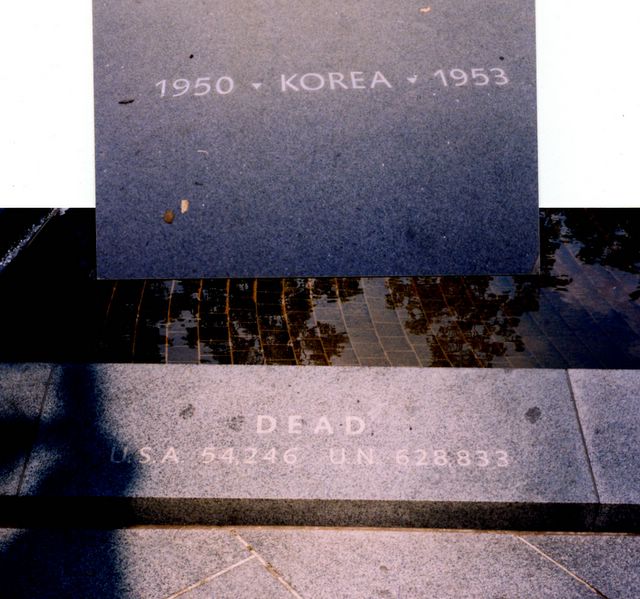
US troops killed in action: 54, 246
... for a country they did not know and a people they never met.
All gave some. Some gave ALL.
Memorial Day : Wall of Freedom
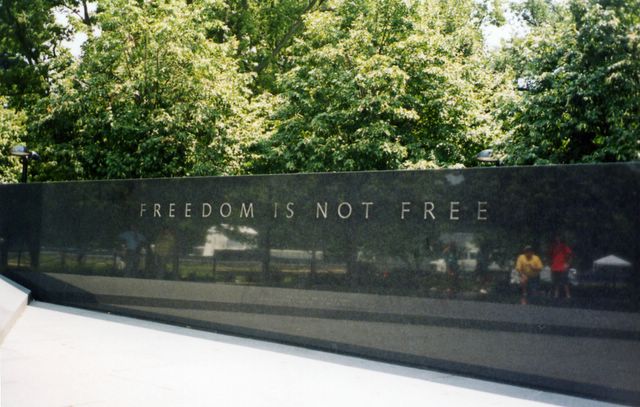
Freedom is not free.
Thank a veteran.
Say a prayer for and honor those who gave all.
[Worth visiting are One Marine's View, Byrd, and Blackfive--keep scrolling down for many posts on Memorial Day--just to name a few.]
Memorial Day : Not Gone, Still Living in Hearts They Leave Behind

This poem reminds us to keep alive the brave men and women who have given the gift of their lives so we could be free. Keep them alive in our hearts as they softly walk in our thoughts.
THEY SOFTLY WALK
By Hugh Robert Orr
They are not gone who pass
Beyond the clasp of hand,
Out from the stone embrace.
They are but come so close
We need not grope with hands,
Nor look to see, nor try
To catch the sound of feet.
They have put off their shoes
Softly to walk by day
Within our thoughts, to tread
At night our dream-led paths
Of sleep.
They are not lost who find
The sunset gate, the goal
Of all their faithful years.
Not lost are they who reach
The summit of their climb,
The peak above the clouds
And storms. They are not lost
Who find the light of sun
And stars and God.
They are not dead who live
In hearts they leave behind.
In those whom they have blessed
They live a life again,
And shall live through the years
Eternal life, and grow
Each day more beautiful
As time declares their good,
Forgets the rest, and proves
Their immortality.
Memorial Day : Remembering Freedom's Defenders
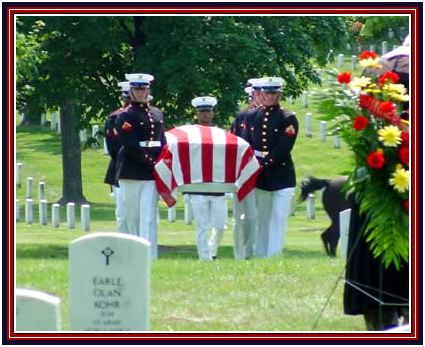
Memorial Day. It is important to remember (each day and not just on the "holiday") the sacrifice many have made in defense of this country, our freedom, and the protection and security of those throughout the world who have not been able to defend themselves sufficiently.
Freedom Is Not Free
By LCDR Kelly Strong, USCG - Copyright 1981
I watched the flag pass by one day,
It fluttered in the breeze.
A young Service man saluted it,
And then he stood at ease.
I looked at him in uniform
So young, so tall, so proud,
With hair cut square and eyes alert
He'd stand out in any crowd.
I thought how many men like him
Had fallen through the years.
How many died on foreign soil
How many mothers' tears?
How many pilots' planes shot down?
How many died at sea
How many foxholes were soldiers' graves?
No, freedom isn't free.
I heard the sound of Taps one night,
When everything was still,
I listened to the bugler play
And felt a sudden chill.
I wondered just how many times
That Taps had meant "Amen,"
When a flag had draped a coffin.
Of a brother or a friend.
I thought of all the children,
Of the mothers and the wives,
Of fathers, sons and husbands
With interrupted lives.
I thought about a graveyard
At the bottom of the sea
Of unmarked graves in Arlington.
No, freedom isn't free.
Memorial Day : The American Flag

--Henry Ward Beecher from " The American Flag"
Memorial Day : Honoring the Sacrifice of Heroes

Let me not mourn for men who have died fighting,
but rather let me be glad that such heroes have lived.
Saturday, May 24, 2008
John Hagee : The Truth Will Out ... We Hope
It is worth listening to Dennis Prager on this issue. He sheds quite a bit of light and truth on the matter.
Thursday, May 15, 2008
Climate Change Truths?
And then this:Watch the web for climate change truths
by Christopher Booker
[...]
On April 24 the World Wildife Fund (WWF), another body keen to keep the warmist flag flying, published a study warning that Arctic sea ice was melting so fast that it may soon reach a "tipping point" where "irreversible change" takes place. This was based on last September's data, showing ice cover having shrunk over six months from 13 million square kilometres to just 3 million.What the WWF omitted to mention was that by March the ice had recovered to 14 million sq km (see the website Cryosphere Today), and that ice-cover around the Bering Strait and Alaska that month was at its highest level ever recorded. (At the same time Antarctic sea ice-cover was also at its highest-ever level, 30 per cent above normal).
The most dramatic evidence, however, emerged last week with an announcement by Nasa's Jet Propulsion Laboratory that an immense slow-cycling movement of water in the Pacific, known as the Pacific Decadal Oscillation (PDO), had unexpectedly shifted into its cool phase, something which only happens every 30 years or so, ultimately affecting climate all over the globe.
[...]
It is notable that the German computer predictions published last week by Nature forecast a decade of cooling due to deep-ocean movements in the Atlantic, without taking account of how this may now be reinforced by a similar, even greater movement in the Pacific.
Mr Watts points out that the West coast of the USA might already be experiencing these effects in the recent freezing temperatures that have devastated orchards and vineyards in California, prompting an appeal for disaster relief for growers who fear they may have lost this year's crops.
On one hand our politicians are committing us to spending unimaginable sums on wind farms, emissions trading schemes, absurdly ambitious biofuel targets, and every kind of tax and regulation designed to reduce our "carbon footprint" - all based on blindly accepting the predictions of computer models that the planet is overheating due to our output of greenhouse gases.
On the other hand, a growing number of scientists are producing ever more evidence to show how those computer models are based on wholly inadequate data and assumptions - as is being confirmed by the behaviour of nature itself (not least the continuing non-arrival of sunspot cycle 24).
The fact is that what has been happening to the world's climate in recent years, since global temperatures ceased to rise after 1998, was not predicted by any of those officially-sponsored models. The discrepancy between their predictions and observable data becomes more glaring with every month that passes.
Sunday, May 11, 2008
To Be a Mother
on earth is a mother.
having built Notre Dame Cathedral.
than any other creature;
performing this act of creation…
Friday, May 09, 2008
Obama and My Hope
One can hope.Obama’s style of being all things to all people threatens to melt under the inescapable spotlight of a national campaign against a Republican. It’s like what brings on the downfall of really successful con artists: They get themselves onto a stage that’s so big that they can’t hide their contradictions anymore, and everyone finds out about the different stories they’ve told different people. And Obama’s belonging to Wright’s church in the first place was quite likely part of establishing a South Side bourgeois nationalist street cred because his political base was with Hyde Park/University of Chicago liberals and the foundation world.
[...]
Because he’s tried carefully to say enough of whatever the audiences he’s been speaking to at the time want to hear while leaving himself enough space later on to deny his intentions to leave that impression, his record represents precisely the “character” weakness the Republicans have exploited in every Democratic candidate since Dukakis: Another Dem trying to put things over on the American people.Obama’s campaign has been very clever in carving out a strategy to amass Democratic delegate votes, but its momentum is in some ways a Potemkin construction—built largely on victories in states that no Democrat will win in November—that will fall apart under Republican pressure.