Thursday, July 26, 2007
Moore Sicko
Wednesday, July 25, 2007
Nietzsche : Truth and Woman? Woman and Truth?
Supposing truth is a woman--what then?
Even now truth finds it necessary to stifle her yawns when she is expected to give answers. In the end she is a woman: she should not be violated. (Beyond Good and Evil, 220)
Tuesday, July 24, 2007
The Final Harry Potter : Virtue and the Dead
“The last enemy that shall be destroyed is death.” This passage, without a reference to its scriptural source (I Corinthians 15:26), appears nearly half way through J. K. Rowling’s Harry Potter and the Deathly Hollows, the final book in her hugely popular series. Deathly Hallows marks a satisfying completion of the series, more dramatically captivating and more effectively orchestrated than any book in the series since Harry Potter and the Goblet of Fire. As both the title and the scriptural reference indicate, the book is preoccupied with death. While addressing our peculiarly modern obsessions, the reflection on death and its possible overcoming is hardly morbid. Ultimately, it is not even tragic; instead, it is a comic affirmation of the triumph of life over death, love over hate, and community over isolation.
[...]
The early pacing of Deathly Hallows is superb; because the central characters (Ron, Hermione, and Harry) are no longer attending Hogwarts Academy, in the wake of Dumbledore’s death and Voldemort’s takeover of the institution, the plot is freed from having to follow the rhythm of the academic year. Rowling’s formula had been to give us an initial scare in the opening chapters and then slowly to build up to a particular quest and its defining battle. In the middle parts of her books, however, Rowling had developed a bad habit of inordinate expansion and repetition, testing readers’ interest in the daily life of Hogwarts Academy and particularly in the politics of institutional gossip, teen angst, and petty competitions for recognition.
In saving the big battle for the finale, previous plots also delayed until then the deaths of major figures. In Deathly Hallows, there are significant casualties early, middle, and late and important revelations early, middle, and late. Through it all, Harry, much more clearly and forcefully than in the previous books, comes into his own, as he grows in confidence and judgment. What was becoming a bit tiresome in the last few books — the bottomless teen angst and Harry’s internal horrors — here achieves an equilibrium between external challenge and internal preparedness. In short, he becomes an adult and a leader.
Readers of the final book are left to puzzle over, not just the mysterious powers of mercy and self-sacrifice, but also explicit references to the New Testament, the one from Corinthians cited above and a passage from Matthew, “where your treasure is, there will your heart be also.” Harry encounters these statements on tombstones and knows neither their source nor their precise import. In that respect, Harry is a stand-in for most modern readers. Although he never explicitly formulates it this way, Harry’s great quest in Deathly Hallows leads him toward an understanding of the meaning of these scriptural passages, an understanding not just theoretical but eminently practical.
Beyond her creation of memorable characters and plots that will likely remain part of the cultural vocabulary for years to come, Rowling has crafted — and this is no mean achievement — a mythical universe at whose center stands the cultivation of the virtues of remembering, and preparing for, death.
Friday, July 20, 2007
Friday, July 13, 2007
Wobbly Republicans and Time for Petraeus
Finally, after four terribly long years, we know what works. Or what can work. A year ago, a confidential Marine intelligence report declared Anbar province (which comprises about a third of Iraq's territory) lost to al-Qaeda. Now, in what the Times's John Burns calls an "astonishing success," the tribal sheiks have joined our side and committed large numbers of fighters that, in concert with American and Iraqi forces, have largely driven out al-Qaeda and turned its former stronghold of Ramadi into one of most secure cities in Iraq.
It began with a U.S.-led offensive that killed or wounded more than 200 enemy fighters and captured 600. Most important was the follow-up. Not a retreat back to American bases but the setting up of small posts within the population that, together with the Iraqi national and tribal forces, have brought relative stability to Anbar.
The same has started happening in many of the Sunni areas around Baghdad, including Diyala province -- just a year ago considered as lost as Anbar -- where, for example, the Sunni insurgent 1920 Revolution Brigades has turned against al-Qaeda and joined the fight on the side of U.S. and Iraqi government forces.
[...]
Just this week, Petraeus said that the one thing he needs more than anything else is time. To cut off Petraeus's plan just as it is beginning -- the last surge troops arrived only last month -- on the assumption that we cannot succeed is to declare Petraeus either deluded or dishonorable. Deluded in that, as the best-positioned American in Baghdad, he still believes we can succeed. Or dishonorable in pretending to believe in victory and sending soldiers to die in what he really knows is an already failed strategy.
That's the logic of the wobbly Republicans' position. [...]
Wobbly, indeed. Give the general time. If not, then why did you send him there with an 81-0 vote to start this new strategy of the "surge" (counterinsurgency strategy)?
Thursday, July 12, 2007
Facing East?
However, one discussion at The Cafeteria Is Closed led someone to criticize Fr. Fessio et al. for facing "East," for facing the altar, when celebrating Mass, the so-called "regular one," not the Tridentine. Can they do that without explicit permission? Isn't that going against the rules?
Well, no, it is not.Here is what I wrote:
From what I have read, priests are able to celebrate Mass ad orientam [facing East, toward the altar].
Yes, there is a suggestion that the priest face the people, but facing "east" is not precluded. In fact, at one point, it is implied that the priest is facing east since the rubrics say something along the lines of "then turn and face the people."
However, in reading the pertinent documents, I think it is not as clear as could be. Both sides seem to have arguments with strong points.
Which is precisely why the cardinal at the head of the Church's congregation in charge of such matters had to issue a statement on whether or not the GIRM (the Church's manual, if you will, for celebrating the Mass) meant to exclude the possibility of facing east:The Congregation for Divine Worship and the Discipline of the Sacraments has been asked whether the expression in no. 299 of the Instituto Generalis Missalis Romani constitutes a norm according to which, during the Eucharistic liturgy, the position of the priest versus absidem [facing towards the apse] is to be excluded.
The Congregation for Divine Worship and the Discipline of the Sacraments, after mature reflection and in light of liturgical precedents, responds:
Negative, and in accordance with the following explanation.In the explanation, the cardinal explains that versus absidem and versus orientem (toward the East) mean the same thing.
Thus, facing the altar, facing the East is not excluded in the current rubrics.
Fr. Fessio is not violating any Church rubric.
[...]
You can read the entirety of the cardinal's explanation here.
Wish more of us had experienced the priest facing the same direction as the people and had also known why. Very deep reasons and reasons which might help some "get more" out of the Mass.
Friday, July 06, 2007
Gore and the Rejection and Distortion of Science
In his new book, The Assault on Reason, Al Gore pleads, "We must stop tolerating the rejection and distortion of science. We must insist on an end to the cynical use of pseudo-studies known to be false for the purpose of intentionally clouding the public's ability to discern the truth." Gore repeatedly asks that science and reason displace cynical political posturing as the central focus of public discourse.
If Gore really means what he writes, he has an opportunity to make a difference by leading by example on the issue of global warming.
[...]
Many of the assertions Gore makes in his movie, ''An Inconvenient Truth,'' have been refuted by science, both before and after he made them. Gore can show sincerity in his plea for scientific honesty by publicly acknowledging where science has rebutted his claims.
For example, Gore claims that Himalayan glaciers are shrinking and global warming is to blame. Yet the September 2006 issue of the American Meteorological Society's Journal of Climate reported, "Glaciers are growing in the Himalayan Mountains, confounding global warming alarmists who recently claimed the glaciers were shrinking and that global warming was to blame."Gore claims the snowcap atop Africa's Mt. Kilimanjaro is shrinking and that global warming is to blame. Yet according to the November 23, 2003, issue of Nature magazine, "Although it's tempting to blame the ice loss on global warming, researchers think that deforestation of the mountain's foothills is the more likely culprit. Without the forests' humidity, previously moisture-laden winds blew dry. No longer replenished with water, the ice is evaporating in the
strong equatorial sunshine."
Gore claims global warming is causing more tornadoes. Yet the United Nations Intergovernmental Panel on Climate Change stated in February that there has been no scientific link established between global warming and tornadoes.
Sunday, July 01, 2007
Immaculée update
Immaculée Ilibagiza was born in Rwanda and studied Electronic and Mechanical Engineering at the National University of Rwanda. Her life transformed dramatically in 1994 during the Rwanda genocide when she and seven other women huddled silently together in a cramped bathroom of a local pastor’s house for 91 days! During this horrific ordeal, Immaculée lost most of her family, but she survived to share the story and her miraculous transition into forgiveness and a profound relationship with God. Four years later, she emigrated from Rwanda to the United States and began working for the United Nations in New York City. She has since established the Left to Tell Charitable Fund to help others heal from the long-term effects of genocide and war.
Saturday, June 30, 2007
Back to Blogging; Nietzsche, the Koran, and the Will
I am taking a summer class on Nietzsche and spending my summer reading the Koran. Should be fun. Considering the Regensberg address and Fr. Schall's developed commentary on it, perhaps there is a coincidental voluntarist confluence with the role of the will. We shall see.
Monday, May 28, 2007
Memorial Day : Honoring the Sacrifice of Heroes
Memorial Day : The American Flag

--Henry Ward Beecher from " The American Flag"
Memorial Day : Remembering Freedom's Defenders

Memorial Day. It is important to remember (each day and not just on the "holiday") the sacrifice many have made in defense of this country, our freedom, and the protection and security of those throughout the world who have not been able to defend themselves sufficiently.
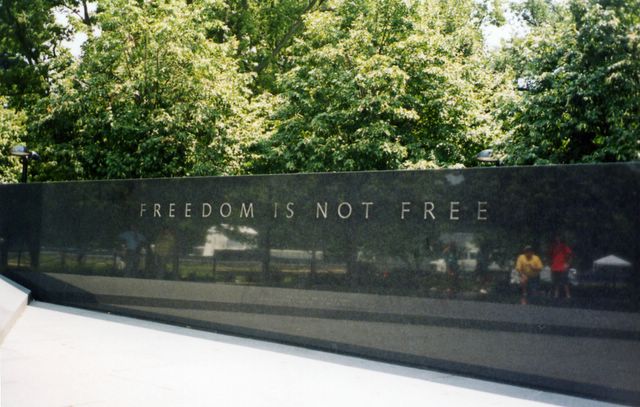
Freedom Is Not Free
By LCDR Kelly Strong, USCG - Copyright 1981
I watched the flag pass by one day,
It fluttered in the breeze.
A young Service man saluted it,
And then he stood at ease.
I looked at him in uniform
So young, so tall, so proud,
With hair cut square and eyes alert
He'd stand out in any crowd.
I thought how many men like him
Had fallen through the years.
How many died on foreign soil
How many mothers' tears?
How many pilots' planes shot down?
How many died at sea
How many foxholes were soldiers' graves?
No, freedom isn't free.
I heard the sound of Taps one night,
When everything was still,
I listened to the bugler play
And felt a sudden chill.
I wondered just how many times
That Taps had meant "Amen,"
When a flag had draped a coffin.
Of a brother or a friend.
I thought of all the children,
Of the mothers and the wives,
Of fathers, sons and husbands
With interrupted lives.
I thought about a graveyard
At the bottom of the sea
Of unmarked graves in Arlington.
No, freedom isn't free.
Sunday, May 27, 2007
Not Gone, Still Living in Hearts They Leave Behind


This poem reminds us to keep alive the brave men and women who have given the gift of their lives so we could be free. Keep them alive in our hearts as they softly walk in our thoughts.
THEY SOFTLY WALK
By Hugh Robert Orr
They are not gone who pass
Beyond the clasp of hand,
Out from the stone embrace.
They are but come so close
We need not grope with hands,
Nor look to see, nor try
To catch the sound of feet.
They have put off their shoes
Softly to walk by day
Within our thoughts, to tread
At night our dream-led paths
Of sleep.
They are not lost who find
The sunset gate, the goal
Of all their faithful years.
Not lost are they who reach
The summit of their climb,
The peak above the clouds
And storms. They are not lost
Who find the light of sun
And stars and God.
They are not dead who live
In hearts they leave behind.
In those whom they have blessed
They live a life again,
And shall live through the years
Eternal life, and grow
Each day more beautiful
As time declares their good,
Forgets the rest, and proves
Their immortality.
Gore and a High School Challenge?
Two related sites worth reading through are by a high school student responding to global warming/climate change arguments. Her name is Kristen Byrnes and she has really done a thorough job in her research. Check them out:
Welcome to Ponder the Maunder, an extra credit assignment for Honors Earth Science, Portland High School, by Kristen Byrnes of Portland Maine.
This report is a comprehensive look at the global warming issue without financial or political bias. It uses the most updated information provided by scientists and researchers and interjects common sense, an important component missing from the global warming debate.
Facts and Fictions of Al Gore’s "An Inconvenient Truth":
Al Gore’s film An Inconvenient Truth does indeed have some correct facts, but as he even says himself, sometimes you have to over-exaggerate to send the message to people.
Go check them out.
Saturday, May 26, 2007
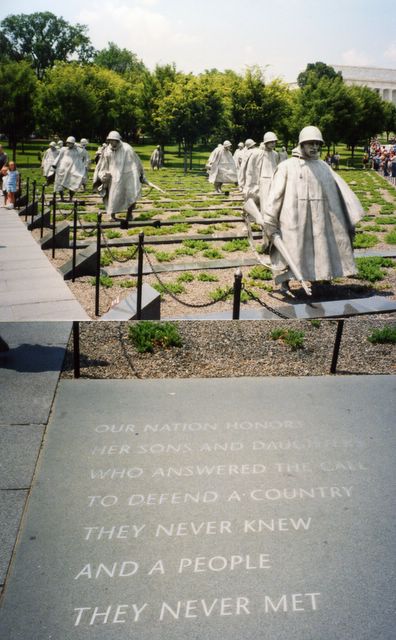
To Defend a Country They Never Knew and a People They Never Met
Friday, May 25, 2007
Illegal Immigration : A Middle Eastern Connection?
Saturday, May 19, 2007
Scruton on Vernon, Roger, and Living with Gypsies
I was a timid child, who keenly felt the double injury of red hair and a sissy name. The critical moment came aged 10, during the last year at primary school. A large boy called Herman, whose misfortune was also contained in a name, and who, therefore, became the school bully by way of compelling us to respect him, kicked me as I sat down for morning assembly, launching into a diatribe against red hair with every word of which I fully concurred. I gave him to understand that, had it been possible to vote for the abolition of red hair, I would have been first to raise my hand. To my dismay, however, Herman was not satisfied with this general apology for my condition, and indicated that I must meet him in the playground during break, so that my head could be bashed in and the problem of red hair solved for good and all.
"There's no helping it," said my friend Brian (the only one in the playground who was more timid than I). "He's after you. If not today then tomorrow. Best to get it over with." News of the impending fight spread rapidly through the school and at the appointed hour the spectators gathered into a ring. Brian pushed me forward and my antagonist strode out from the crowd with flaring nostrils, fists up and big lips parted in a sneer. I closed my eyes, shielded my face with my left hand, and stretched my right arm out to protect myself. Herman came forward at a run, with blood-curdling shrieks and flailing arms. I stood rooted to the spot, the sounds of Herman's war-dance filling my ears, my outstretched fist trembling in the air before me. After what seemed like an age, there was a staggering blow to my knuckles. I opened my eyes to discover Herman recoiling backwards, lips split open and blood pouring over his chin. With a howl of dismay he pirouetted through the crowd and fled to the headmaster's office to report my crime.
It seemed unjust at the time that I should be caned and Herman comforted. But it added to a reputation that had already spread through the school as quickly as the newest cigarette card, and I resolved at once to exploit my eminence as the conqueror of Herman. I went from gang to gang in the playground, escorted by Brian (now promoted to first lieutenant), and informing my respectful listeners that henceforth I was not Vernon but Roger, that all uses of my former name, which had been no more than a disguise adopted for secret service reasons, would be as severely punished as remarks about red hair. Obedience was immediate and universal, and henceforth I was Roger to everyone, including my family, who were told that the choice was simple: either they ceased to call me Vernon, or I went to live with the Gypsies. (12-13)
Scruton and Stealing the Heart
Two people stand out among the many who have illuminated for me the path to Rome — a path that I never took. One enjoyed wealth and social standing. The other lived at the bottom of society, impoverished, oppressed, but serene.
God is offended by nothing and bears everything, even crucifixion; he loves humanity boundlessly and helps in the manner of a disarmed man: he teaches, leads, praises, gives examples, chides and warns. How does he practise this method? He sends good people into the world, who are a model to those around them ...
The apostolic church is a church of the heart. When you steal from it you steal the heart. Hence the theft is easy; and amends are long and hard.
Thursday, May 17, 2007
Thomas Howard and Lead, Kindly Light
Protestantism was not, whatever else I might have wished to say about it, a picture of things that would have been at all recognizable to the apostles, nor to the generation that followed them. The faithful from Pentecost on were certainly aware of a great babel of voices among the Christians [...] . But the faithful were also aware that there was a body that could speak into the chaos and declare with serene and final authority what the Faith that had been taught by the apostles was. Clearly we modern non-Catholics were living in a scheme of things altogether unimaginable to the Twelve Apostles and the Fathers of the Church. (39)
But of course the great paradox is that she is more than in time: she is eternal, and the vicissitudes both of history and of one's own private life do not change her substance. A Catholic in first-century Smyrna, a Frankish peasant in sixth-century Merovingian France, a seventeenth-century countess in Seville, Madame de Maintenon, and I all live with our turbulent or tranquil surroundings finding their center in that which does not change. The Mass is there. The Apostolic See is there. The Magisterium is there. The clergy, high and low, good and wicked, are there. The prayers of the Church are there. War and peace are there. Doom threatens in the form of Attila, or the Black Death, or Modernism, or infidelity. But Our Lord's words about the gates of Hell stand unqualified by the threats. (97-8)
I may say that every yearning, aspiration, hope, and desire that marked my life as a most earnest Protestant Evangelical, and then as an Anglican, has been fulfilled a thousand times over. I have come home. I have dropped anchor. I have taken my place in the Church of the apostles, Fathers, confessors, martyrs, bishops, saints, and all the Catholic faithful. I have nothing to "protest." (103-4)
As I get ready to teach a little more on Newman's own "Lead, Kindly Light," a poem some of my students are memorizing (and yes, they know the proper title is "Pillar of the Cloud"), I am the better for having read Howard's short book, seeing the trust and hope of a contemporary Christian, the trust and hope we should all have in being led by the Light of Truth:
Now onto Roger Scruton's Gentle Regrets.Lead, Kindly Light, amid the encircling gloom
Lead Thou me on!
The night is dark, and I am far from home—
Lead Thou me on!
Keep Thou my feet; I do not ask to see
The distant scene—one step enough for me.I was not ever thus, nor pray'd that Thou
Shouldst lead me on.
I loved to choose and see my path, but now
Lead Thou me on!
I loved the garish day, and, spite of fears,
Pride ruled my will: remember not past years.
So long Thy power hath blest me, sure it still
Will lead me on,
O'er moor and fen, o'er crag and torrent, till
The night is gone;
And with the morn those angel faces smile
Which I have loved long since, and lost awhile.