Tuesday, March 29, 2011

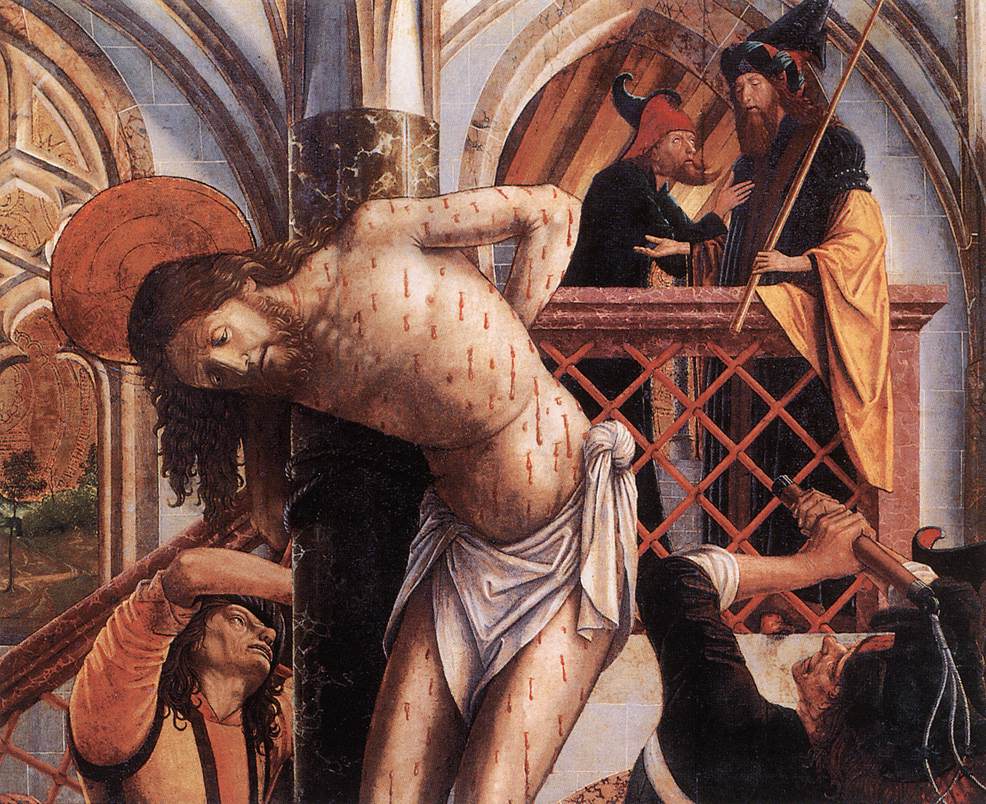
Lent : Kneeling before the Lord

I know many words, O men, but today you must kneel--
Your knees are your wings.

--Gertrud von Le Fort, Hymns to the Church (50)


A leper comes to Jesus and begs him for help. He falls to his knees before him and says: "If you will, you can make me clean." (Mark 1.40)


The bodily gesture itself is the bearer of the spiritual meaning, which is precisely that of worship. Without the worship, the bodily gesture would be meaningless, while the spiritual act must of its very nature, because of the psychosomatic unity of man, express itself in the bodily gesture. The two aspects are united in the one word, because in a very profound way they belong together. When kneeling becomes merely external, a merely physical act, it becomes meaningless.

On the other hand, when someone tries to take worship back into the purely spiritual realm and refuses to give it embodied form, the act of worship evaporates, for what is purely spiritual is inappropriate to the nature of man. Worship is one of those fundamental acts that affect the whole man. That is why bending the knee before the presence of the living God is something we cannot abandon.

Again, there is a story that comes from the sayings of the Desert Fathers, according to which the devil was compelled by God to show himself to a certain Abba Apollo. He looked black and ugly, with frighteningly thin limbs, but most strikingly, he had no knees. The inability to kneel is seen as the very essence of the diabolical.

--Joseph Ratzinger (Pope Benedict XVI), The Spirit of the Liturgy (189-93)


I [...] fell upon my knees and spread out my hands to the Lord my God.
--Ezra 9.5

Friday, March 25, 2011

Annunciation : God became man ...

"God became man so that man might become god." --St. Athanasius

Tuesday, March 22, 2011

Lent : Bl. Elizabeth of the Trinity

I still remember the first secret you shared with me at Gemeaux, you were very little, but already the Master had taken your little heart captive, and my soul felt drawn toward yours! ... A Carmelite, my darling, is a soul who has gazed on the Crucified, who has seen Him offering Himself to His Father as a Victim for souls and, recollecting herself in this great vision of the charity of Christ, has understood the passionate love of His soul, and has wanted to give herself as He did! ... And on the mountain of Carmel, in silence, in solitude, in prayer that never ends, for it continues through everything, the Carmelite already lives as if in Heaven: "by God alone." The same One who will one day be her beatitude and will fully satisfy her in glory is already giving Himself to her. He never leaves her, He dwells within her soul; more than that, the two of them are but one. So she hungers for silence that she may always listen, penetrate ever deeper into His infinite Being. She is identified with Him whom she loves, she finds Him everywhere, she sees Him shining through all things! Is this not Heaven on earth! You carry this Heaven within your soul, my little Germaine, you can be a Carmelite already, for Jesus recognizes the Carmelite from within, by her soul. Don't ever leave Him, do everything beneath His divine gaze, and remain wholly joyful in His peace and love, making those around you happy!

Saturday, March 19, 2011

St. Joseph


Suspending our Lenten observations, this is how we spent our St. Joseph Day:

Friday, March 18, 2011

Lent and Matthew the Poor : Finding Comfort in the Good Samaritan

"The penitent is described by Christ as a stranger who has fallen into the hands of robbers in a foreign country. They strip him of his clothes, rob him, humiliate him, wound him, and leave him more dead than alive. The penitent is like a man stripped of the garment of his honor by the devil, whose will has therefore been stripped naked and whose members have been defiled. The devil robs him of his treasure--the treasure being the sanity of the mind, the light of insight, and the action of conscience--his person being humiliated, his fall disclosed, and his will shattered. Last of all, he wounds him deeply with lust to draw off his life quickly. At the end he leaves him a dead corpse unable to live! It is thus that the good Samaritan finds no occasion to ask questions or time to reproach, but immediately gathers him in his arms.


"The good Samaritan in the parable (Lk. 10.30-37) is Christ, and our interpretation hits the mark exactly, for He does not upbraid him or ask him to perform any action, but comes to him personally where he fell and stoops over him with His affection, washes and dresses his wound by His own wound, stops his bleeding by His own bleeding, and pours upon him the oil of His compassion and of His life, carrying him on the arms of His mercy, offering him a ride to the inn of His Church, asking His angels to serve him, and expending His grace on him till he recovers.


"Such is the penitent, a wretched man that has fallen on the way after being attacked by the oppression of man and the spite of the devil, and no longer able to do anything. After his strength has been drawn off, he finds room at the house of the Benign, room in His heart, room between His arms, on His beasts of burden, and in His Kingdom."


--Abouna Matta al-Meskeen (Matthew the Poor), "Repentance," Communion of Love (98)

Lent : Practice in Silence


A life properly lived includes practice in silence. This begins with keeping our mouth shut whenever this is required by the confidence of another person, the duties of our vocation, tact, or respect for others. It goes on to include keeping silence at times even when it might be permissible to speak, especially if speaking would create an impression. Not to speak at such times is a good exercise in keeping our mastery over the inordinate desire to talk. We should strive to conquer the mania for constant chatter and idle talk. How many superfluous things we say in the course of the day--how many foolish things! We must learn that silence is beautiful, that it is not emptiness, but true and full life.

Sunday, March 13, 2011

Lent and Leiva-Merikakis : Repentant Tears and Grasping the Incarnation

Tears are a mystical indication of true joy, as the Lord showed when He said, "Blessed are you that weep now, for you shall laugh."

Tears that spring from hope are part of the mystery of repentance; they are evidence that the penitent has entered into grace and a secret sign that the state of true joy has been attained.

[...] Tears are a clear sign of the process of inner change and also evidence of the truth and power of the mystery of repentance.
--Matta al-Meskeen (Matthew the Poor), Communion of Love, 88

One of the Pharisees asked [Jesus] to eat with him, and he went into the Pharisee's house, and sat at table. And behold, a woman of the city, who was a sinner, when she learned that he was sitting at table in the Pharisee's house, brought an alabaster flask of ointment, and standing behind him at his feet, weeping, she began to wet his feet with her tears, and wiped them with the hair of her head, and kissed his feet, and anointed them with the ointment. [...]

Then turning toward the woman he said to Simon, "Do you see this woman? I entered your house, you gave me no water for my feet, but she has wet my feet with her tears and wiped them with her hair. You gave me no kiss, but from the time I came in she has not ceased to kiss my feet. You did not anoint my head with oil, but she has anointed my feet with ointment. Therefore I tell you, her sins, which are many, are forgiven, for she loved much [...].
--Luke 7.36-50
Jesus' mere presence in the town mysteriously draws the sinful woman to him, magnet-like, and how different are her motivations from those of the hypocritical Pharisee! While Simon wants to use Jesus to enhance his own public image as a pious and holy man, the woman for her part feels that the simple presence of Jesus' holiness in her proximity is an instant judgment that reveals all the ugliness of her sins. How truthful and bold she is in her self-appraisal! But, instead of going to hide like Adam and Eve at feeling so shamefully naked before the glance of the Son of God, penetrating miraculously through all the walls of the town to arrive at her own heart, what does she do?

[...] In one moment of luminous intuition, this woman realizes that Jesus is at once the destroyer of her sins, the victor over all evil, and the Bridegroom of her soul.
--Erasmo Leiva-Merikakis, The Way of the Disciple, 89-90

Thus leaving her to say:
It is you, my Lord, who desired that we should grasp you and implore you. For, if you had not wanted us to grasp you, you would not have become incarnate. It is you who called me to come near you. I saw your beauty and ran toward you.
--Syriac Liturgy for the Feast of Saint Mary Magdalen (quoted in Leiva above, 90)

How impressive this woman who, despite the great emotions shaking her soul, does not utter a single word throughout the episode. Instead, she makes herself present to Jesus [...]. All the verbal dialogue takes place between Jesus and the Pharisee; what transpires between Jesus and the woman is the mute dialogue of love, in which only the gestures of the body and the expression of the eyes can communicate what is happening in the soul. Deep and overwhelming love is beyond words and arguments, beyond reason. The Pharisee's words have the effect of separating him from Jesus, of keeping Jesus far from his soul, while the woman's silence unites her to Jesus as the surest bridge and bond. She has understood the full meaning of the injunction, "Be still, and know that I am God!" (Ps. 46.10)
--Erasmo Leiva-Merikakis, The Way of the Disciple, 90-91

Truly, she has understood:

For, if you had not wanted us to grasp you, you would not have become incarnate. It is you who called me to come near you. I saw your beauty and ran toward you.

Thursday, March 10, 2011

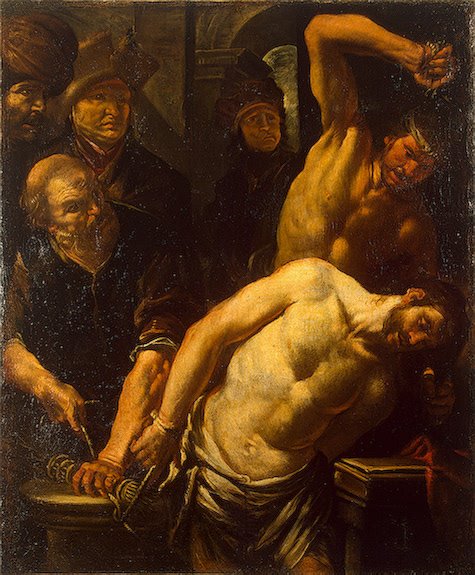
Lent and Corbon : Kenosis of the Cross

In the kenosis of the Incarnation grace dawned; in the kenosis of the Cross it shines forth where the darkness is thickest. After all, when day dawns, what happens? Night is scattered. Night was simply an absence; it had no existence in itself; [...] and consequently when it is there nothing exists for anyone; people do not even recognize each other. Night as such is empty of meaning and strips everything else of meaning. Well, at the core of every human event, at the bottom of every human heart, there is a night of death and rupture, of nonmeaning and absence. "Flesh and blood", or mere human nature (Jn 1.13; 1 Cor 15.50), cannot dissipate this night; nothing outside man can introduce light into that blackness. It reigns in the heart and from that vantage point spreads its veil over everything, from the depths of the person to its most conscious structures. Only he who is Light can assume the human without damaging any part of it. And only this Man-God, in whom death finds no complicity with itself, can enter into the thickest darkness of death; that is what happens in the kenosis of the Cross.

[...] Did the executioners realize what they were doing when they raised the Lord of glory on his Cross? What happened when the Light was immersed in this darkness? Not a romantic dawn, but a struggle, the combat that decided the salvation of all men. Death feeds on lies and engenders lies; it feeds upon appearances and leaves emptiness behind it. Here, at the ninth hour, the hour when darkness reigns (Lk 22.53), death seizes its prey--only to be throttled by him whom it expects to swallow up. It is "gripped by terror", for he who enters into it is not mortal because caught in the nets of sin, but mortal out of love, mortal by grace and truth. Death has been deceived; its lies have been turned back upon it. When truth shines forth, all lying is shown up for what it is and is scattered like the night before the dawning day. Death is no longer: the Son of the Living God has crushed it by his own death.

Lent : Temptation and the Will

Now the serpent was more cunning than any beast.
--Gen 3.1

Temptation properly so-called is rarely the exclusive work of the devil. Ordinarily he uses his knowledge of the dominant tendencies of a soul and his power over the senses in order to make an image more enticing, to stir up an impression, to intensify a pleasure, to quicken thus a desire, or make a solicitation more attractive and more actual, so that it will invade the field of conscience and win the consent of the will.


This kind can be cast out in no way except by prayer and fasting.
--Mark 9.28

Wednesday, March 09, 2011

Lent : Matthew the Poor & the Deep Meaning of Fasting

If we eat of a sacrificed body and do not sacrifice our own selves, how can we claim that a union takes place?
--Abouna Matta al-Meskeen (Matthew the Poor)


Fr. Matthew the Poor was a Coptic monk who affected the lives of many, both Coptic and non-Coptic Christians, especially Christoph Cardinal Schonborn, who writes that Father Matthew the Poor is "[o]ne of the great spiritual masters of our time." (201)

Well, one of the first writings I read from him is on fasting and it is in his book Communion of Love. This chapter, "The Deep Meaning of Fasting," can also be found here. Some selections from throughout the chapter:

Fasting, in the life and works of Christ, ranks as the first response to the act of unction and of being filled with the Holy Spirit. It represents the first battle in which Christ did away with His adversary, the prince of hte world. [...] For when a person enters into prayerful fasting, Satan departs from the flesh.

Fasting was to elevate the flesh to the level of war with the spirits of evil, those powers that hold sway over our weaker part, the flesh.

[B]aptism, being filled with the Holy Spirit, and fasting form a fundamental and inseparable series of acts in Christ’s life that culminated in perfect victory over Satan in preparation for his total annihilation by the cross.

The ultimate aim of [...] fasting is that Christ Himself may dwell in us: “It is no longer I who live, but Christ lives in me” (Ga. 2:20).

[F]asting is a divine act of life.

[F]asting is an extremely important stage between baptism and crucifixion. [...] He [Christ] thus raised the flesh to the stage of the cross.

He invites us to a total communion with Him in suffering and glory alike. We thus have to prove our communion with Him in faith by having communion with Him in His works; only works testify to the genuineness of our faith. Yet He, as a true Bridegroom, did not leave us to invent works for ourselves but laid down the course of our works and life: ‘I am the way.”

Fasting is a test in which the personality defies the self. [...] Fasting may therefore be considered an act of love of the highest order, a physical way of entering into the experience of the cross.

You know that the effort of fasting is felt primarily by the body, which is the physical area that contains the self where it reveals its nature and desires. Thus, when we fast we exhaust the body, and so, indirectly, subdue the self.(3) If we subdue the self through the subjugation of the body, we have in fact come close to the destruction of the self, at least partially. So it is that by fasting we fulfill the word of the Lord: “Whoever loses his life for my sake will save it” (Lk. 9:24).


As for the Lord Jesus, He fasted not to receive something but to make a free offering of Himself in an act of will and to manifest the coming sacrifice of the cross.

As for us, we fast not to receive anything or to offer anything, for we have received Christ, and in Him we have already received everything before we fast. In Him we receive everything even before we are born. No offering of ours, even if we go to our death, is of any avail in removing a single sin.


We fast and offer our bodies as a sacrifice; the outward form of this is bearing fatigue, but its essence is the intentional acceptance of death, that we may be counted fit to be mystically united in the flesh and blood of Christ. It is then that we become, in Christ’s sacrifice, a pure sacrifice, capable of interceding and redeeming.

Fasting [...] has to be consummated in Communion, partaking in the pure body and blood, to become a perfect sacrifice, efficacious in prayer and intercession. Every Holy Communion Has to be preceded by fasting, and every fast has to end with Holy Communion.

If we eat of a sacrificed body and do not sacrifice our own selves, how can we claim that a union takes place?

Whenever we eat of the body and drink of the blood, we are mystically prepared for preaching the death of the Lord and confessing His resurrection. Every testimony to the death and resurrection of the Lord carries with it a readiness for martyrdom. And every martyrdom carries with it a resurrection.

Friday, July 16, 2010

A Carmelite is ...

Today is the feast day of Our Lady of Mount Carmel.

What is a Carmelite?
I still remember the first secret you shared with me at Gemeaux, you were very little, but already the Master had taken your little heart captive, and my soul felt drawn toward yours! ... A Carmelite, my darling, is a soul who has gazed on the Crucified, who has seen Him offering Himself to His Father as a Victim for souls and, recollecting herself in this great vision of the charity of Christ, has understood the passionate love of His soul, and has wanted to give herself as He did! ... And on the mountain of Carmel, in silence, in solitude, in prayer that never ends, for it continues through everything, the Carmelite already lives as if in Heaven: "by God alone." The same One who will one day be her beatitude and will fully satisfy her in glory is already giving Himself to her. He never leaves her, He dwells within her soul; more than that, the two of them are but one. So she hungers for silence that she may always listen, penetrate ever deeper into His infinite Being. She is identified with Him whom she loves, she finds Him everywhere, she sees Him shining through all things! Is this not Heaven on earth! You carry this Heaven within your soul, my little Germaine, you can be a Carmelite already, for Jesus recognizes the Carmelite from within, by her soul. Don't ever leave Him, do everything beneath His divine gaze, and remain wholly joyful in His peace and love, making those around you happy!

Tuesday, July 06, 2010

Mary: Ever-Virgin?

Click here for an essay on the perpetual virginity of Mary. I wrote it many years ago. It could use some updating and editing, but the main points and biblical citations are still valid. One day, I will make the necessary revisions.

For much, much more on explaining or defending teachings about Mary, go here or for more on Mary and the Saints go here.

Thursday, April 08, 2010

This Tree is my eternal salvation ...

This Tree is my eternal salvation. It is my nourishment and my banquet. Amidst its roots I cast my own roots deep: beneath its boughs I grow and expand, revelling in its sigh as in the wind itself. Flying from the burning heat, I have pitched my tent in its shadow, and have found a resting-place of dewy freshness. I flower with its flowers; its fruits bring perfect joy--fruits which have been preserved for me since time's beginning, and which now I freely eat. This Tree is a food, sweet food, for my hunger, and a fountain for my thirst; it is a clothing for my nakedness; its leaves are the breath of life. Away with the fig-tree, from this time on! If I fear God, this is my protection; if I stumble, this is my support; it is the prize for which I fight and the reward of my victory. This is my straitened path, my narrow way; this is the stairway of Jacob, where angels pass up and down, and where the Lord in very truth standing at the head.

This Tree, vast as heaven itself, rises from earth to the skies, a plant immortal, set firm in the midst of heaven and earth, base of all that is, foundation of the universe, support of this world of men, binding-force of all creation, holding within itself all the- mysterious essence of man. Secured with the unseen clamps of the spirit, so that, adjusted to the Divine, it may never bend or warp, with foot resting firm on earth it towers to the topmost skies, and spans with its allembracing arms the boundless gulf of space between.

He was All, and in all, filling it with himself; stripped naked for battle against the powers of the air. . .

With him two thieves were extended, bearing within themselves the marks of those two peoples, the marks of those two types of mind. . .

When this cosmic combat came to an end ... the heavens shook; almost, the stars fell from the skies; the light of the sun was extinguished for a time; rocks were split asunder; the entire world was all but shattered ... But great Jesus breathed forth his divine Soul, saying: "Father, into Thy hand I commend my spirit." And lo, even while all things shuddered and heaved in earthquake, reeling for fear, his divine Soul ascended, giving life and strength to all; and again creation was still, as if this divine Crucifixion and Extension had everywhere unfolded and spread, penetrating all things, through all, and in all.

O Thou who art alone among the alone, and all in all! Let the heavens hold thy Godhead; and paradise, thy soul; and earth, thy blood. For the Indivisible has become divided, so that all might be saved, and the world below might not remain ignorant of the coming of God....


We beseech thee now, Lord God,
Christ, eternal King of souls:
stretch forth thy mighty hands over thy sacred Church,
and over a holy people for ever thine.


-Ancient Paschal Homily, 51
(aka Pseudo-Chrysostom, Sermon VI for Holy Week)

Feeling the Light of the Risen Son

Lord, I believe, help thou mine unbelief.

I needed blood to tell me the truth,
the touch of blood. Even
my sight of the dark crust of it round the nailholes
didn't thrust its meaning all the way through to that manifold knot in me
that willed to possess all knowledge, refusing to loosen
unless that insistence won the battle I fought with life.

But when my hand led by His hand's firm clasp
entered the unhealed wound, my fingers encountering
rib-bone and pulsing heat, what I felt was not
scalding pain, shame for my obstinate need,
but light, light straming into me, over me, filling the room
as if I had lived till then in a cold cave, and now
coming forth for the first time, the knot that bound me unravelling,
I witnessed all things quicken to color, to form,
my question not answered but given its part
in a vast unfolding design lit by a risen sun.


--Denise Levertov, "St. Thomas Didymus"

Wednesday, April 07, 2010

Dominus Meus et Deus Meus : My Lord and My God

Thomas, you have plunged your finger into my open Heart.
--Hans Urs von Balthasar
The wound of the body also reveals the spiritual wound. ...
Let us look through the visible wound to the invisible wound of love.

--St. Bonaventure, Mystical Vine


Where did I triumph if not on the Cross? Are you as blind as the Jews and the pagans to think that Golgotha was my downfall and my failure? … Look: this is my secret, and there is no other in heaven or on earth: My Cross is salvation, my Death is victory, my Darkness is light. At that time, when I hung in torment and dread rushed into my soul because of the forsakenness, rejectedness, uselessness of my suffering, and all was gloomy, and only the seething rage of that mass of teeth hissed up mockingly at me, while heaven kept silence, shut tight as the mouth of a scoffer (but through the open gates of my hands and feet my blood bubbled out in spurts, and with each throb my Heart became more desolate, strength poured out from me in streams and there remained only faintness, death’s fatigue, infinite failure), and at last I neared that mysterious and final spot on the very edge of being, and then—the fall into the void, the capsizing into the bottomless abyss, the vertigo, the finale, the un-becoming: that colossal death which only I have died. Through my death this has been spared you, and no one will ever experience what it really means to die: This was my victory.

Haven’t I told you that if the grain of seed falls into the ground and dies it bears much fruit?

Of whom was I thinking when, as a freezing child, I lay in the crib, if not of you? Of what did I speak in the splendor of Tabor with Moses and Elias, if not of my suffering for you? For whom did I ask the Father for signs, if not for you? For whose sake did I stumble my way through fourteen endless stations, if not for yours? And my divinity and the embrace of my Father: for whom did I leave these if not for you? You want to follow me? You want to be called my disciples? Then let that mind be yours which animated me: being God in my very substance, I did not cling to my equality with God, but rather emptied and annulled myself. I took on the figure of a slave, becoming wholly like men and descending below myself in men’s everyday appearance, in bondage unto death, unto death on the Cross.

For to be God was not enough for me. … I wanted to prove my divinity to you in no way other than by letting go of it in order to become your slave.

[T]he most divine thing about God (and to show this was my whole concern): God was free enough to give himself up. … This was his self-sufficiency: that he began to hunger and to thirst and that, in the person of his members, he suffered every sort of poverty and disgrace and imprisonment and nakedness and disease. This, my brothers, was his victory: that I was able to defeat even my divinity and that in the slave’s form I was able to manifest the Lord, and in sin’s likeness the essence of love. That, being outside of God, I knew how to be in God. That I became all in everything I was not.

Understand what it means to give oneself away. To strip oneself of one’s freedom out of freedom; and out of love, no longer to be free or to be lord over oneself; no longer to be able to determine where the journey will take you; to surrender oneself, to deliver oneself over to the series of consequences that carry us off in a direction we did not want—where to? You leap down from a high cliff. The leap is freely made, and yet, the moment you leap, gravity leaps upon you, and you tumble exactly like a dead stone to the very bottom of the gorge. This is how I decided to give myself. To give myself right out of my hand. To whom? It did not matter. To sin, to the world, to all of you, to the devil, to the Church, to the kingdom of Heaven, to the Father … I wanted to be the one given away par excellence. The corpse over which the vultures gather. The Consumed, the Eaten, the Drunk, the Spilled, the Poured Out. The Plaything. The Worn Out. The one squeezed to the very dregs. The one trod upon to infinity. The one run over. The one thinned to air. The one liquified into an ocean. The Dissolved. This was the plan; this was the will of the Father. By fulfilling it through obedience (the fulfillment itself was obedience), I have filled the world from heaven down to hell, and every knee must bend before me, and all tongues must confess me. Now I am all in all, and this is why the death which poured me out is my victory. My descent, my vertiginous collapse, my going under (under myself) into everything that was foreign and contrary to God—down into the underworld: this was the ascent of this world into me, into God. My victory.

Thomas, you have plunged your finger into my open Heart.


The wound of the body also reveals the spiritual wound. ...
Let us look through the visible wound to the invisible wound of love.

--St. Bonaventure

Tuesday, April 06, 2010

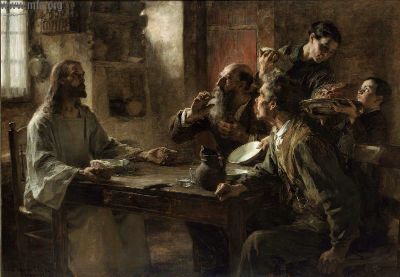
Event of Emmaus: Word and Sacrament

[H]ere too he [Christ] remains unrecognizable to the accustomed eye. … [H]e sets the hearts of the two wanderers aflame by his interpretation of the Scriptures and by breaking bread he opens their eyes. This is a reference to the two basic elements in early Christian worship, which consisted of the liturgy of the word (the reading and expounding of Scripture) and the eucharistic breaking of bread. In this way the evangelist makes it clear that the encounter with the risen Christ lies on a quite new plane; he tries to describe the indescribable in terms of the liturgical facts. He thereby provides both a theology of the resurrection and a theology of the liturgy: one encounters the risen Christ in the word and in the sacrament; divine service is the fashion in which he becomes touchable to us and recognizable as the living Christ. And conversely, the liturgy is based on the mystery of Easter; it is to be understood as the Lord’s approach to us. In it he becomes our travelling companion, sets our dull hearts aflame and opens our sealed eyes. He still walks with us, still finds us worried and downhearted, and still has the power to make us see.

Experience of the risen Christ is something other than a meeting with a historical man, and it must certainly not be traced back to conversations at table and recollections which would have finally crystallized in the idea that he still lived and went about his business. Such an interpretation reduces what happened to the purely human level and robs it of its specific quality. The resurrection narratives are something other and more than disguised liturgical scenes; they make visible the founding event on which all Christian liturgy rests. They testify to an approach which did not rise from the hearts of the disciples but came to them from outside, convinced them against their doubts and made them certain that the Lord had truly risen. He who lay in the grave is no longer there; he—really he himself—lives. He who had been transposed into the other world of God showed himself powerful enough to make it palpably clear that he himself stood opposite them again, that in him the power of love had really proved itself stronger than the power of death.

The comfortable attempt to spare oneself the belief in the mystery of God’s mighty actions in this world and yet at the same time to have the satisfaction of remaining on the foundation of the biblical message leads nowhere; it measures up neither to the honesty of reason nor to the claims of faith. One cannot have both the Christian faith and “religion within the bounds of pure reason”; a choice is unavoidable. He who believes will see more and more clearly, it is true, how rational it is to have faith in the love that has conquered death.

--Joseph Ratzinger (Pope Benedict XVI)

Top icon written by Sister Marie-Paul. Bottom icon by Nicholas Papas.

Monday, April 05, 2010

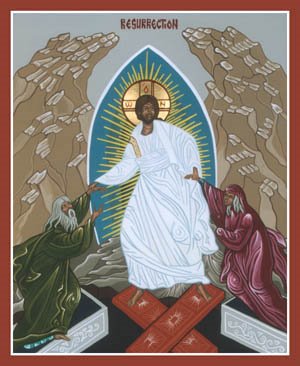
A Love Stronger Than Death: ALITHOS ANESTI!

“Love is strong as death” (Song of Sol. 8.6). … [L]ove demands infinity, indestructibility; indeed it is, so to speak, a call for infinity. But it is also a fact that this cry of love’s cannot be satisfied, that it demands infinity but cannot grant it; that it claims eternity but in fact is included in the world of death, in its loneliness and its power of destruction. Only from this angle can one understand what “resurrection” means. It is the greater strength of love in face of death.

For [man], since he has no continuance in himself, survival, from a purely human point of view, can only become possible through his continuing to exist in another.

[O]nly one could truly give lasting stability: he who is, who does not come into existence and pass away again but abides in the midst of transience: the God of the living, who does not hold just the shadow and echo of my being, whose ideas are not just copies of reality. … In him I can stand as more than a shadow; in him I am truly closer to myself than I should be if I just tried to stay by myself.

[O]nly where someone values love more highly than life, that is, only where someone is ready to put life second to love, for the sake of love, can love be stronger and more than death. … If the power of love for another were so strong anywhere that it could keep alive not just his memory, the shadow of his “I”, but that person himself, then a new stage in life would have been reached. … [This new realm] would signify the end of the sovereignty of bios, which is at the same time the sovereignty of death; it would open up the realm which the Greek Bible calls “zoe” that is, definitive life, which has left behind the rule of death. … It would no longer be evolution but decision and gift in one.

[A]s man has no permanence in himself his survival could only brought about by his living on in another. … [O]nly the love which takes up the beloved in itself, into its own being, could make possible this existence in the other. … Jesus’ total love for men, which leads him to the cross, is perfected in total stepping-over to the Father and therein becomes stronger than death, because in this it is at the same time total “being held” by him.

[I]mmortality always proceeds from love, never out of the autarchy of that which is sufficient to itself. … [T]his principle, properly understood, also applies even to God as he is seen by the Christian faith. … [W]hat is revolutionary about the Christian view of the world and of God … is that it learns to understand the “absolute” as absolute “relativity”, as relatio subsistens.

[L]ove found immortality, and immortality proceeds from love alone. … [H]e who has love for all has founded immortality for all. That is precisely the meaning of the biblical statement that his resurrection is our life. … [I]f he has risen, then we have too, for then love is stronger than death; if he has not risen, then we have not either, for then the situation is still that death has the last word, nothing else. … [E]ither love is stronger than death or it is not. … This also means, it is true, that our own love, left to itself, is not sufficient to overcome death; taken in itself it would have to remain an unanswered cry. It means that only his love, coinciding with God’s own power of life and love, can found our immortality.

It goes without saying that the life of him who has risen from the dead in not once again bios, the bio-logical form of our mortal life inside history; it is zoe, new, different, definitive life; life which has stepped beyond the mortal realm of bios and history, a realm which has here been surpassed by a greater power. … [T]his new life begot itself in history and had to do so, because after all it is there for history, and the Christian message is basically nothing else than the transmission of the testimony that love has here broken through death and thus transformed fundamentally the situation of all of us.
--Joseph Ratzinger (Pope Benedict XVI)

Top icon written by Joanna Ferencz.

Thursday, December 10, 2009

Two Hearts

From a sermon by Fr. Thomas Joseph White, OP:

St. Augustine says that she conceived the Word in her heart before she conceived the Word in her flesh. So that her maternity was accompanied by an intensification and growth in faith, in contemplation, in the intelligent perception of mystery. The second Vatican Council says that during the time of her pregnancy the heart of the Incarnate Word beat gently below the heart of Mary, her immaculate heart. Two immaculate hearts, beating silently and prayerfully in the night of this world.

And during this time, Mary grew in faith and in love, in expectation and in quite joy. Such should be also our advent, a time to accept the silence of mystery and expectation, of quiet penance and joy, waiting for the dawn of Christmas, and the light of Christ that is to illumine the world.

Hmmm. Thomas Joseph? Like that name.

Saturday, October 24, 2009

Chaput on Conscience and Responsibility

Archbishop Chaput on "Conscience, Courage, and Children With Down Syndrome":
The American Jesuit scholar Father John Courtney Murray once said that “Anyone who really believes in God must set God, and the truth of God, above all other considerations.” Here’s what that means. Catholic public officials who take God seriously cannot support laws that attack human dignity without lying to themselves, misleading others, and abusing the faith of their fellow Catholics. Catholic doctors who take God seriously cannot do procedures, prescribe drugs, or support health policies that attack the sanctity of unborn children or the elderly, or that undermine the dignity of human sexuality and the family. And Catholic citizens who take God seriously cannot claim to love their Church and then ignore her counsel on vital public issues that shape our nation’s life. God will demand an accounting. As individuals, we can claim to be or believe whatever we want. But God knows our hearts better than we do. If we don’t conform our hearts and actions to the faith we claim to believe, we’re simply fooling ourselves.

Saturday, August 08, 2009

St. Dominic & Dominican Prayer


THE NINE WAYS OF PRAYER OF ST. DOMINIC is worth reading.

From the Office:

He spoke with God or about God
Dominic possessed such great integrity and was so strongly motivated by divine love, that without a doubt he proved to be a bearer of honour and grace. He was a man of great equanimity, except when moved to compassion and mercy. And since a joyful heart animates the face, he displayed the peaceful composure of a spiritual man in the kindness he manifested outwardly and by the cheerfulness of his countenance.

Wherever he went he showed himself in word and deed to be a man of the Gospel. During the day no one was more community-minded or pleasant toward his brothers and associates. During the night hours no one was more persistent in every kind of vigil and supplication. He seldom spoke unless it was with God, that is, in prayer, or about God, and in this matter he instructed his brothers. Frequently he made a special personal petition that God would deign to grant him a genuine charity, effective in caring for and obtaining the salvation of men. For he believed that only then would he be truly a member of Christ, when he had given himself totally for the salvation of men, just as the Lord Jesus, the Saviour of all, had offered himself completely for our salvation. So, for this work, after a lengthy period of careful and provident planning, he founded the Order of Friars Preachers.

In his conversations and letters he often urged the brothers of the Order to study constantly the Old and New Testaments. He always carried with him the gospel according to Matthew and the epistles of Paul, and so well did he study them that he almost knew them from memory.

Two or three times he was chosen bishop, but he always refused, preferring to live with his brothers in poverty. Throughout his life, he preserved the honour of his virginity. He desired to be scourged and cut to pieces, and so die for the faith of Christ. Of him Pope Gregory IX declared: “I knew him as a steadfast follower of the apostolic way of life. There is no doubt that he is in heaven, sharing in the glory of the apostles themselves”.