Monday, April 05, 2010

A Love Stronger Than Death: ALITHOS ANESTI!

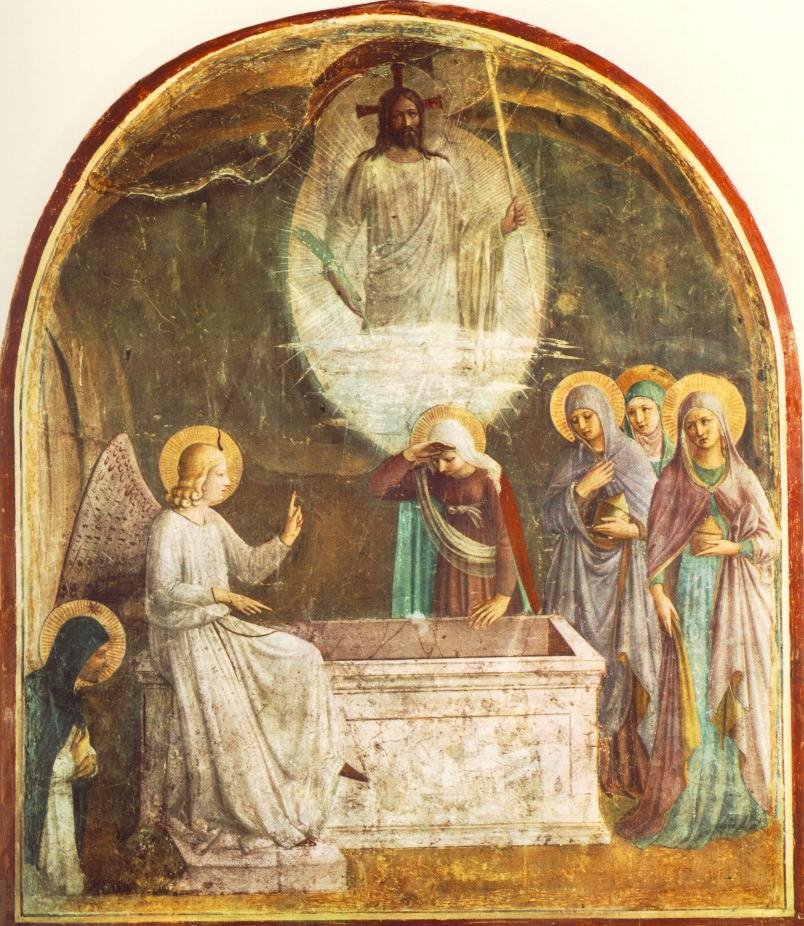
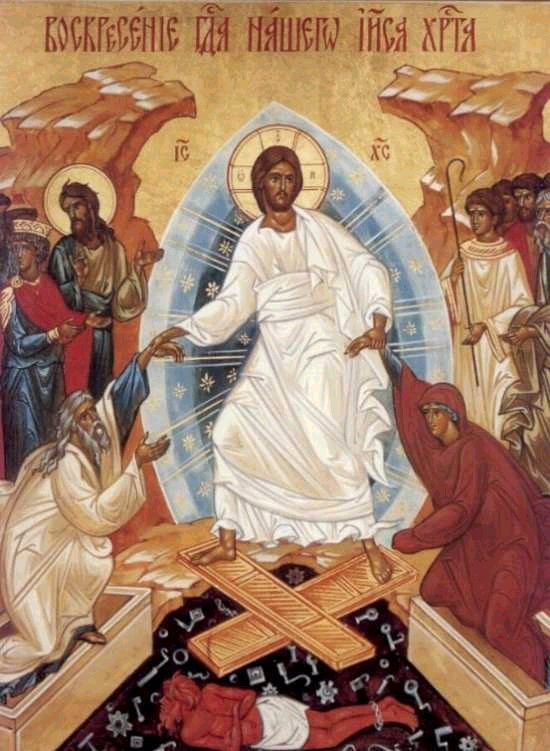
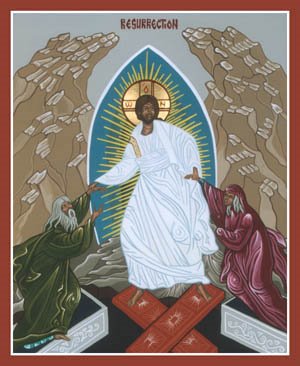
“Love is strong as death” (Song of Sol. 8.6). … [L]ove demands infinity, indestructibility; indeed it is, so to speak, a call for infinity. But it is also a fact that this cry of love’s cannot be satisfied, that it demands infinity but cannot grant it; that it claims eternity but in fact is included in the world of death, in its loneliness and its power of destruction. Only from this angle can one understand what “resurrection” means. It is the greater strength of love in face of death.

For [man], since he has no continuance in himself, survival, from a purely human point of view, can only become possible through his continuing to exist in another.

[O]nly one could truly give lasting stability: he who is, who does not come into existence and pass away again but abides in the midst of transience: the God of the living, who does not hold just the shadow and echo of my being, whose ideas are not just copies of reality. … In him I can stand as more than a shadow; in him I am truly closer to myself than I should be if I just tried to stay by myself.

[O]nly where someone values love more highly than life, that is, only where someone is ready to put life second to love, for the sake of love, can love be stronger and more than death. … If the power of love for another were so strong anywhere that it could keep alive not just his memory, the shadow of his “I”, but that person himself, then a new stage in life would have been reached. … [This new realm] would signify the end of the sovereignty of bios, which is at the same time the sovereignty of death; it would open up the realm which the Greek Bible calls “zoe” that is, definitive life, which has left behind the rule of death. … It would no longer be evolution but decision and gift in one.
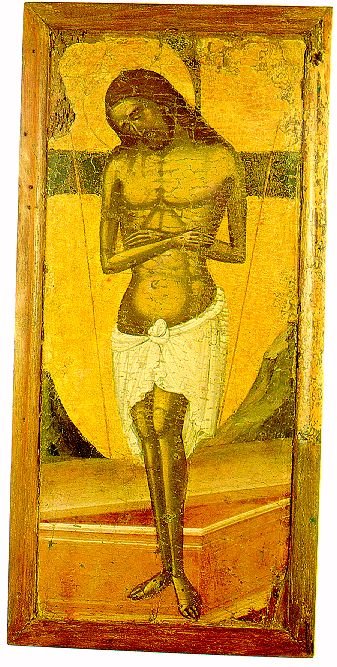
[A]s man has no permanence in himself his survival could only brought about by his living on in another. … [O]nly the love which takes up the beloved in itself, into its own being, could make possible this existence in the other. … Jesus’ total love for men, which leads him to the cross, is perfected in total stepping-over to the Father and therein becomes stronger than death, because in this it is at the same time total “being held” by him.

[I]mmortality always proceeds from love, never out of the autarchy of that which is sufficient to itself. … [T]his principle, properly understood, also applies even to God as he is seen by the Christian faith. … [W]hat is revolutionary about the Christian view of the world and of God … is that it learns to understand the “absolute” as absolute “relativity”, as relatio subsistens.

[L]ove found immortality, and immortality proceeds from love alone. … [H]e who has love for all has founded immortality for all. That is precisely the meaning of the biblical statement that his resurrection is our life. … [I]f he has risen, then we have too, for then love is stronger than death; if he has not risen, then we have not either, for then the situation is still that death has the last word, nothing else. … [E]ither love is stronger than death or it is not. … This also means, it is true, that our own love, left to itself, is not sufficient to overcome death; taken in itself it would have to remain an unanswered cry. It means that only his love, coinciding with God’s own power of life and love, can found our immortality.

It goes without saying that the life of him who has risen from the dead in not once again bios, the bio-logical form of our mortal life inside history; it is zoe, new, different, definitive life; life which has stepped beyond the mortal realm of bios and history, a realm which has here been surpassed by a greater power. … [T]his new life begot itself in history and had to do so, because after all it is there for history, and the Christian message is basically nothing else than the transmission of the testimony that love has here broken through death and thus transformed fundamentally the situation of all of us.
--Joseph Ratzinger (Pope Benedict XVI)

Top icon written by Joanna Ferencz.

Thursday, December 10, 2009

Two Hearts

From a sermon by Fr. Thomas Joseph White, OP:

St. Augustine says that she conceived the Word in her heart before she conceived the Word in her flesh. So that her maternity was accompanied by an intensification and growth in faith, in contemplation, in the intelligent perception of mystery. The second Vatican Council says that during the time of her pregnancy the heart of the Incarnate Word beat gently below the heart of Mary, her immaculate heart. Two immaculate hearts, beating silently and prayerfully in the night of this world.

And during this time, Mary grew in faith and in love, in expectation and in quite joy. Such should be also our advent, a time to accept the silence of mystery and expectation, of quiet penance and joy, waiting for the dawn of Christmas, and the light of Christ that is to illumine the world.

Hmmm. Thomas Joseph? Like that name.

Saturday, October 24, 2009

Chaput on Conscience and Responsibility

Archbishop Chaput on "Conscience, Courage, and Children With Down Syndrome":
The American Jesuit scholar Father John Courtney Murray once said that “Anyone who really believes in God must set God, and the truth of God, above all other considerations.” Here’s what that means. Catholic public officials who take God seriously cannot support laws that attack human dignity without lying to themselves, misleading others, and abusing the faith of their fellow Catholics. Catholic doctors who take God seriously cannot do procedures, prescribe drugs, or support health policies that attack the sanctity of unborn children or the elderly, or that undermine the dignity of human sexuality and the family. And Catholic citizens who take God seriously cannot claim to love their Church and then ignore her counsel on vital public issues that shape our nation’s life. God will demand an accounting. As individuals, we can claim to be or believe whatever we want. But God knows our hearts better than we do. If we don’t conform our hearts and actions to the faith we claim to believe, we’re simply fooling ourselves.

Saturday, August 08, 2009

St. Dominic & Dominican Prayer


THE NINE WAYS OF PRAYER OF ST. DOMINIC is worth reading.

From the Office:

He spoke with God or about God
Dominic possessed such great integrity and was so strongly motivated by divine love, that without a doubt he proved to be a bearer of honour and grace. He was a man of great equanimity, except when moved to compassion and mercy. And since a joyful heart animates the face, he displayed the peaceful composure of a spiritual man in the kindness he manifested outwardly and by the cheerfulness of his countenance.

Wherever he went he showed himself in word and deed to be a man of the Gospel. During the day no one was more community-minded or pleasant toward his brothers and associates. During the night hours no one was more persistent in every kind of vigil and supplication. He seldom spoke unless it was with God, that is, in prayer, or about God, and in this matter he instructed his brothers. Frequently he made a special personal petition that God would deign to grant him a genuine charity, effective in caring for and obtaining the salvation of men. For he believed that only then would he be truly a member of Christ, when he had given himself totally for the salvation of men, just as the Lord Jesus, the Saviour of all, had offered himself completely for our salvation. So, for this work, after a lengthy period of careful and provident planning, he founded the Order of Friars Preachers.

In his conversations and letters he often urged the brothers of the Order to study constantly the Old and New Testaments. He always carried with him the gospel according to Matthew and the epistles of Paul, and so well did he study them that he almost knew them from memory.

Two or three times he was chosen bishop, but he always refused, preferring to live with his brothers in poverty. Throughout his life, he preserved the honour of his virginity. He desired to be scourged and cut to pieces, and so die for the faith of Christ. Of him Pope Gregory IX declared: “I knew him as a steadfast follower of the apostolic way of life. There is no doubt that he is in heaven, sharing in the glory of the apostles themselves”.

Saturday, July 04, 2009

4th of July : The American Flag


A thoughtful mind, when it sees a Nation's flag, sees not the flag only, but the Nation itself; and whatever may be its symbols, its insignia, he reads chiefly in the flag the Government, the principles, the truths, the history which belongs to the Nation that sets it forth.

--Henry Ward Beecher from " The American Flag"

Fly the Flag!

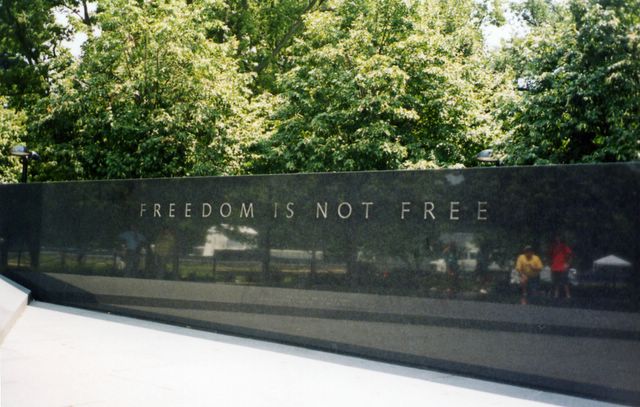
4th of July : Freedom Is Not Free


Freedom Is Not Free

By LCDR Kelly Strong, USCG - Copyright 1981

I watched the flag pass by one day,
It fluttered in the breeze.
A young Service man saluted it,
And then he stood at ease.

I looked at him in uniform
So young, so tall, so proud,
With hair cut square and eyes alert
He'd stand out in any crowd.

I thought how many men like him
Had fallen through the years.
How many died on foreign soil
How many mothers' tears?

How many pilots' planes shot down?
How many died at sea
How many foxholes were soldiers' graves?
No, freedom isn't free.

I heard the sound of Taps one night,
When everything was still,
I listened to the bugler play
And felt a sudden chill.

I wondered just how many times
That Taps had meant "Amen,"
When a flag had draped a coffin.
Of a brother or a friend.

I thought of all the children,
Of the mothers and the wives,
Of fathers, sons and husbands
With interrupted lives.

I thought about a graveyard
At the bottom of the sea
Of unmarked graves in Arlington.
No, freedom isn't free.

4th of July : Life, Liberty, and the Pursuit of Happiness


Posted by Picasa

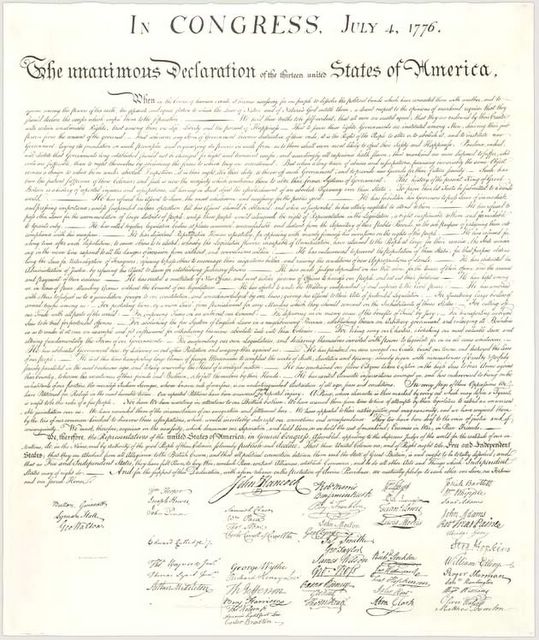
When in the Course of human events it becomes necessary for one people to dissolve the political bands which have connected them with another and to assume among the powers of the earth, the separate and equal station to which the Laws of Nature and of Nature's God entitle them, a decent respect to the opinions of mankind requires that they should declare the causes which impel them to the separation.

We hold these truths to be self-evident, that all men are created equal, that they are endowed by their Creator with certain unalienable Rights, that among these are Life, Liberty and the pursuit of Happiness. --That to secure these rights, Governments are instituted among Men, deriving their just powers from the consent of the governed, --That whenever any Form of Government becomes destructive of these ends, it is the Right of the People to alter or to abolish it, and to institute new Government, laying its foundation on such principles and organizing its powers in such form, as to them shall seem most likely to effect their Safety and Happiness. Prudence, indeed, will dictate that Governments long established should not be changed for light and transient causes; and accordingly all experience hath shewn that mankind are more disposed to suffer, while evils are sufferable than to right themselves by abolishing the forms to which they are accustomed. But when a long train of abuses and usurpations, pursuing invariably the same Object evinces a design to reduce them under absolute Despotism, it is their right, it is their duty, to throw off such Government, and to provide new Guards for their future security. --Such has been the patient sufferance of these Colonies; and such is now the necessity which constrains them to alter their former Systems of Government. The history of the present King of Great Britain is a history of repeated injuries and usurpations, all having in direct object the establishment of an absolute Tyranny over these States. To prove this, let Facts be submitted to a candid world.

For the rest of the Declaration of Independence, go here.
Now, to show some gratitude and appreciation for those Brave ones who protect and defend our freedoms, the precise freedoms you are celebrating today, go to
and contribute either financial support or some other type, but contribute.

Friday, July 03, 2009

4th of July : Schall and Chesterton on America

A few years ago, Fr. Schall, SJ, wrote "Do We Deserve To Be Free? On The Fourth of July, 2006," wherein he said:

Chesterton said someplace that the United States is almost the only country ever to have been founded on an idea. [1] That is to say, it was founded by men who knew well the English and Western Christian tradition, themselves thinking with principles formulated in that tradition. These men who signed the Declaration also knew their Cicero and Aristotle, their Bible. They were presenting before mankind an argument that explained the validity of their political action. They did not intend to act unwisely or unreasonably. They knew it was a delicate situation that merited rational statement. They did not know whether they would succeed or not. No small part of their eventual success was in fact the persuasive force of their principles. But we know that rightness of cause does not, in world history, always assure political success. They had to risk, as they said at the end of the Declaration, their lives, their fortunes, and their "sacred honor." Not all men are so willing. Men who have no conception of what this "risk" means have no grounds for freedom or to the truth on which it is based. Nor should they really live in regimes based on "sacred honor."

Speaking of Chesterton, in his What I Saw in America by G. K. Chesterton, he writes:

The American Constitution does resemble the Spanish Inquisition in this: that it is founded on a creed. America is the only nation in the world that is founded on creed. That creed is set forth with dogmatic and even theological lucidity in the Declaration of Independence; perhaps the only piece of practical politics that is also theoretical politics and also great literature. It enunciates that all men are equal in their claim to justice, that governments exist to give them that justice, and that their authority is for that reason just. It certainly does condemn anarchism. and it does also by inference condemn atheism, since it clearly names the Creator as the ultimate authority from whom these equal rights are derived. Nobody expects a modern political system to proceed logically in the application of such dogmas, and in the matter of God and Government it is naturally God whose claim is taken more lightly. The point is that there is a creed, if not about divine, at least about human things.

Sunday, April 19, 2009

Love Triumphs : The Easter Octave and the Liturgy of the Redemption Fills the World


When on the Cross my Heart was sweating in the wine-press, when all strength had already been surrendered and only the emptiness and the impotence still suffered; when all it could yield, drop by drop, was “I can’t any more,” and “I hardly have the will”;


when all blood had abandoned the Heart and all spirit the soul: then it was only nothingness that bled, only the water of perfect exhaustion that still flowed when the lance bored in (visibly into the Heart of flesh, and invisibly into soul, spirit and God): in me God himself became exhausted. The Inexhaustible was exhausted. Life was lived out. Love was loved out.

Life was lived out.

Love was loved out.

This was my victory. In the Cross was Easter.

In death the grave of the world was burst open.

In the leap into the void was the ascension to heaven.

Now I fill the world, and at last every soul lives from my dying.

You do not bear the judgment, but the grace. … Your participation in the redemption (your status as co-redeemers, we might say) is but an analogy, an expression of my love. But it is real: I myself make it real and valid. I make up for your failure and bring it to plenitude. … Taste with me the futility of the redemption. It is from such stuff that the Father has always wrought his grace. There is a judgment; in the Father’s hand there is a balance. In the one scale there lies the heavy and oppressive futility of it all. In the other, a buoyant, mounting hope. And, as the first scale falls, the judgment is decided. Hope mounts up and my Kingdom triumphs; a soaring escape.


Let us look steadfastly to the blood of Christ, and see how precious that blood is to God, which, having been shed for our salvation, has set the grace of repentance before the whole world.

--Pope St Clement, First Epistle to the Corinthians


***Considering the event of today, you might want to watch/listen to/pray with "Divine Mercy and How This Effects Your Thinking," a program that features Fr. Benedict Groeschel and a good friend, Br. Michael Gaitley, MIC.***

Friday, April 17, 2009

This Tree is my eternal salvation ...

This Tree is my eternal salvation. It is my nourishment and my banquet. Amidst its roots I cast my own roots deep: beneath its boughs I grow and expand, revelling in its sigh as in the wind itself. Flying from the burning heat, I have pitched my tent in its shadow, and have found a resting-place of dewy freshness. I flower with its flowers; its fruits bring perfect joy--fruits which have been preserved for me since time's beginning, and which now I freely eat. This Tree is a food, sweet food, for my hunger, and a fountain for my thirst; it is a clothing for my nakedness; its leaves are the breath of life. Away with the fig-tree, from this time on! If I fear God, this is my protection; if I stumble, this is my support; it is the prize for which I fight and the reward of my victory. This is my straitened path, my narrow way; this is the stairway of Jacob, where angels pass up and down, and where the Lord in very truth standing at the head.

This Tree, vast as heaven itself, rises from earth to the skies, a plant immortal, set firm in the midst of heaven and earth, base of all that is, foundation of the universe, support of this world of men, binding-force of all creation, holding within itself all the- mysterious essence of man. Secured with the unseen clamps of the spirit, so that, adjusted to the Divine, it may never bend or warp, with foot resting firm on earth it towers to the topmost skies, and spans with its allembracing arms the boundless gulf of space between.

He was All, and in all, filling it with himself; stripped naked for battle against the powers of the air. . .

With him two thieves were extended, bearing within themselves the marks of those two peoples, the marks of those two types of mind. . .

When this cosmic combat came to an end ... the heavens shook; almost, the stars fell from the skies; the light of the sun was extinguished for a time; rocks were split asunder; the entire world was all but shattered ... But great Jesus breathed forth his divine Soul, saying: "Father, into Thy hand I commend my spirit." And lo, even while all things shuddered and heaved in earthquake, reeling for fear, his divine Soul ascended, giving life and strength to all; and again creation was still, as if this divine Crucifixion and Extension had everywhere unfolded and spread, penetrating all things, through all, and in all.

O Thou who art alone among the alone, and all in all! Let the heavens hold thy Godhead; and paradise, thy soul; and earth, thy blood. For the Indivisible has become divided, so that all might be saved, and the world below might not remain ignorant of the coming of God....


We beseech thee now, Lord God,
Christ, eternal King of souls:
stretch forth thy mighty hands over thy sacred Church,
and over a holy people for ever thine.


-Ancient Paschal Homily, 51
(aka Pseudo-Chrysostom, Sermon VI for Holy Week)

The Resurrected Christ : Wellspring & Liturgy

Now, in the hour when the economy of salvation reaches its climax, it is Jesus himself who opens “paradise” (Lk 23:43), the garden of life, to men who are straying far from God. He can do so because the source, the wellspring, is now here.

Christ is risen; he is truly risen! Now everything begins.


On this day of birth the river of life becomes LITURGY as it spreads out from the tomb and reaches us in the incorruptible body of Christ.

[T]he risen Christ [is] the inexhaustible wellspring of the liturgy. […] He is united to the Father and radiates the glory of God from his own body; being united to the wellspring he gives life (see Jn 5:20-21 and 26-27). The river of life can now flow forth from the throne of God and from the throne of the Lamb. The liturgy has been born; the Resurrection of Jesus is its first manifestation.


The Resurrection of Jesus is not in the past, for if it were Jesus would not have conquered our death. […] [T]he death of Jesus was by its nature the death of death. But the event wherein death was put to death cannot belong to the past, for then death would not have been conquered. […] The hour on which the desire of Jesus was focused “has come, and we are in it” forever; the event that is the Cross and Resurrection does not pass away.

More than that, it is the only true event in all of history. All other events are dead and will always be dead; this one alone remains.

The hour in which the Word with a loud cry handed over his Breath of love so that men might live is no longer in the past; it is, it abides, it lives on through history and sustains it.

This unprecedented power that the river of life exercises in the humanity of the risen Christ—that is the liturgy! In it all the promises of the Father find their fulfillment (Acts 13:32). Since that moment the communion of the Blessed Trinity has ceaselessly been spreading throughout our world and flooding our time with its fullness. Henceforth the economy of salvation takes the form of liturgy.

--Fr. Jean Corbon, OP, The Wellspring of Worship

Thursday, April 16, 2009

He Makes All Things New Again

And he who sat upon the throne said, "Behold, I make all things new."
(Rev. 21.5)


He has brought total newness by bringing himself.
--Saint Irenaeus, Adversus Haereses

He was going to inherit a world already made,
And yet he was going to remake it entirely.
--Charles Peguy

Wednesday, April 15, 2009

Feeling the Light of the Risen Son

Lord, I believe, help thou mine unbelief.

I needed blood to tell me the truth,
the touch of blood. Even
my sight of the dark crust of it round the nailholes
didn't thrust its meaning all the way through to that manifold knot in me
that willed to possess all knowledge, refusing to loosen
unless that insistence won the battle I fought with life.

But when my hand led by His hand's firm clasp
entered the unhealed wound, my fingers encountering
rib-bone and pulsing heat, what I felt was not
scalding pain, shame for my obstinate need,
but light, light straming into me, over me, filling the room
as if I had lived till then in a cold cave, and now
coming forth for the first time, the knot that bound me unravelling,
I witnessed all things quicken to color, to form,
my question not answered but given its part
in a vast unfolding design lit by a risen sun.


--Denise Levertov, "St. Thomas Didymus"

Dominus Meus et Deus Meus : My Lord and My God

Thomas, you have plunged your finger into my open Heart.
--Hans Urs von Balthasar
The wound of the body also reveals the spiritual wound. ...
Let us look through the visible wound to the invisible wound of love.

--St. Bonaventure, Mystical Vine


Where did I triumph if not on the Cross? Are you as blind as the Jews and the pagans to think that Golgotha was my downfall and my failure? … Look: this is my secret, and there is no other in heaven or on earth: My Cross is salvation, my Death is victory, my Darkness is light. At that time, when I hung in torment and dread rushed into my soul because of the forsakenness, rejectedness, uselessness of my suffering, and all was gloomy, and only the seething rage of that mass of teeth hissed up mockingly at me, while heaven kept silence, shut tight as the mouth of a scoffer (but through the open gates of my hands and feet my blood bubbled out in spurts, and with each throb my Heart became more desolate, strength poured out from me in streams and there remained only faintness, death’s fatigue, infinite failure), and at last I neared that mysterious and final spot on the very edge of being, and then—the fall into the void, the capsizing into the bottomless abyss, the vertigo, the finale, the un-becoming: that colossal death which only I have died. Through my death this has been spared you, and no one will ever experience what it really means to die: This was my victory.

Haven’t I told you that if the grain of seed falls into the ground and dies it bears much fruit?

Of whom was I thinking when, as a freezing child, I lay in the crib, if not of you? Of what did I speak in the splendor of Tabor with Moses and Elias, if not of my suffering for you? For whom did I ask the Father for signs, if not for you? For whose sake did I stumble my way through fourteen endless stations, if not for yours? And my divinity and the embrace of my Father: for whom did I leave these if not for you? You want to follow me? You want to be called my disciples? Then let that mind be yours which animated me: being God in my very substance, I did not cling to my equality with God, but rather emptied and annulled myself. I took on the figure of a slave, becoming wholly like men and descending below myself in men’s everyday appearance, in bondage unto death, unto death on the Cross.

For to be God was not enough for me. … I wanted to prove my divinity to you in no way other than by letting go of it in order to become your slave.

[T]he most divine thing about God (and to show this was my whole concern): God was free enough to give himself up. … This was his self-sufficiency: that he began to hunger and to thirst and that, in the person of his members, he suffered every sort of poverty and disgrace and imprisonment and nakedness and disease. This, my brothers, was his victory: that I was able to defeat even my divinity and that in the slave’s form I was able to manifest the Lord, and in sin’s likeness the essence of love. That, being outside of God, I knew how to be in God. That I became all in everything I was not.

Understand what it means to give oneself away. To strip oneself of one’s freedom out of freedom; and out of love, no longer to be free or to be lord over oneself; no longer to be able to determine where the journey will take you; to surrender oneself, to deliver oneself over to the series of consequences that carry us off in a direction we did not want—where to? You leap down from a high cliff. The leap is freely made, and yet, the moment you leap, gravity leaps upon you, and you tumble exactly like a dead stone to the very bottom of the gorge. This is how I decided to give myself. To give myself right out of my hand. To whom? It did not matter. To sin, to the world, to all of you, to the devil, to the Church, to the kingdom of Heaven, to the Father … I wanted to be the one given away par excellence. The corpse over which the vultures gather. The Consumed, the Eaten, the Drunk, the Spilled, the Poured Out. The Plaything. The Worn Out. The one squeezed to the very dregs. The one trod upon to infinity. The one run over. The one thinned to air. The one liquified into an ocean. The Dissolved. This was the plan; this was the will of the Father. By fulfilling it through obedience (the fulfillment itself was obedience), I have filled the world from heaven down to hell, and every knee must bend before me, and all tongues must confess me. Now I am all in all, and this is why the death which poured me out is my victory. My descent, my vertiginous collapse, my going under (under myself) into everything that was foreign and contrary to God—down into the underworld: this was the ascent of this world into me, into God. My victory.

Thomas, you have plunged your finger into my open Heart.


The wound of the body also reveals the spiritual wound. ...
Let us look through the visible wound to the invisible wound of love.

--St. Bonaventure

Tuesday, April 14, 2009

Event of Emmaus : Word and Sacrament

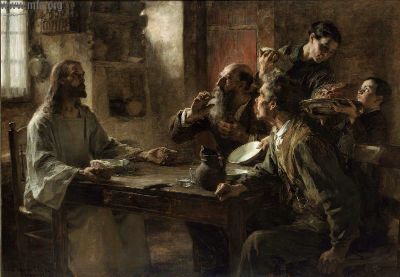
[H]ere too he [Christ] remains unrecognizable to the accustomed eye. … [H]e sets the hearts of the two wanderers aflame by his interpretation of the Scriptures and by breaking bread he opens their eyes. This is a reference to the two basic elements in early Christian worship, which consisted of the liturgy of the word (the reading and expounding of Scripture) and the eucharistic breaking of bread. In this way the evangelist makes it clear that the encounter with the risen Christ lies on a quite new plane; he tries to describe the indescribable in terms of the liturgical facts. He thereby provides both a theology of the resurrection and a theology of the liturgy: one encounters the risen Christ in the word and in the sacrament; divine service is the fashion in which he becomes touchable to us and recognizable as the living Christ. And conversely, the liturgy is based on the mystery of Easter; it is to be understood as the Lord’s approach to us. In it he becomes our travelling companion, sets our dull hearts aflame and opens our sealed eyes. He still walks with us, still finds us worried and downhearted, and still has the power to make us see.

Experience of the risen Christ is something other than a meeting with a historical man, and it must certainly not be traced back to conversations at table and recollections which would have finally crystallized in the idea that he still lived and went about his business. Such an interpretation reduces what happened to the purely human level and robs it of its specific quality. The resurrection narratives are something other and more than disguised liturgical scenes; they make visible the founding event on which all Christian liturgy rests. They testify to an approach which did not rise from the hearts of the disciples but came to them from outside, convinced them against their doubts and made them certain that the Lord had truly risen. He who lay in the grave is no longer there; he—really he himself—lives. He who had been transposed into the other world of God showed himself powerful enough to make it palpably clear that he himself stood opposite them again, that in him the power of love had really proved itself stronger than the power of death.

The comfortable attempt to spare oneself the belief in the mystery of God’s mighty actions in this world and yet at the same time to have the satisfaction of remaining on the foundation of the biblical message leads nowhere; it measures up neither to the honesty of reason nor to the claims of faith. One cannot have both the Christian faith and “religion within the bounds of pure reason”; a choice is unavoidable. He who believes will see more and more clearly, it is true, how rational it is to have faith in the love that has conquered death.

--Joseph Ratzinger (Pope Benedict XVI)

Top icon written by Sister Marie-Paul. Bottom icon by Nicholas Papas.

Sunday, April 12, 2009

Empty Tomb


When Mary Magdalen came to the tomb and did not find the Lord's body, she thought it had been taken away and so informed the disciples.


After they came and saw the tomb, they too believed what Mary had told them. The text then says: "The disciples went back home," and it adds: "but Mary wept and remained standing outside the tomb."


We should reflect on Mary's attitude and the great love she felt for Christ; for though the disciples had left the tomb, she remained. She was still seeking the one she had not found, and while she sought she wept; burning with the fire of love, she longed for him who she thought had been taken away. And so it happened that the woman who stayed behind to seek Christ was the only one to see him. For perseverance is essential to any good deed, as the voice of truth tell us: "Whoever perseveres to the end will be saved."
--St. Gregory the Great

The Risen SON : Easter Sunday

Christos Anesti!

"I did not make you for the dungeon." In this Easter hour let us ask the Lord to visit the dungeons of this world; ... Let us ask him to enter into the spiritual prisons of this age, into the darkness of our lack of truth, revealing himself as the Victor who tears down the gates and says to us, "I, your God, have become your Son. Come out! I have not created you to be in prison for ever. I did not make you for the dungeon." In his play No Exit Jean Paul Sartre portrays man as a being who is hopelessly trapped. He sums up his gloomy picture of man in the words, "Hell is other people". This being so, hell is everywhere, and there is no exit, the doors are everywhere closed.

Christ, however, says to us, "I, your God, have become your Son. Come out!" Now the exact opposite is true: heaven is other people. Christ summons us to find heaven in him, to discover him in others and thus to be heaven to each other. He calls us to let heaven shine into this world, to build heaven here. Jesus stretches out his hand to us in his Easter message, in the mystery of the sacraments, so that Easter may be now, so that the light of heaven may shine forth in this world and the doors may be opened. Let us take his hand! Amen.

--Joseph Ratzinger (Pope BenedictXVI)

Alithos Anesti!

CHRISTOS ANESTI! Christ Is Risen!

Only since Easter can we really utter the first article of faith; only on the basis of Easter is this profession rich and full of consolation: I believe in God, the Father Almighty. For it is only from the Lamb that we know that God is really Father, really Almighty.


This greatest festival of the Church's year encourages us, by looking at him who was slain and is risen, to discover the place where heaven is opened. If we comprehend the message of the Resurrection, we recognize that heaven is not completely sealed off above the earth. Then--gently and yet with immense power--something of the light of God penetrates our life. Then we shall feel the surge of joy ....
--Joseph Ratzinger (Pope BenedictXVI)

Christos Anesti!

The Son Is Rising

The light shines in the darkness, and the darkness has not overcome it. (Jn 1:5)


Easter is concerned with something unimaginable. Initially the event of Easter comes to us solely through the word, not through the senses. So it is all the more important for us to be won over by the immensity of this word. Since, however, we can only think by employing sense images, the faith of the Church has always translated the Easter message into symbols which point to things that the word cannot express. The symbol of light ... plays a special part; the praise of the Paschal candle--a symbol of life in the midst of the darkened church--is actually a praise of him who proved victor over death. Thus the event of long ago is translated into our present time: where light conquers darkness, something of the Resurrection takes place.

--Joseph Ratzinger (Pope BenedictXVI)

Saturday, April 11, 2009

Arise from the Dead


Awake, O sleeper, and arise from the dead, and Christ shall give you light. I have not created you to be in prison forever. I did not make you for the dungeon.
--Epiphanius