Is there a significant difference between a problem and a mystery?
Here is one take by Maritain and here is an ongoing discussion on the matter (in the comments section).
Wednesday, June 28, 2006


Tuesday, June 27, 2006
Zidane Extends His Playing Days At Least One More Game
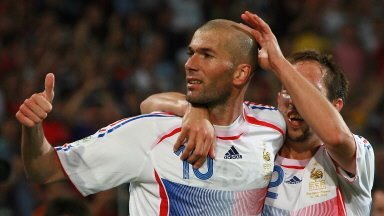 It is always nice when a class act has some moments like this ... especially in his last tournament: Zinedine Zidane sets up a goal with perfectly bending free kick and then scores his own on a beautiful play in the box as France beats Spain 3-1.
It actually reminded me of the good ol' days for Zidane when he played for the best team and was playing his best soccer, even winning the Footballer of the Year award.

This reminds me of an article la nouvelle théologie linked to: "Soccer as Sacrament."
Monday, June 26, 2006
Lessons from 24
What 24 teaches and reminds us: "I Am Jack Bauer: What 24 means for homeland security" by Timothy P. Carney.
Friday, June 23, 2006
"I've Found God." Another Scientist Finds God
Another scientist has found God. And not just any scientist.
Francis Collins is the director of the US National Human Genome Research Institute. In this British Sunday Times article, Steven Swinford writes:
I’ve found God, says man who cracked the genome
THE scientist who led the team that cracked the human genome is to publish a book explaining why he now believes in the existence of God and is convinced that miracles are real.Francis Collins, the director of the US National Human Genome Research Institute, claims there is a rational basis for a creator and that scientific discoveries bring man “closer to God”.
His book, The Language of God, to be published in September [or in July as Amazon site says], will reopen the age-old debate about the relationship between science and faith. “One of the great tragedies of our time is this impression that has been created that science and religion have to be at war,” said Collins, 56. “I don’t see that as necessary at all and I think it is deeply disappointing that the shrill voices that occupy the extremes of this spectrum have dominated the stage for the past 20 years.”
For Collins, unravelling the human genome did not create a conflict in his mind. Instead, it allowed him to “glimpse at the workings of God”.
“When you make a breakthrough it is a moment of scientific exhilaration because you have been on this search and seem to have found it,” he said. “But it is also a moment where I at least feel closeness to the creator in the sense of having now perceived something that no human knew before but God knew all along.
“When you have for the first time in front of you this 3.1 billion-letter instruction book that conveys all kinds of information and all kinds of mystery about humankind, you can’t survey that going through page after page without a sense of awe. I can’t help but look at those pages and have a vague sense that this is giving me a glimpse of God’s mind.”
Collins joins a line of scientists whose research deepened their belief in God. Isaac Newton, whose discovery of the laws of gravity reshaped our understanding of the universe, said: “This most beautiful system could only proceed from the dominion of an intelligent and powerful being.”
Although Einstein revolutionised our thinking about time, gravity and the conversion of matter to energy, he believed the universe had a creator. “I want to know His thoughts; the rest are details,” he said. ...
Among Collins’s most controversial beliefs is that of “theistic evolution”, which claims natural selection is the tool that God chose to create man. In his version of the theory, he argues that man will not evolve further.
“I see God’s hand at work through the mechanism of evolution. If God chose to create human beings in his image and decided that the mechanism of evolution was an elegant way to accomplish that goal, who are we to say that is not the way,” he says.
“Scientifically, the forces of evolution by natural selection have been profoundly affected for humankind by the changes in culture and environment and the expansion of the human species to 6 billion members. So what you see is pretty much what you get.”
Collins was an atheist until the age of 27, when as a young doctor he was impressed by the strength that faith gave to some of his most critical patients.
“They had terrible diseases from which they were probably not going to escape, and yet instead of railing at God they seemed to lean on their faith as a source of great comfort and reassurance,” he said. “That was interesting, puzzling and unsettling.”
He decided to visit a Methodist minister and was given a copy of C S Lewis’s Mere Christianity, which argues that God is a rational possibility. The book transformed his life. “It was an argument I was not prepared to hear,” he said. “I was very happy with the idea that God didn’t exist, and had no interest in me. And yet at the same time, I could not turn away.”
His epiphany came when he went hiking through the Cascade Mountains in Washington state. He said: “It was a beautiful afternoon and suddenly the remarkable beauty of creation around me was so overwhelming, I felt, ‘I cannot resist this another moment’.”
Collins believes that science cannot be used to refute the existence of God because it is confined to the “natural” world. In this light he believes miracles are a real possibility. “If one is willing to accept the existence of God or some supernatural force outside nature then it is not a logical problem to admit that, occasionally, a supernatural force might stage an invasion,” he says.
Tuesday, June 20, 2006
More Deeply Rooted in Freedom ... and Religiously So
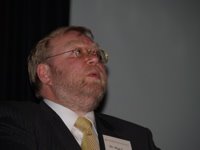 Recently returned from Acton Institute's annual Acton University. It was quite an event. Met many good people and heard some worthwhile talks. The Q & A opened up the sessions to further good discussion and at times some important clarifications.
Aside from Fr. Sirico's typically moving closing talk, I would say the highlight for most was "Making Freedom a Reality: Estonia's Path from Communism to the Free Market," the talk by the former Prime Minister of Estonia, Dr. Mart Laar (see photo).
You can read a blurb about it here and you actually can hear the talk here.
I should have said "the highlight with regard to talks" because the conversation during breaks, at meals, and at the hospitality times at the end of each day were quite rewarding as well. Some good friendships continued and some new ones were embarked upon.
One aspect of Acton events is that folks from all sorts of different backgrounds are invited. There were students, teachers/professors, businessmen, charitable organization members, clerics, retirees, and so on ... along with the many different countries that were represented ... from US, Canada, and Mexico to countries in Europe, South America, and Africa.
That said, Fr. Schall's latest piece highlights an aspect of the University. In "On The Intellectual Needs of Ordinary People," Fr. Schall, SJ, writes
The danger of recent rhetoric about "options for the poor" is that it tends to deprive the impoverished of their intrinsic human dignity by implying that no wrong perpetrated by them is caused by themselves. Rather, all faults are said to be caused by environment or "structures" of society, whatever they might be. This dangerous theoretical position is a hold over--an intellectual hold over--from the influence of Rousseau in modern thought. To put the issue more positively, we can have saints who are poor, saints who are rich, and saints who are everywhere in-between. The same obviously holds true for sinners. What we cannot have is a saint or a sinner who is automatically made so by his external social condition alone.
Nor, to cover the other extreme, is it true that our political and social institutions make no difference at all in our moral character. Aristotle quite clearly maintains, as does Aquinas following him, that a certain sufficiency of wealth and political participation is advisable for the possibility of virtue for ordinary people. The real issue here is what kind of political, moral, and economic ideas and institutions cause this sufficiency to come into being through the workings of human enterprise itself. Many theories and ideas about helping the poor do not help them, even when it is claimed that they do. Not a few ideas even destroy them. In practice, the intention to help someone, whatever his situation, is not by itself a guarantee that the help will do what it is supposed to do. The poor should not be conceived as objects of one's social experiments.
Saturday, June 17, 2006
U.S. Ties in World Cup
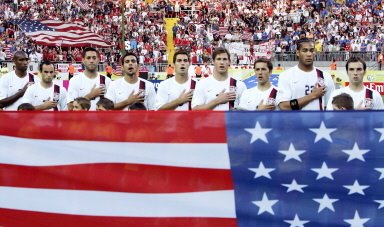 US and Italy tie 1-1.
I'll take that.
Now just for Italy to beat the Czech Republic and for the U.S. to beat Ghana.
It can happen.
Tuesday, June 13, 2006
Acton and Freedom: A week back in Grand Rapids
I will be at Acton University this week. I may have time to post and I may not or I might just post little snippets of what is happening here.
For more and related info, I suggest you check out Acton Power Blog.
For more and related info, I suggest you check out Acton Power Blog.
Friday, June 09, 2006

Thursday, June 08, 2006
Zarqawi Killed
Good news from Iraq: "Abu Musab al-Zarqawi, the most-wanted terrorist in Iraq who waged a bloody campaign of beheadings and suicide bombings, was killed when U.S. warplanes dropped 500-pound bombs on his isolated safehouse, officials said Thursday."
Good job, U.S. military and the Iraqis who helped.
Let's hope the MSM covers this story appropriately by recognizing the good done by the U.S. military and the Iraqi people. In the bit I have seen, it seems not.
Who is Abu Zarqawi? A monster.
Good job, U.S. military and the Iraqis who helped.
Let's hope the MSM covers this story appropriately by recognizing the good done by the U.S. military and the Iraqi people. In the bit I have seen, it seems not.
Who is Abu Zarqawi? A monster.
Tuesday, June 06, 2006
Being Wrong, Believing Wrong, and Doing Wrong: Some Notes on a Review
My recent review of Kevin Seamus Hasson's book The Right To Be Wrong has generated the kind of response I figured would happen. I have received some emails from folks surprised I would endorse relativism. Me? Endorse relativism? Did I do that? Not intentionally.
With regard to the book review, please keep in mind that the limited number of words kept me from much criticism. They really just wanted me to convey what the book was about and if possible offer some critical commentary. I did the first, but my verbose self precluded me from getting to the second part, at least in the published version.
Because of editing down and having to meet a limited number of words, some key thoughts of mine were not in the review. So what better place to present them than here.
I agree with most of the comments I have received.
Keep in mind that Hasson primarily is talking about one having the right to conscience and to holding religious views and expressing them when they are solely personal acts or acts that don't do violence to another. Even if one is wrong, this person still has the right to hold such beliefs.
That said, he acknowledges that some believers, he talks about Islamists and Communists here, do take their faith/ideology to the point of doing violence to another and he does say that they have gone too far. It is here that the right to be(lieve) wrong(ly) is no right at all. It is an abuse of someone else's rights. This is the line he says cannot be crossed and is the line the Park Rangers should truly be spending their time monitoring. Not the other benign religious expressions.
Perhaps I should have made the effort to include the distinctions: be wrong, believing something wrong, and doing wrong. By the response in my emails, apparently so.
In between the last two paragraphs, I originally wrote but had to cut out because of limited space:
In between the last two paragraphs, I originally wrote but had to cut out because of limited space:
Supplying a rational foundation for religious liberty is important for Hasson. The constitutional and legal arguments matter, but as Mary Dyer found out, something can be legally justified without necessarily being morally justified. Consider the case of Gedhun Choekyi Nyima. Arrested as a six-year-old in 1995, he has been in the custody of the Chinese government ever since. His charge? Tibetan Buddhists believe that he is the reincarnation of the Panchen Lama, second to the Dalai Lama. The American State Department has complained numerous times that this is a violation of religious liberty. The Chinese respond with a legal argument, of sorts. American or any foreign “protests,” it is said, “are an improper interference in their internal affairs.” Under Chinese law, Hasson reports, “the decision to detain one of their citizens, whether six years old or sixty, for any reason or no reason, is theirs to make.” If all that matters is the legal argument, then yes the Chinese government is justified. However, as Hasson argues, the moral argument for religious liberty matters too. Freedom is “a human right, not just a constitutional one.” As a human right, it is
a universal moral limit on the government’s power. It doesn’t come from Chinese law in the first place, so Chinese law, while it may violate religious freedom, can never really repeal it. Religious liberty is as much a human right in China as it is here, regardless of what China’s law says.
In other words, just as it was morally wrong for the Pilgrims to hang Mary Dyer and just as it was wrong for the teacher to implement the Park Rangers’ code in disallowing Zach to read from his Beginner’s Bible in front of the entire class, it is also wrong for the Chinese government to imprison anyone solely on account of belonging to a religious community. Freedom matters. The right to religious freedom is a basic one. Regardless of what governments do, they should especially respect the rights that are prior to them and that they are supposed to protect. Though these rights may be violated, as Hasson points out, “they can’t be eliminated.”
One void in this otherwise worthy read is a consideration of what Hasson’s solution would look like in today’s America. Would there still be a federal holiday for Christmas? Would federal offices shut down on Good Friday? Would any special or preferential treatment be given to Christian events or even to the public recognition of a God, as is with our motto, our coinage, the Pledge, and among other things the prayer that begins the Congressional session? Hasson argues for “an authentic pluralism that allows all faiths into the public square.” He says this “follows from who we are.” How about who we are as Americans and our cultural heritage? This country was founded and has flourished as one with strong roots and continual ties to its Christian heritage and its Judeo-Christian ethic. The faith of many Christians is one strong factor in the identity of America and it has played a significant role in the culture of the country. If Hasson’s argument is built upon who we are as humans, then why not incorporate who we are and have been as Americans into his solution? Is it improbable? If so, I would like to have read why.
With this and the above distinction in mind, then maybe my closing would not have sounded as relativistic as some have pointed out:
The story of America begins with the Pilgrims. It is not just a history of a people, however. It is more than that. The story of America has unfolded as a drama, one with many sub-plots but one over-riding theme: the desire for freedom. Though at times she has fallen short of her ideals, America has grown to be a place where religious freedom has found a home. Though the final act has yet to be played out, freedom is safer as long as we all recognize that in this pluralistic society no matter how right we think we are our neighbor still has the right to be wrong.
Thursday, June 01, 2006
The Right To Be Wrong
I reviewed a book that I also recommend: The Right To Be Wrong: Ending the Culture War over Religion in America by Kevin Seamus Hasson, the founder and chairman of the Becket Fund for Religious Liberty. I had to keep the review to a limited number of words so, as usual, I did not say all I wanted to. Who does? I do have some comments, though, about the book that did not make it into the review so I will post them soon. Until then, I give you the opening paragraphs and you can go check out the rest here.
Mary Dyer was regarded as a “very proper and comely young woman”—that is, before she broke the law and was hanged. Her crime: being a Quaker in Massachusetts Bay Colony. Laws against this were on the books and notice had been given. Everything was legal. Was it moral?
Three hundred years later, Zach, a first-grade student, was excited to learn that his teacher was going to let him read in front of the class for the first time. She added a personal touch to the experience by allowing him to read from his favorite book, which Zach brought the next day: the Beginner's Bible. The teacher told him he could not read it in front of the class and would have to read it to her in private. Is this right?
These are just two of the many anecdotes Kevin Seamus Hasson relates in The Right To Be Wrong: Ending the Culture War over Religion in America, his narrative account of the struggle over religious liberty. The work explains how certain events and laws helped to shape the codification of religious liberty in the United States—for good and for bad.
Tuesday, May 30, 2006
Best American Novel? You Decide
PowerLine is hosting a poll on the best American novel. Go here and scroll down just a bit on the right side, looking for "POWERLINE POLL."
Right now, the top five are:
Huckleberry Finn 26.4%
To Kill A Mockingbird 20.0%
Moby-Dick 13.3%
The Great Gatsby 7.6%
Catch-22 5.5%
Go cast your vote.
Right now, the top five are:
Huckleberry Finn 26.4%
To Kill A Mockingbird 20.0%
Moby-Dick 13.3%
The Great Gatsby 7.6%
Catch-22 5.5%
Go cast your vote.
Wishing I Had Been in Vienna
During a conversation in Cracow last July, Cardinal Christoph Schoenborn, O.P., the archbishop of Vienna, proposed that he and I organize a conference to discuss the growing gap between America and Europe, the roots of that gap as analyzed in my book The Cube and the Cathedral, and the possibilities of strengthening the trans-Atlantic Catholic dialogue and the new evangelization on both continents. I readily agreed, and the conference, which included some fifty public intellectuals from “Old Europe,” “New Europe,” and the United States, met in April in the archbishop’s palace in Vienna.
And at the conference was Rémi Brague:
Picking up on a phrase I had used in The Cube and the Cathedral, that Europe is “dying from a false story,” Brague suggested a fascinating way of looking at the last two centuries of western history. The 19th century, he proposed, was focused on the question of good-and-evil: the “social question,” posed by the industrial revolution, the emergence of an urban working class, and the demise of traditional society, dominated the landscape. The 20th century, he argued, had been the century of the question of true-and-false: totalitarian ideologies, built on perverse misunderstandings of the human person, defined the contest for the human future that drove history from the aftermath of World War I until the Soviet crack-up in 1991.
And the 21st century? Ours, Professor Brague said, is the century of the question of being-and-nothingness — the century of the metaphysical question.
Which may sound extremely abstract, but is, in fact, very concrete. For if nothing is “given” in the human condition, then everything is up-for-grabs. If, to take a salient example on both sides of the Atlantic, maleness and femaleness are mere “social constructs,” then “marriage” can mean anything someone wants it to mean, including not only “gay marriage” but polygamy and polyandry — and to deny that is an act of irrational bigotry.
Brague, who knows a great deal about Islamic philosophy, knows all about the threat to the West from jihadist Islam. In Vienna, however, he insisted that nihilism – a soured cynicism about the mystery and wonder of being — is the prior enemy-within-the-gates. For nihilism leads to deep skepticism about the human capacity to know the truth of anything; skepticism leads to what Cardinal Joseph Ratzinger described on April 18, 2005, as the “dictatorship of relativism;” and relativism is a solvent eating away the foundations of western self-understanding, western civilizational morale — and the western capacity for intelligent self-defense.
An Enlightenment intellectual, cited by Professor Brague, once said that he didn’t have children because begetting children was a criminal act — a matter of condemning another human being to death, to oblivion. That is the kind of nihilism that lies beneath Europe’s demographic suicide of recent decades. That is the kind of nihilism that occupies some of the commanding heights of American culture. That is the kind of nihilism that makes the defense of western civilization difficult today — and would make it impossible tomorrow, were it to triumph culturally.
The very goodness of life, the goodness of being — that is The Issue beneath all the other issues of the 21st century. So suggested Rémi Brague. I’m afraid he’s right.
I agree. With thoughts like these and the weapon of truth on their side, is it merely a coincidence that the event took place in Vienna? Hmm. Which side of the gate will you be on?
And then take a look at Weigel's longer essay in Commentary, "Europe's Two Culture Wars," wherein he writes:
It remains to be seen whether initiatives similar to Marcello Pera’s, or analyses similar to those he has advanced in intellectual tandem with Pope Benedict, can begin to get a purchase on the cultural high ground in Europe. Some would argue that it is already too late, that the demographic tipping point has been reached and that, as Mark Steyn puts it, with “the successor population [i.e., Islam] already in place, . . . the only question is how bloody the transfer of real estate will be.” But if Europe’s two culture wars are not to result in the accelerated emergence of “Eurabia” (in Bat Ye’or’s coinage), something resembling Pera’s initiative will have to lead the way, and soon.
The alternative approach to Europe’s future was graphically on display last August upon the death of Robin Cook, the former British foreign secretary (and critic of the Iraq war). The funeral service was held in the historic “High Kirk” of Edinburgh, St. Giles, and led by Bishop Richard Holloway, the erstwhile Anglican primate of Scotland, who some years ago wrote a book attempting to reconcile his readers to what he termed the “massive indifference of the universe.” Holloway later described the funeral in these words: “Here was I, an agnostic Anglican, taking the service in a Presbyterian church, for a dead atheist politician. And I thought that was just marvelous.”
Nihilism rooted in skepticism, issuing in the bad faith of moral relativism and Western self-loathing, comforting itself with a vacuous humanitarianism: not only is this not marvelous, it has contributed to killing Europe demographically, and to paralyzing Europe in the face of an aggressive ideology aimed at the eradication of Western humanism in the name of a lethally distorted understanding of God’s will. Those who love Europe and what it has meant and still could mean for the world had better hope that Marcello Pera and his allies among believers, and not Bishop Holloway and his fellow debonair nihilists, are the ones who will prevail in the contest to resolve Europe’s two culture wars.
Go and read the whole thing.
Monday, May 29, 2006
Wall of Freedom
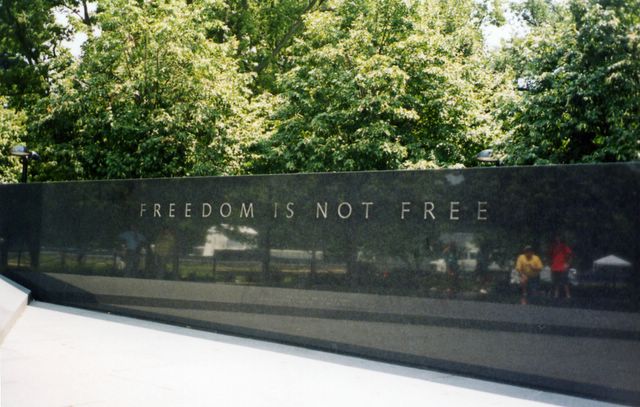
Freedom is not free.
Thank a veteran.
Say a prayer for and honor those who gave all.

[Worth visiting are One Marine's View, Byrd, and Blackfive--keep scrolling down for many posts on Memorial Day--just to name a few.]

The Price of Freedom: Some Gave All
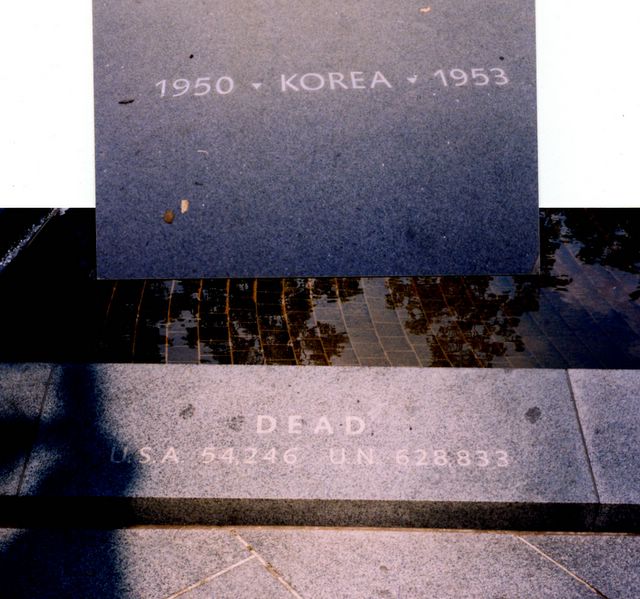
US troops killed in action: 54, 246
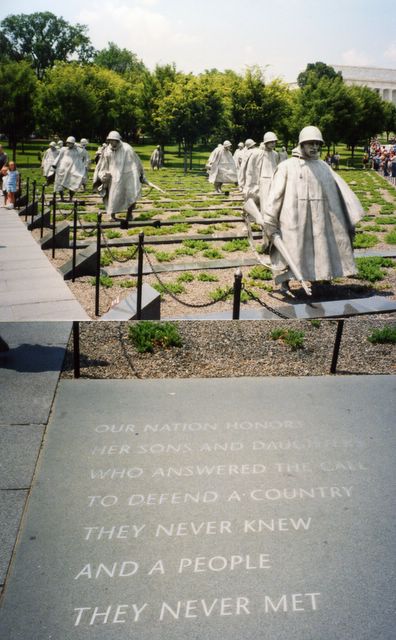
... for a country they did not know and a people they never met.
All gave some. Some gave ALL.
Saturday, May 20, 2006
Getting Married
I hear my Beloved. See how he comes leaping on the mountains, bounding over the hills. My Beloved is like a gazelle, like a young stag. See where he stands behind our wall. He looks in at the window, he peers through the lattice. My Beloved lifts up his voice, he says to me, 'Come then, my love, my lovely one, come. My dove, hiding in the clefts of the rock. In the coverts of the cliff, show me your face, let me hear your voice; for your voice is sweetand your face is beautiful. 'My beloved is mine and I am his. Set me like a seal on your heart, like a seal on your arm. For love is strong as Death, jealousy relentless as Sheol. The flash of it is a flash of fire, a flame of the Lord himself. Love no flood can quench, no torrents drown.
--Song of Songs 2:8-10.14.16; 8:6-7

On the evening of their marriage, Tobias said to Sarah, `You and I must pray and petition our Lord to win his grace and protection.' They began praying for protection, and this was how he began:'You are blessed, O God of our fathers; blessed, too, is your name for ever and ever. Let the heavens bless you and all things you have made for evermore. It was you who created Adam, you who created Eve his wife to be his help and support; and from these two the human race was born. It was you who said, "It is not good that the man should be alone; let us make him a helpmate like himself." And so I do not take my sister for any lustful motive; I do it in singleness of heart. Be kind enough to have pity on her and on me and bring us to old age together.' And together they said, `Amen, Amen'.
--Tobit 8:4-8
The time is approaching. Today, in fact: Saturday, May 20. Keep us in your prayers.
Tuesday, May 16, 2006
Killing, Murder, 5th Commandment, & Biblical Teaching: Continuing a Discussion
Is all killing wrong? Is any deliberate killing ever justified? Can a Christian or even a Jewish believer justifiably hold to the fifth commandment (or sixth for Jews) and also support any type of killing? What does the fifth commandment really say?
I have been involved in a good exchange over at Against the Grain. Though the original post is titled "Fr. Sirico, The Zwicks, and the Compendium of the Social Doctrine of the Church," the dialogue in the comments section has turned to all sorts of somewhat--or perhaps I should say "somehow"--related issues.
You can read the comments here and continue the discussion on this blog in the comment section below.
I have been involved in a good exchange over at Against the Grain. Though the original post is titled "Fr. Sirico, The Zwicks, and the Compendium of the Social Doctrine of the Church," the dialogue in the comments section has turned to all sorts of somewhat--or perhaps I should say "somehow"--related issues.
You can read the comments here and continue the discussion on this blog in the comment section below.
Friday, May 12, 2006
Watching United 93
I just finished watching United 93 with my daughter. She was fine. No fits. No uncontrollable emotional outbursts. In other words, no trauma like some of the pundits forecasted and hyped.
In fact, she was interested and attentive throughout. Asking questions at times and at the end. It gave me a good opportunity to explain some things, such as the nature of the enemy we are fighting in some parts of the world--most notably, not here on our land--airline safety, and the different forms or versions of Islam: both the peaceful or at least non-threatening Muslims and the extreme Islamists (the fascistic terrorist-minded Muslims who seek the end of the Western Judeo-Christian and secular humanist ways).
Teenage and older children in particular should see this film. If the younger teens have nightmares, comfort them. But young Americans need to know the nature of whom we are fighting. If they are attending a typical American high school or college, they probably don't know.
That said, you should see the movie and get others to see it too.
A point Dennis made this week is that if large numbers are not seeing this movie, then what message is that sending to the movie industry: not to make movies that highlight or dramatize the struggle, the war, we are in? not to make movies that inspire Americans to greater patriotism? not to make movies that promote and respectfully portray modern-day American heroes?
Is that what you want?
I hope not.
Go see the movie.
If that is not enough, read "All Americans must see 'United 93,'" Dennis Prager's column wherein he calls on all of us to
go and see "United 93," to see why some Americans still take "Home of the brave" seriously; and to see why we have to win this war more than any since World War II. That's how bad our enemy is. You have an unfortunately rare chance to see that enemy at work when you see what happened to everyone who boarded United Airlines Flight 93 that left Newark on September 11, 2001.
Then go and read this collection of excerpts of essays/articles/posts on the film: "Flight 93: Remembering Heroes."
Subscribe to:
Posts (Atom)
