Get the book."The kind of life that incorporates intelligence clarifies what life is. We are, therefore, special, after all, in the way we are 'selves.' These are all issues in the philosophy of being. There is no such thing as epistemology separated from metaphysics." -- Robert Sokolowski [1]
[...]
The book is nothing less than a masterpiece of philosophical clarity and depth of understanding. The book draws on a lifetime devoted to teaching, writing, conversing, and meditating on the great issues and minds--Plato, Aristotle, Augustine, Aquinas, Machiavelli, Hobbes, and particularly Edmund Husserl, though not neglecting the moderns before and after him. The great questions are asked: "How do we know?" "What is it we know?" "Why do we know?"
Sokolowski does not think that the task of the philosopher is only to ask questions but also to give as clear and basic, yes, as truthful an answer to them as possible. The purpose of philosophy, as he often says, is to "make distinctions" whereby we can finally understand what is. Fully to understand something is to know its truth. It is also to speak this same truth to others, to listen to others speaking of it. All the while we know that we are not gods. The gods know the truth; we human beings only seek it, love it. But our seeking is not a form of skepticism that denies any possibility of knowing anything. Rather it is a step by step verification of what we do know. Our ignorance comes from too much light, not from no light at all. "Truth is the conformity of the mind with reality," as Aquinas often said. This book explains this sentence.
[...]
On finishing this remarkable book, my judicious advice to all past and present students of philosophy, or theology, or any thing else for that matter, is simply to drop everything. Read this book! It is a free education in everything you ever wanted to know but never found out where to go to find it. Indeed, it is an education in what you wanted to know even if you did not know you wanted to know it. This book comes as close as any that I know to putting everything together in a concise, intelligible way.
[...]
If there is any one problem with which the book is most concerned, it is the so-called epistemological problem. That is, how is it that we can know reality and not our own "image" of reality? How is it that we know that we know and at the same time know that what we know really exists? Sokolowski is at pains to show where this epistemological problem came from in the history of philosophy. He presents a careful thesis about how one is to explain what a philosopher wants to articulate but, in the process, often ends up making things worse. The way we know "things" and not "representations" of things is in some ways the most fundamental problem of particularly modern philosophy.
[...]
Yet, it is a surprise. It is this "surprise" that each of us is, in our very being, an "agent," that is, an actor in the world that we did not cause to be. Truth, Aquinas said, exists in the "mind." But it is in the mind affirming what is there, what is not in its own mind. Something is there besides ourselves, but we can know it and in knowing it, also know our own knowing and its ways. But knowing involves truth. We all must begin here. This is what Sokolowski's penetrating book is about. This is a book of our time, a time that needs to know that it can know the truth—and that it can also lie to itself if it doesn't.
Ours is a time that needs to know that time is itself under the sway of being, of the metaphysics that begins in wonder and seeks to know the why of things, including the things of itself and those with whom it converses. The human person is an "agent of truth." This is what we are. Something "new" is at the "margin of the world." The something new is indeed "me" who, with all who come to be in their time, stands at the world's "edge" affirming, as Plato said, of what is that it is, of what is not, that it is not. The world itself cannot do this for itself. It needs an "agent of truth" within it.
Sunday, June 22, 2008
Finally! Schall on Sokolowski's latest : Phenomenology of the Human Person


Friday, June 20, 2008
Laffer and JFK : The Wonders of the Market
Economist Arthur Laffer to graduates of Mercer University:
Pursuing your dream of prospering will benefit everyone . . . When I graduated from Yale University, we had a serious commencement speaker not like the one you are stuck with today. The commencement speaker was President John F. Kennedy. And the point I'm making today is the same point he made all those years ago. He said, "No American is ever made better off by pulling a fellow American down, and all of us are made better off whenever any one of us is made better off." He concluded by using the analogy that "a rising tide raises all boats."
Never forget or be ashamed of the fact that pursuing your own self interest furthers everyone's interest. Without you, the poor would be poorer.
Thursday, June 19, 2008
Don't Like Being Grounded? Sue Your Father
A 12-year-old Quebec girl who felt so strongly about her end-of-year school trip that she took her father to court after he forbade her from going is at the centre of a case that challenges the authority of parental discipline.
The dispute between father and daughter began when he cut off her Internet access over her misuse. When she continued to find a way to use the Internet, he told his daughter she couldn't go on the three-day school trip.
The girl's mother allowed her to go on the trip, but because the school wouldn't allow the girl to go unless both parents consented, the girl, with the mother's support took legal action against her father.
According to Ms. Beaudoin, the judge ruled that denying the trip was unduly severe punishment.The father, who is appealing the decision, was "devastated" by the ruling, and is refusing to take his daughter back "because he has no authority over her."
Monday, June 16, 2008
The War in Iraq : Bush Did Not Lie
"Bush never lied to us about Iraq"
Touring Vietnam in 1965, Michigan Gov. George Romney proclaimed American involvement there "morally right and necessary." Two years later, however, Romney -- then seeking the Republican presidential nomination -- not only recanted his support for the war but claimed that he had been hoodwinked."When I came back from Vietnam, I had just had the greatest brainwashing that anybody can get," Romney told a Detroit TV reporter who asked the candidate how he reconciled his shifting views.
Romney (father of Mitt) had visited Vietnam with nine other governors, all of whom denied that they had been duped by their government. With this one remark, his presidential hopes were dashed.
The memory of this gaffe reverberates in the contemporary rhetoric of many Democrats, who, when attacking the Bush administration's case for war against Saddam Hussein, employ essentially the same argument. In 2006, John F. Kerry explained the Senate's 77-23 passage of the Iraq war resolution this way: "We were misled. We were given evidence that was not true." On the campaign trail, Hillary Rodham Clinton dodged blame for her pro-war vote by claiming that "the mistakes were made by this president, who misled this country and this Congress."
Nearly every prominent Democrat in the country has repeated some version of this charge, and the notion that the Bush administration deceived the American people has become the accepted narrative of how we went to war.
Yet in spite of all the accusations of White House "manipulation" -- that it pressured intelligence analysts into connecting Hussein and Al Qaeda and concocted evidence about weapons of mass destruction -- administration critics continually demonstrate an inability to distinguish making claims based on flawed intelligence from knowingly propagating falsehoods.
In 2004, the Senate Intelligence Committee unanimously approved a report acknowledging that it "did not find any evidence that administration officials attempted to coerce, influence or pressure analysts to change their judgments." The following year, the bipartisan Robb-Silberman report similarly found "no indication that the intelligence community distorted the evidence regarding Iraq's weapons of mass destruction."
Contrast those conclusions with the Senate Intelligence Committee report issued June 5, the production of which excluded Republican staffers and which only two GOP senators endorsed. In a news release announcing the report, committee Chairman John D. Rockefeller IV got in this familiar shot: "Sadly, the Bush administration led the nation into war under false pretenses."
Yet Rockefeller's highly partisan report does not substantiate its most explosive claims. Rockefeller, for instance, charges that "top administration officials made repeated statements that falsely linked Iraq and Al Qaeda as a single threat and insinuated that Iraq played a role in 9/11." Yet what did his report actually find? That Iraq-Al Qaeda links were "substantiated by intelligence information." The same goes for claims about Hussein's possession of biological and chemical weapons, as well as his alleged operation of a nuclear weapons program.
Four years on from the first Senate Intelligence Committee report, war critics, old and newfangled, still don't get that a lie is an act of deliberate, not unwitting, deception. If Democrats wish to contend they were "misled" into war, they should vent their spleen at the CIA.
In 2003, top Senate Democrats -- not just Rockefeller but also Carl Levin, Clinton, Kerry and others -- sounded just as alarmist. Conveniently, this month's report, titled "Whether Public Statements Regarding Iraq by U.S. Government Officials Were Substantiated by Intelligence Information," includes only statements by the executive branch. Had it scrutinized public statements of Democrats on the Intelligence, Foreign Relations and Armed Services committees -- who have access to the same intelligence information as the president and his chief advisors -- many senators would be unable to distinguish their own words from what they today characterize as warmongering.
This may sound like ancient history, but it matters. After Sept. 11, President Bush did not want to risk allowing Hussein, who had twice invaded neighboring nations, murdered more than 1 million Iraqis and stood in violation of 16 U.N. Security Council resolutions, to remain in possession of what he believed were stocks of chemical and biological warheads and a nuclear weapons program. By glossing over this history, the Democrats' lies-led-to-war narrative provides false comfort in a world of significant dangers.
"I no longer believe that it was necessary for us to get involved in South Vietnam to stop communist aggression in Southeast Asia," Romney elaborated in that infamous 1967 interview. That was an intellectually justifiable view then, just as it is intellectually justifiable for erstwhile Iraq war supporters to say -- given the way it's turned out -- that they don't think the effort has been worth it. But predicating such a reversal on the unsubstantiated allegation that one was lied to is cowardly and dishonest.
A journalist who accompanied Romney on his 1965 foray to Vietnam remarked that if the governor had indeed been brainwashed, it was not because of American propaganda but because he had "brought so light a load to the laundromat." Given the similarity between Romney's explanation and the protestations of Democrats 40 years later, one wonders why the news media aren't saying the same thing today.
Thursday, June 12, 2008
Fr. Norris Clarke, SJ ... RIP
Fordham University has a page for people to comment.
Friday, June 06, 2008
D-Day : Honoring "the Boys of Pointe du Hoc"
"Remarks at the U.S. Ranger Monument"
Pointe du Hoc, France
June 6, 1984
Worth viewing, especially today: "President Ronald Reagan's Speech at Point-du-Hoc, Normandy"
Monday, May 26, 2008
Memorial Day
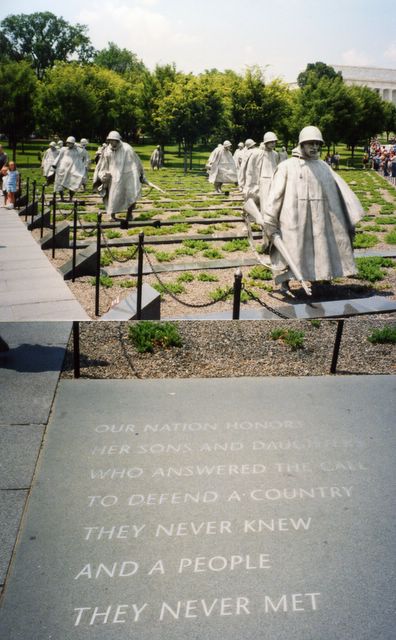
"OUR NATION HONORS
HER SONS AND DAUGHTERS
WHO ANSWERED THE CALL
TO DEFEND A COUNTRY
THEY NEVER KNEW
AND A PEOPLE
THEY NEVER MET."
KOREAN WAR MEMORIAL

Memorial Day : The Price of Freedom: Some Gave All
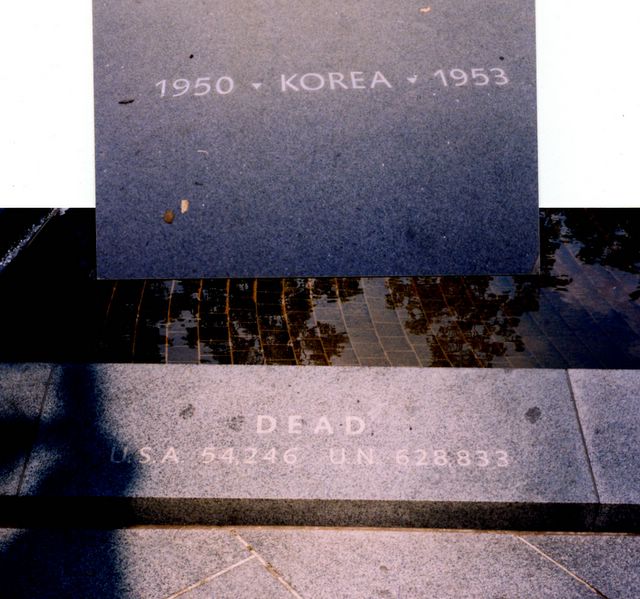
US troops killed in action: 54, 246
... for a country they did not know and a people they never met.
All gave some. Some gave ALL.
Memorial Day : Wall of Freedom
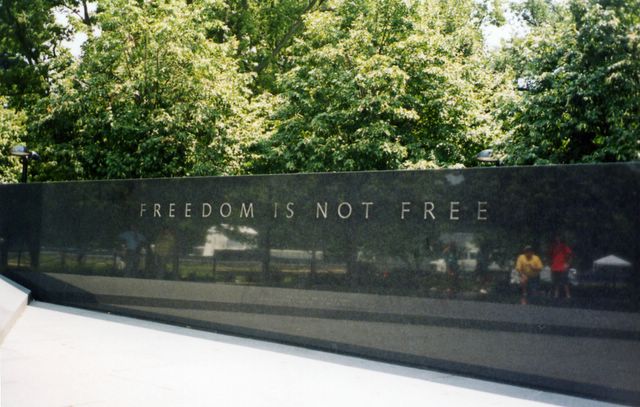
Freedom is not free.
Thank a veteran.
Say a prayer for and honor those who gave all.
[Worth visiting are One Marine's View, Byrd, and Blackfive--keep scrolling down for many posts on Memorial Day--just to name a few.]
Memorial Day : Not Gone, Still Living in Hearts They Leave Behind

This poem reminds us to keep alive the brave men and women who have given the gift of their lives so we could be free. Keep them alive in our hearts as they softly walk in our thoughts.
THEY SOFTLY WALK
By Hugh Robert Orr
They are not gone who pass
Beyond the clasp of hand,
Out from the stone embrace.
They are but come so close
We need not grope with hands,
Nor look to see, nor try
To catch the sound of feet.
They have put off their shoes
Softly to walk by day
Within our thoughts, to tread
At night our dream-led paths
Of sleep.
They are not lost who find
The sunset gate, the goal
Of all their faithful years.
Not lost are they who reach
The summit of their climb,
The peak above the clouds
And storms. They are not lost
Who find the light of sun
And stars and God.
They are not dead who live
In hearts they leave behind.
In those whom they have blessed
They live a life again,
And shall live through the years
Eternal life, and grow
Each day more beautiful
As time declares their good,
Forgets the rest, and proves
Their immortality.
Memorial Day : Remembering Freedom's Defenders
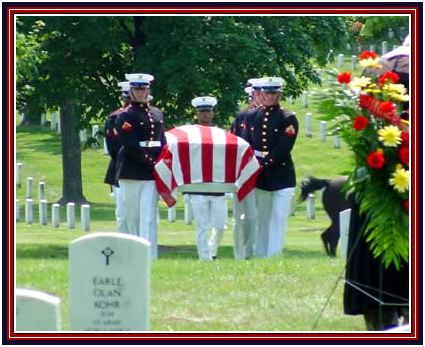
Memorial Day. It is important to remember (each day and not just on the "holiday") the sacrifice many have made in defense of this country, our freedom, and the protection and security of those throughout the world who have not been able to defend themselves sufficiently.
Freedom Is Not Free
By LCDR Kelly Strong, USCG - Copyright 1981
I watched the flag pass by one day,
It fluttered in the breeze.
A young Service man saluted it,
And then he stood at ease.
I looked at him in uniform
So young, so tall, so proud,
With hair cut square and eyes alert
He'd stand out in any crowd.
I thought how many men like him
Had fallen through the years.
How many died on foreign soil
How many mothers' tears?
How many pilots' planes shot down?
How many died at sea
How many foxholes were soldiers' graves?
No, freedom isn't free.
I heard the sound of Taps one night,
When everything was still,
I listened to the bugler play
And felt a sudden chill.
I wondered just how many times
That Taps had meant "Amen,"
When a flag had draped a coffin.
Of a brother or a friend.
I thought of all the children,
Of the mothers and the wives,
Of fathers, sons and husbands
With interrupted lives.
I thought about a graveyard
At the bottom of the sea
Of unmarked graves in Arlington.
No, freedom isn't free.
Memorial Day : The American Flag

--Henry Ward Beecher from " The American Flag"
Memorial Day : Honoring the Sacrifice of Heroes

Let me not mourn for men who have died fighting,
but rather let me be glad that such heroes have lived.
Saturday, May 24, 2008
John Hagee : The Truth Will Out ... We Hope
It is worth listening to Dennis Prager on this issue. He sheds quite a bit of light and truth on the matter.
Thursday, May 15, 2008
Climate Change Truths?
And then this:Watch the web for climate change truths
by Christopher Booker
[...]
On April 24 the World Wildife Fund (WWF), another body keen to keep the warmist flag flying, published a study warning that Arctic sea ice was melting so fast that it may soon reach a "tipping point" where "irreversible change" takes place. This was based on last September's data, showing ice cover having shrunk over six months from 13 million square kilometres to just 3 million.What the WWF omitted to mention was that by March the ice had recovered to 14 million sq km (see the website Cryosphere Today), and that ice-cover around the Bering Strait and Alaska that month was at its highest level ever recorded. (At the same time Antarctic sea ice-cover was also at its highest-ever level, 30 per cent above normal).
The most dramatic evidence, however, emerged last week with an announcement by Nasa's Jet Propulsion Laboratory that an immense slow-cycling movement of water in the Pacific, known as the Pacific Decadal Oscillation (PDO), had unexpectedly shifted into its cool phase, something which only happens every 30 years or so, ultimately affecting climate all over the globe.
[...]
It is notable that the German computer predictions published last week by Nature forecast a decade of cooling due to deep-ocean movements in the Atlantic, without taking account of how this may now be reinforced by a similar, even greater movement in the Pacific.
Mr Watts points out that the West coast of the USA might already be experiencing these effects in the recent freezing temperatures that have devastated orchards and vineyards in California, prompting an appeal for disaster relief for growers who fear they may have lost this year's crops.
On one hand our politicians are committing us to spending unimaginable sums on wind farms, emissions trading schemes, absurdly ambitious biofuel targets, and every kind of tax and regulation designed to reduce our "carbon footprint" - all based on blindly accepting the predictions of computer models that the planet is overheating due to our output of greenhouse gases.
On the other hand, a growing number of scientists are producing ever more evidence to show how those computer models are based on wholly inadequate data and assumptions - as is being confirmed by the behaviour of nature itself (not least the continuing non-arrival of sunspot cycle 24).
The fact is that what has been happening to the world's climate in recent years, since global temperatures ceased to rise after 1998, was not predicted by any of those officially-sponsored models. The discrepancy between their predictions and observable data becomes more glaring with every month that passes.
Sunday, May 11, 2008
To Be a Mother
on earth is a mother.
having built Notre Dame Cathedral.
than any other creature;
performing this act of creation…
Friday, May 09, 2008
Obama and My Hope
One can hope.Obama’s style of being all things to all people threatens to melt under the inescapable spotlight of a national campaign against a Republican. It’s like what brings on the downfall of really successful con artists: They get themselves onto a stage that’s so big that they can’t hide their contradictions anymore, and everyone finds out about the different stories they’ve told different people. And Obama’s belonging to Wright’s church in the first place was quite likely part of establishing a South Side bourgeois nationalist street cred because his political base was with Hyde Park/University of Chicago liberals and the foundation world.
[...]
Because he’s tried carefully to say enough of whatever the audiences he’s been speaking to at the time want to hear while leaving himself enough space later on to deny his intentions to leave that impression, his record represents precisely the “character” weakness the Republicans have exploited in every Democratic candidate since Dukakis: Another Dem trying to put things over on the American people.Obama’s campaign has been very clever in carving out a strategy to amass Democratic delegate votes, but its momentum is in some ways a Potemkin construction—built largely on victories in states that no Democrat will win in November—that will fall apart under Republican pressure.
Wednesday, April 30, 2008
Atheist Pro-Lifer : Hentoff on Obama
(H/t: FirstThings)I am a nonreligious pro-lifer, my only religion being the Constitution.
[...]
But on abortion, Mr. Obama is an extremist. He has opposed the Supreme Court decision that finally upheld the Partial-Birth Abortion Ban Act against that form of infanticide. Most startlingly, for a professed humanist, Mr. Obama in the Illinois Senate also voted against the Born Alive Infant Protection Act. I have reported on several of those cases, when, before the abortion was completed, an alive infant was suddenly in the room. It was disposed of as a horrified nurse who was not necessarily pro-life followed the doctors' orders to put the baby in a pail or otherwise get rid of the child.
Saturday, April 19, 2008
Cabotte and Ciacci
 And for an even better choice (though it requires a few more $), I suggest this Rosso di Montalcino from Ciacci:
 Here is one review on the Rosso:
Both have been very tasty ... or I should say were tasty.It's such a beauty, this Rosso di Montalcino from the old and respected Ciacci Piccolomini d'Aragona estate, which holds some of the best vineyards in the Brunello di Montalcino appellation. A baby Brunello, 100% Sangiovese Grosso, it's a gorgeous ruby red, laced with flavors of dark cherries, sweet spices and a light touch of oak. It's racy and full of life, let loose on the world a year or so after the vintage while its more restrained elder brother, Brunello di Montalcino, has to wait a full 50 months. This is the wine to drink with bistecca alla Fiorentina (a char-grilled, 2-inch-thick T-bone), or a bowl of earthy pasta fagioli. It would be terrific with sausages or a mixed grill, and with heartier pasta dishes too.
Thursday, April 17, 2008
Intellectual Charity and a Memory
How might Christian educators respond? [...]
[With] what we might call "intellectual charity". This aspect of charity calls the educator to recognize that the profound responsibility to lead the young to truth is nothing less than an act of love. Indeed, the dignity of education lies in fostering the true perfection and happiness of those to be educ ated. In practice "intellectual charity" upholds the essential unity of knowledge against the fragmentation which ensues when reason is detached from the pursuit of truth. It guides the young towards the deep satisfaction of exercising freedom in relation to truth, and it strives to articulate the relationship between faith and all aspects of family and civic life. Once their passion for the fullness and unity of truth has been awakened, young people will surely relish the discovery that the question of what they can know opens up the vast adventure of what they ought to do. Here they will experience "in what" and "in whom" it is possible to hope, and be inspired to contribute to society in a way that engenders hope in others.
Wednesday, April 16, 2008
Music, Mozart, and Awaiting Another Thing
In music, in the panorama of nature, in dreams at night, it is something else that man pays homage to, from which he expects something; he awaits it. His enthusiasm is for something that music, or everything that is beautiful in this world, has awakened within him. When a person begins to feel this, his soul immediately harkens to await the other thing, even in the presence of what he can grasp, but he awaits another thing.
Tuesday, April 15, 2008
The Latest ... and the Wounds of Beauty
Wounded, indeed.The encounter with the beautiful can become the wound of the arrow that strikes the heart and in this way opens our eyes, so that later, from this experience, we take the criteria for judgment and can correctly evaluate the arguments.
Sunday, February 03, 2008
Preparing for Lent
Fr. Schall, SJ, on Spe Salvi
Q: In paragraph 15 of "Spe Salvi," there is a rich comparison of a monastery and a soul. What is the Holy Father trying to illustrate through the use of this imagery?"
Father Schall: A passage of Josef Pieper, originally based in Aquinas, if not in Aristotle and Plato, addresses this same question. The passage is found in "Josef Pieper -- an Anthology," called "The Purpose of Politics." It is only a couple of paragraphs long. I always point students to it as the most central of all passages about politics and political philosophy. It basically says both that you cannot understand politics without understanding the transcendent order, and that you cannot have a healthy society in which there is only politics.
Pieper writes, quoting St. Thomas Aquinas: "'It is requisite for the good of the human community that there should be persons who devote themselves to the life of contemplation.' For it is contemplation which preserves in the midst of human society the truth which is at one and the same time useless and the yardstick of every possible use; so it is also contemplation which keeps the true end insight, gives meaning to every practical act of life" ("An Anthology," 123). This passage is also behind much of what the Pope writes on natural law as the yardstick and measure of human actions.
One can state the issue succinctly: No political order can be itself healthy unless it has within it those who are not devoted to politics. This is not in any way a denial that politics are important, but it is a denial that they are the most important things in a society. Indeed, a society that makes politics the most important thing is already a totalitarian society, as Aristotle had already implied.
When the Pope treats this issue in "Spe Salvi," he refers to the monastic tradition and to Augustine. The Pope is careful to relate how this contemplative life is not opposed to any proper understanding of the temporal life of this world. He is even attentive to the relation of work to contemplation. Indeed, the elevation of work to a dignity and not a slavery or oppression had to do with the Benedictine notion of "pray and work."
The Pope cites a certain pseudo-Rufinus who says basically what Pieper did: "The human race lives thanks to a few: Were it not for them the world would perish." This is a remarkable statement indeed. It not only shows the absolute need of someone who constantly within society shows others that there is something more than this world, but it shows the importance of contemplation itself in keeping our mind straight.
The delicate relation of will and mind is a central drama of philosophy and revelation. This is why it has always been said that the great disorders of soul, as well as the great movements for good, begin in the heart of the dons, academic and religious, long before they appear in the public order. Again this is what "immenantize the eschaton" means.
Monday, January 28, 2008
St Thomas Aquinas : The Dumb Ox
From a conference by Saint Thomas Aquinas, priest
The Cross exemplifies every virtue
Why did the Son of God have to suffer for us? There was a great need, and it can be considered in a twofold way: in the first place, as a remedy for sin, and secondly, as an example of how to act. It is a remedy, for, in the face of all the evils which we incur on account of our sins, we have found relief through the passion of Christ. Yet, it is no less an example, for the passion of Christ completely suffices to fashion our lives. Whoever wishes to live perfectly should do nothing but disdain what Christ disdained on the cross and desire what he desired, for the cross exemplifies every virtue.If you seek the example of love: Greater love than this no man has, than to lay down his life for his friends. Such a man was Christ on the cross. And if he gave his life for us, then it should not be difficult to bear whatever hardships arise for his sake. If you seek patience, you will find no better example than the cross. Great patience occurs in two ways: either when one patiently suffers much, or when one suffers things which one is able to avoid and yet does not avoid. Christ endured much on the cross, and did so patiently, because when he suffered he did not threaten; he was led like a sheep to the slaughter and he did not open his mouth. Therefore Christ’s patience on the cross was great. In patience let us run for the prize set before us, looking upon Jesus, the author and perfecter of our faith who, for the joy set before him, bore his cross and despised the shame. If you seek an example of humility, look upon the crucified one, for God wished to be judged by Pontius Pilate and to die.If you seek an example of obedience, follow him who became obedient to the Father even unto death. For just as by the disobedience of one man, namely, Adam, many were made sinners, so by the obedience of one man, many were made righteous.If you seek an example of despising earthly things, follow him who is the King of kings and the Lord of lords, in whom are hidden all the treasures of wisdom and knowledge. Upon the cross he was stripped, mocked, spat upon, struck, crowned with thorns, and given only vinegar and gall to drink. Do not be attached, therefore, to clothing and riches, because they divided my garments among themselves. Nor to honours, for he experienced harsh words and scourgings. Nor to greatness of rank, for weaving a crown of thorns they placed it on my head. Nor to anything delightful, for in my thirst they gave me vinegar to drink.
St Thomas Aquinas and Santa Claus
Demonstration of God's Existence
I answer that, The existence of God can be proved in five ways.
The first and more manifest way is the argument from motion. It is certain, and evident to our senses, that in the world some things are in motion. Now whatever is in motion is put in motion by another, for nothing can be in motion except it is in potentiality to that towards which it is in motion; whereas a thing moves inasmuch as it is in act. For motion is nothing else than the reduction of something from potentiality to actuality. But nothing can be reduced from potentiality to actuality, except by something in a state of actuality. Thus that which is actually hot, as fire, makes wood, which is potentially hot, to be actually hot, and thereby moves and changes it. Now it is not possible that the same thing should be at once in actuality and potentiality in the same respect, but only in different respects. For what is actually hot cannot simultaneously be potentially hot; but it is simultaneously potentially cold. It is therefore impossible that in the same respect and in the same way a thing should be both mover and moved, i.e. that it should move itself. Therefore, whatever is in motion must be put in motion by another. If that by which it is put in motion be itself put in motion, then this also must needs be put in motion by another, and that by another again. But this cannot go on to infinity, because then there would be no first mover, and, consequently, no other mover; seeing that subsequent movers move only inasmuch as they are put in motion by the first mover; as the staff moves only because it is put in motion by the hand. Therefore it is necessary to arrive at a first mover, put in motion by no other; and this everyone understands to be God.
The second way is from the nature of the efficient cause. In the world of sense we find there is an order of efficient causes. There is no case known (neither is it, indeed, possible) in which a thing is found to be the efficient cause of itself; for so it would be prior to itself, which is impossible. Now in efficient causes it is not possible to go on to infinity, because in all efficient causes following in order, the first is the cause of the intermediate cause, and the intermediate is the cause of the ultimate cause, whether the intermediate cause be several, or only one. Now to take away the cause is to take away the effect. Therefore, if there be no first cause among efficient causes, there will be no ultimate, nor any intermediate cause. But if in efficient causes it is possible to go on to infinity, there will be no first efficient cause, neither will there be an ultimate effect, nor any intermediate efficient causes; all of which is plainly false. Therefore it is necessary to admit a first efficient cause, to which everyone gives the name of God.
The third way is taken from possibility and necessity, and runs thus. We find in nature things that are possible to be and not to be, since they are found to be generated, and to corrupt, and consequently, they are possible to be and not to be. But it is impossible for these always to exist, for that which is possible not to be at some time is not. Therefore, if everything is possible not to be, then at one time there could have been nothing in existence. Now if this were true, even now there would be nothing in existence, because that which does not exist only begins to exist by something already existing. Therefore, if at one time nothing was in existence, it would have been impossible for anything to have begun to exist; and thus even now nothing would be in existence--which is absurd. Therefore, not all beings are merely possible, but there must exist something the existence of which is necessary. But every necessary thing either has its necessity caused by another, or not. Now it is impossible to go on to infinity in necessary things which have their necessity caused by another, as has been already proved in regard to efficient causes. Therefore we cannot but postulate the existence of some being having of itself its own necessity, and not receiving it from another, but rather causing in others their necessity. This all men speak of as God.
The fourth way is taken from the gradation to be found in things. Among beings there are some more and some less good, true, noble and the like. But "more" and "less" are predicated of different things, according as they resemble in their different ways something which is the maximum, as a thing is said to be hotter according as it more nearly resembles that which is hottest; so that there is something which is truest, something best, something noblest and, consequently, something which is uttermost being; for those things that are greatest in truth are greatest in being, as it is written in Metaph. ii. Now the maximum in any genus is the cause of all in that genus; as fire, which is the maximum heat, is the cause of all hot things. Therefore there must also be something which is to all beings the cause of their being, goodness, and every other perfection; and this we call God.
The fifth way is taken from the governance of the world. We see that things which lack intelligence, such as natural bodies, act for an end, and this is evident from their acting always, or nearly always, in the same way, so as to obtain the best result. Hence it is plain that not fortuitously, but designedly, do they achieve their end. Now whatever lacks intelligence cannot move towards an end, unless it be directed by some being endowed with knowledge and intelligence; as the arrow is shot to its mark by the archer. Therefore some intelligent being exists by whom all natural things are directed to their end; and this being we call God.
(Summa Theologica, I, q. 2, art. 3)
Here is a spoof, of sorts:
THE FIVE WAYS OF PROVING SANTA CLAUS*
(from Joseph Magee's Thomistic Humor Page)
Whether Santa Clause Exists
We proceed thus to the third article:
Objections
It seems that Santa Claus does not exist; because Christmas gifts are able to be given by good elves. Therefore, Santa Claus does not exist.
Further, if Santa Claus did exist, there would be no narrow chimneys. But there are narrow chimneys, and sometimes there are no chimneys at all. Therefore, Santa Claus does not exist.
On the contrary, Kay Starr says: "I saw Mommy kissing Santa Claus underneath the mistletoe last night."
I answer that, The existence of Santa Claus Can be proved in five ways.
The first and most manifest way is that taken from Christmas trees. It is certain and evident to our senses, that in the world some things are Christmas trees. Now no pine tree becomes a Christmas tree unless it is trimmed. Now to be trimmed means to receive ornaments from another. But this cannot go on to infinity in the trimming of Christmas trees. One must come to some first untrimmed trimmer; and this everyone understands to be Santa Claus.
The second way is from the nature of Christmas gifts. We see that in the world that Christmas gifts are given and received. Whoever, then, gives Christmas gifts either receives them from another or makes them in his workshop. If, however, no one makes Christmas gifts in his workshop, they are not given nor received. Therefore it is necessary to posit some first giver of Christmas gifts, who everyone calls Santa Claus.
The third way is taken from plastic images resembling Santa Claus. At all stores we see things of plastic that represent Santa Claus. These things are of such a quality that they are representations according to Santa himself or according to other images of him. But, it is not possible to proceed to infinity in images. Therefore, it is necessary to posit something which is resembling Santa Claus and hence Santa Claus exists.
The fourth way is taken from the grades which are found in Christmas spirit. Indeed, in this world, among men there are some of more and some of less Christmas spirit. But "more" and "less" is said of diverse things according as they resemble in their diverse ways something which is the "maximum." Therefore there must be something which has the most Christmas spirit, and this we call Santa Claus.
The fifth way is taken from the behavior of children. When Christmas day approaches, we see from their being good always or frequently that children, who lack understanding, are moved because of an end. But children would not be good because of the Nativity of Christ unless there were someone who strengthened them so that they were good. And this someone is known by all to be Santa Claus.
Replies to Objections:
Good elves, since they receive Christmas gifts from another, should be named the highest helpers of Santa.
It is not impossible that Santa Claus should use the door like everyone else.
NOTE
* Also known in various places under the name of Saint Nicholas, Father Christmas, etc.
Sunday, January 27, 2008
Cardinal Mahony Leaving Los Angeles ? Not Exactly
NOMINA DI MEMBRI DELLA CONGREGAZIONE PER LE CHIESE ORIENTALI
Il Papa ha nominato Membri della Congregazione per le Chiese Orientali gli Em.mi Cardinali Roger Michael Mahony e Edward Michael Egan.
NOMINATION OF MEMBERS OF THE CONGREGATION FOR ORIENTAL [EASTERN] CHURCHES
The Pope has named as Members of the Congregation for the Oriental Churches ... Cardinals Roger Michael Mahony and Edward Michael Egan.
Monday, January 21, 2008
MLK Day and Roe v. Wade Thoughts
Language and Liberty
This country recently commemorated two events: Martin Luther King, Jr. Day and the ... anniversary of Roe v. Wade. They are related by similar concerns: freedom and equality for all. Recalling the former sheds some light on the latter.
The fundamental source of King’s message is “the moral law or the law of God.” This law binds all humans in granting liberty and demanding justice. As history has shown, unfortunately, man-made law does not always conform to this greater and higher law. When a law, as Rev. King put it, is “out of harmony” with the universal law, it is an “unjust law” and thus no law at all. During the American experience, there have been many unjust laws. In fact, this country was founded in response to unjust laws.
Rooting himself in a tradition that incorporates America’s Founding Fathers, King suggested a response: disobedience. However, the disobedience of King is not a license to do anything. It is a morally-superior response to grave injustice. He writes, “One who breaks an unjust law must do it openly, lovingly, and with a willingness to accept the penalty. I submit that an individual who breaks a law that conscience tells him is unjust, and willingly accepts the penalty by staying in jail to arouse the conscience of the community over its injustice, is in reality expressing the very highest respect for law.”
This disobedience of King is his extremism. It is a truly morally-uplifting extremism. For King, the question “is not whether we will be extremists, but what kind of extremist will we be.” This sense of action rooted in justice harkens back to the abolitionists of the mid-1800s. “I will be as harsh as truth,” David Walker wrote in 1831, “and as uncompromising as justice.” Faced with the great deprivation of rights in the battle against slavery, Walker continued to voice his commitment to endure and persevere against any and all injustice, “On this subject [of slavery] I do not wish to think, or speak, or write with moderation....I am in earnest—I will not equivocate –I will not excuse—I will not retreat a single inch—and I will be heard.” I am sure King felt the same sentiment and passion for his cause of true justice and liberty for all.
The Declaration of Independence asserts that “all men are created equal” with the same “unalienable rights” of “life, liberty, and the pursuit of happiness.” Slavery and many laws of the early and mid-1900s were not in harmony with this truth of the Declaration and this is what King and Walker attested to.
They were arguing against a system at odds with itself. The black American was considered a “subordinate and inferior class of being,” “an article of property,” and even “not a person.” This abuse of language was the legal foundation upon which racist attitudes could translate into discrimination and acts of evil. What happened to “all men are created equal”?
The abuse of language is part of what happened. “When words lose their meaning,” Confucius once said, “peoples lose their liberty.” This is probably one of the greatest evils of man: Deny the full personhood or humanity of those we do not like and then we have the legal justification to discriminate, segregate, enslave, and even murder in mass numbers (e.g., the Holocaust).
Before being elected President, Abraham Lincoln joined in the debate over the evil of slavery: “‘A house divided against itself cannot stand.’ I believe this government cannot endure permanently half slave and half free.” He went on to later voice his concern over the abuse of language and the relative manner by which men selectively acknowledged humanity in others: “I should like to know if taking this old Declaration of Independence, which declares that all men are equal upon principle, and making exceptions to it, where will it stop. If one man says it does not mean a Negro, why not another say it does not mean some other man?”
Some other man? Yes. Today, society has found another, but this time, this “other” is a baby. The unborn baby! The humanity of the child in the womb is unquestionably affirmed by science. The zygote “results from fertilization of an oocyte by a sperm and is the beginning of a human being.” (The Developing Human: Clinically Oriented Embryology, 1) Besides, what else could the entity be? If the natural and physical source is human (the mother and father), then the result (the new life) will be human. Basic common sense. Thus, the entity in the womb who is often torn apart in an abortion is none other than a little defenseless child, the most vulnerable of all human life. What do these issues all have to do with each other, one might ask?
The answer is simple. The attempt to redefine a human person, whether it is with regard to black Americans, Jews, or even the child in the womb, is nothing but “semantic gymnastics,” as one critic (William Brennan) put it. Again, the words of Confucius reveal great wisdom, “When words lose their meaning, peoples lose their liberty.” And, I might add, their lives!
One should never forget where our rights and privileges come from. The rights to property, free speech, religion, liberty, etc. are great, but what roots them? It is the right to life. It is my right to keep and maintain my life which no one on earth has sovereignty over. Sincere and unbiased seekers of justice and liberty must acknowledge that at conception, a new human being is present. Since this new being is human, all rights predicated to a human as basic must be predicated to all humans, whether they be Black, Jewish, disabled, elderly, or even a young human in the womb. This young human being is a person with rights that must be protected. What good are all the other rights if we forego the right to life? It is the right upon which all others are rooted. Without it, the others are worthless.
Rev. King had a dream where “all men...would be guaranteed the unalienable rights of life, liberty, and the pursuit of happiness.” It is a dream where the nation’s people would “not be judged by the color of their skin but by the content of their character.” Today, we still face the test of our character. We made it through the evils of slavery and racist laws. Now, we face the test with abortion. How we treat the defenseless is a true mark of our character. With slavery and the Holocaust, this country was involved in bloody wars. The same need not happen to save the unborn child. However, true seekers of justice for all will not back down. The question is not whether we will be extremists, but what kind of extremist we will be. We do not wish to think, or speak, or write with moderation. We are in earnest. We will not equivocate. We will not excuse. We will not retreat a single inch. And we will be heard: Direct abortions are the unjust killing of innocent human beings, of little children! Life is not negotiable and neither are the passions and principles of those who truly seek liberty and justice for all, as we will be as harsh as truth and as uncompromising as justice!
Friday, January 04, 2008
Sarkozy and Spiritual Recalibration?
Sarkozy met for twenty-five minutes with Benedict XVI and the Holy See’s secretary of state. One of the first things he said to them was that the Church in France has “to be more courageous” in intervening publicly because the French Republic has need of people of faith. This was already quite daring, but he did not stop there. Remarkably, in both events, Sarkozy openly expressed his agreement with the pope’s view that a Europe without faith is a Europe without hope—and maybe without a future. And, perhaps even more notably, he made a powerful case that the present and future depend on a more inclusive embrace of the past.
He started out by reminding his listeners that [. ...] Christianity helped create France, and France helped Christianize Europe.
For him [Sarkozy], French culture should be more open to all the wisdom available in the various religious traditions of his people. He put this forward with all due respect for the nonbelievers in France but also with a breadth of spirit that made the old claims of a rigidly secularist public order as the only guarantor of liberty for all citizens look decidedly illiberal. [Emphases added.]
Thursday, January 03, 2008
Weigel Faith Reason and Jihadism
To hear an interview with the author on the book and related issues, go here.
UPDATE: Though I have a few questions about some minor points, this is a very good and comprehensive overview of what has happened, what continues to happen, and what needs to happen.
Friday, December 28, 2007

Thursday, December 27, 2007

Wednesday, December 26, 2007

[…] If the world wanted what is called a non-controversial aspect of Christianity, it would probably select Christmas. Yet it is obviously bound up with what is supposed to be a controversial aspect […]; the respect paid to the Blessed Virgin. […] You cannot chip away the statue of a mother from all round that of a new-born child. You cannot suspend the new-born child in mid-air; indeed you cannot really have a statue of a new-born child at all. Similarly, you cannot suspend the idea of a new-born child in the void or think of him without thinking of his mother. You cannot visit the child without visiting the mother; you cannot in common human life approach the child except through the mother. […] We must either leave Christ out of Christmas, or Christmas out of Christ, or we must admit, if only as we admit it in an old picture, that those holy heads are too near together for the haloes not to mingle and cross.
--G. K. Chesterton

Tuesday, December 25, 2007

Monday, December 24, 2007
Christmas 2007
-Benedict XVI

Christianity is not born as the fruit of our culture or as the discovery of our intelligence... it reveals itself in facts events, which constitute a new reality in the world, a living reality; in movement. Christian reality is God's mystery that has entered the world as a human history.
Schall on Christmas
- Belloc's The Four Men
- E.F. Schumacher's A Guide for the Perplexed
- Dorothy Sayers's The Nine Tailors and The Man Born to Be King
- Anything by P. G. Wodehouse, but especially Right Ho, Jeeves and Leave It to Psmith
- Josef Pieper's Enthusiasm and the Divine Madness
- Mad Magazine
- G. K. Chesterton's Orthodoxy
There is a difference between a "Christmas Shopping Guide" and a "Short List of What to Read for Christmas." It is said that one can "recommend" his own books! What else? My memory is hazy, but Scott Walter once told me that Belloc, in his old age, was supposed to have read nothing but "Wodehouse, the Diary of a Nobody, and his own works."Of my own works, I have a few of late that I am glad are out, to wit: On the Unseriousness of Human Affairs, Sum Total of Human Happiness, and The Order of Things.
My friend Jim Campbell recently asked me if I wanted anything from London. I said, "Find me a copy of Belloc's Towns of Destiny," a 1927 book. And he found a very handsome edition. It is almost painfully beautiful. I think that Christmas reading and giving of books should not be in the ordinary line of what are called "best-sellers." Rarely are best sellers worth too much effort.
Most of the world's wisdom is found in things that did not currently sell very well. There are exceptions. This year is the 100th anniversary of the publication of Chesterton's Orthodoxy. It is the greatest book of the last hundred years. No one should be without a copy. No one will read it and not be delighted.
I read Peter Kreeft's The Philosophy of Jesus, which I much enjoyed.
The pope's Jesus of Nazareth is something of an event.
I am still amused, from several years ago, at having read, while at my brother's for Christmas, Dostoevsky's The Idiot. Needless to say, my brother had great fun explaining to his friends that his brother spent Christmas reading a book called The Idiot. But of course, it is a great book.
Finally, I had mentioned in an InsideCatholic.com interview that I had somehow lost my copy of Robert Short's The Gospel According to Peanuts. When one arrived unexpectedly in the mail from a generous reader, I was most pleased. This book is well worth reading at Christmas. It contains no Christmas sequences, but it does have two Great Pumpkin ones. It's the Great Pumpkin is, after all, a Christmas story. Linus insists on believing that the Great Pumpkin will come no matter what. He is not exactly a fideist. But one suspects that if we do not believe it will come, we will likely never see it when it does.
There is a Santa Claus!
Sunday, October 28, 2007
Bella

If you live in LA, Pasadena, Orange County, or surrounding areas,METANOIA FILMS HAS HUNDREDS OF FREE TICKETS TO GIVE AWAY!Call Amanda or Emily at (323) 850-5467 RIGHT NOW! We will hook you up - Tickets are available for this Saturday's matinee showtimes and all showtimes for this Sunday! CALL NOW and remember to mention the Bella Free Tickets Facebook giveaway! TELL ALL OF YOUR FRIENDS!

Thursday, October 04, 2007
Claire Marie

O Claire, endowed with so many titles of clarity! Clear [clara] even before your conversion, clearer [clarior] in your manner of living, exceedingly clear [praeclarior] in your enclosed life, and brilliant [clarissima] in splendor after the course of your mortal life. In Claire, a clear mirror is given to the entire world.
--Pope Alexander IV
Tuesday, October 02, 2007
Our Second Daughter

From a sermon by St. Bernard:
That they might guard you in all your ways
He has given his angels charge over you to guard you in all your ways. Let them thank the Lord for his mercy; his wonderful works are for the children of men. Let them give thanks and say among the nations, the Lord has done great things for them. O Lord, what is man that you have made yourself known to him, or why do you incline your heart to him? And you do incline your heart to him; you show him your care and your concern. Finally, you send your only Son and the grace of your Spirit, and promise him a vision of your countenance. And so, that nothing in heaven should be wanting in your concern for us, you send those blessed spirits to serve us, assigning them as our guardians and our teachers.He has given his angels charge over you to guard you in all your ways. These words should fill you with respect, inspire devotion and instil confidence; respect for the presence of angels, devotion because of their loving service, and confidence because of their protection. And so the angels are here; they are at your side, they are with you, present on your behalf. They are here to protect you and to serve you. But even if it is God who has given them this charge, we must nonetheless be grateful to them for the great love with which they obey and come to help us in our great need.
So let us be devoted and grateful to such great protectors; let us return their love and honour them as much as we can and should. Yet all our love and honour must go to him, for it is from him that they receive all that makes them worthy of our love and respect.
We should then, my brothers, show our affection for the angels, for one day they will be our co-heirs just as here below they are our guardians and trustees appointed and set over us by the Father. We are God’s children although it does not seem so, because we are still but small children under guardians and trustees, and for the present little better than slaves.Even though we are children and have a long, a very long and dangerous way to go, with such protectors what have we to fear? They who keep us in all our ways cannot be overpowered or led astray, much less lead us astray. They are loyal, prudent, powerful. Why then are we afraid? We have only to follow them, stay close to them, and we shall dwell under the protection of God’s heaven.
Saturday, September 22, 2007
Little Blogging These Days
Sunday, September 02, 2007
Mother Teresa's Faith
By her faith, what Mother Teresa did what every great man and woman has done, and every true Christian seeks to do. That is this: to live for others. She chose to do this in the context of her faith, even when her emotions and understanding could not support her. Here, the mystery of Mother Teresa’s faith is much richer than Hitchens sees. For Christians, faith means specifically to imitate Christ: to accept God's love even when it cannot be felt and to love as he commanded even when it does not seem to make sense to do so. By her faith, even when she could not feel God’s love and wondered whether it was real at all, Mother Teresa chose to believe in that love enough to reach out to the world: to the lonely, to the abandoned, to the dying, and to the poorest of the poor. For Hitchens living out such a decision is a scandal. For Christians, it is the mystery of the Cross.
