Wednesday, April 11, 2007

Dominus Meus et Deus Meus : My Lord and My God

Thomas, you have plunged your finger into my open Heart.
--Hans Urs von Balthasar
The wound of the body also reveals the spiritual wound. ...
Let us look through the visible wound to the invisible wound of love.

--St. Bonaventure, Mystical Vine


Where did I triumph if not on the Cross? Are you as blind as the Jews and the pagans to think that Golgotha was my downfall and my failure? … Look: this is my secret, and there is no other in heaven or on earth: My Cross is salvation, my Death is victory, my Darkness is light. At that time, when I hung in torment and dread rushed into my soul because of the forsakenness, rejectedness, uselessness of my suffering, and all was gloomy, and only the seething rage of that mass of teeth hissed up mockingly at me, while heaven kept silence, shut tight as the mouth of a scoffer (but through the open gates of my hands and feet my blood bubbled out in spurts, and with each throb my Heart became more desolate, strength poured out from me in streams and there remained only faintness, death’s fatigue, infinite failure), and at last I neared that mysterious and final spot on the very edge of being, and then—the fall into the void, the capsizing into the bottomless abyss, the vertigo, the finale, the un-becoming: that colossal death which only I have died. Through my death this has been spared you, and no one will ever experience what it really means to die: This was my victory.

Haven’t I told you that if the grain of seed falls into the ground and dies it bears much fruit?

Of whom was I thinking when, as a freezing child, I lay in the crib, if not of you? Of what did I speak in the splendor of Tabor with Moses and Elias, if not of my suffering for you? For whom did I ask the Father for signs, if not for you? For whose sake did I stumble my way through fourteen endless stations, if not for yours? And my divinity and the embrace of my Father: for whom did I leave these if not for you? You want to follow me? You want to be called my disciples? Then let that mind be yours which animated me: being God in my very substance, I did not cling to my equality with God, but rather emptied and annulled myself. I took on the figure of a slave, becoming wholly like men and descending below myself in men’s everyday appearance, in bondage unto death, unto death on the Cross.
For to be God was not enough for me. … I wanted to prove my divinity to you in no way other than by letting go of it in order to become your slave.
[T]he most divine thing about God (and to show this was my whole concern): God was free enough to give himself up. … This was his self-sufficiency: that he began to hunger and to thirst and that, in the person of his members, he suffered every sort of poverty and disgrace and imprisonment and nakedness and disease. This, my brothers, was his victory: that I was able to defeat even my divinity and that in the slave’s form I was able to manifest the Lord, and in sin’s likeness the essence of love. That, being outside of God, I knew how to be in God. That I became all in everything I was not.

Understand what it means to give oneself away. To strip oneself of one’s freedom out of freedom; and out of love, no longer to be free or to be lord over oneself; no longer to be able to determine where the journey will take you; to surrender oneself, to deliver oneself over to the series of consequences that carry us off in a direction we did not want—where to? You leap down from a high cliff. The leap is freely made, and yet, the moment you leap, gravity leaps upon you, and you tumble exactly like a dead stone to the very bottom of the gorge. This is how I decided to give myself. To give myself right out of my hand. To whom? It did not matter. To sin, to the world, to all of you, to the devil, to the Church, to the kingdom of Heaven, to the Father … I wanted to be the one given away par excellence. The corpse over which the vultures gather. The Consumed, the Eaten, the Drunk, the Spilled, the Poured Out. The Plaything. The Worn Out. The one squeezed to the very dregs. The one trod upon to infinity. The one run over. The one thinned to air. The one liquified into an ocean. The Dissolved. This was the plan; this was the will of the Father. By fulfilling it through obedience (the fulfillment itself was obedience), I have filled the world from heaven down to hell, and every knee must bend before me, and all tongues must confess me. Now I am all in all, and this is why the death which poured me out is my victory. My descent, my vertiginous collapse, my going under (under myself) into everything that was foreign and contrary to God—down into the underworld: this was the ascent of this world into me, into God. My victory.

Thomas, you have plunged your finger into my open Heart.


The wound of the body also reveals the spiritual wound. ...
Let us look through the visible wound to the invisible wound of love.

--St. Bonaventure

Tuesday, April 10, 2007

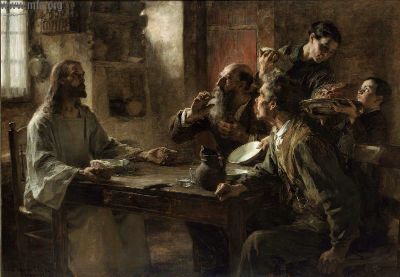
Event of Emmaus: Word and Sacrament

[H]ere too he [Christ] remains unrecognizable to the accustomed eye. … [H]e sets the hearts of the two wanderers aflame by his interpretation of the Scriptures and by breaking bread he opens their eyes. This is a reference to the two basic elements in early Christian worship, which consisted of the liturgy of the word (the reading and expounding of Scripture) and the eucharistic breaking of bread. In this way the evangelist makes it clear that the encounter with the risen Christ lies on a quite new plane; he tries to describe the indescribable in terms of the liturgical facts. He thereby provides both a theology of the resurrection and a theology of the liturgy: one encounters the risen Christ in the word and in the sacrament; divine service is the fashion in which he becomes touchable to us and recognizable as the living Christ. And conversely, the liturgy is based on the mystery of Easter; it is to be understood as the Lord’s approach to us. In it he becomes our travelling companion, sets our dull hearts aflame and opens our sealed eyes. He still walks with us, still finds us worried and downhearted, and still has the power to make us see.

Experience of the risen Christ is something other than a meeting with a historical man, and it must certainly not be traced back to conversations at table and recollections which would have finally crystallized in the idea that he still lived and went about his business. Such an interpretation reduces what happened to the purely human level and robs it of its specific quality. The resurrection narratives are something other and more than disguised liturgical scenes; they make visible the founding event on which all Christian liturgy rests. They testify to an approach which did not rise from the hearts of the disciples but came to them from outside, convinced them against their doubts and made them certain that the Lord had truly risen. He who lay in the grave is no longer there; he—really he himself—lives. He who had been transposed into the other world of God showed himself powerful enough to make it palpably clear that he himself stood opposite them again, that in him the power of love had really proved itself stronger than the power of death.

The comfortable attempt to spare oneself the belief in the mystery of God’s mighty actions in this world and yet at the same time to have the satisfaction of remaining on the foundation of the biblical message leads nowhere; it measures up neither to the honesty of reason nor to the claims of faith. One cannot have both the Christian faith and “religion within the bounds of pure reason”; a choice is unavoidable. He who believes will see more and more clearly, it is true, how rational it is to have faith in the love that has conquered death.

--Joseph Ratzinger (Pope Benedict XVI)

Top icon written by Sister Marie-Paul. Bottom icon by Nicholas Papas.

Monday, April 09, 2007

A Love Stronger Than Death: ALITHOS ANESTI!

“Love is strong as death” (Song of Sol. 8.6). … [L]ove demands infinity, indestructibility; indeed it is, so to speak, a call for infinity. But it is also a fact that this cry of love’s cannot be satisfied, that it demands infinity but cannot grant it; that it claims eternity but in fact is included in the world of death, in its loneliness and its power of destruction. Only from this angle can one understand what “resurrection” means. It is the greater strength of love in face of death.

For [man], since he has no continuance in himself, survival, from a purely human point of view, can only become possible through his continuing to exist in another.

[O]nly one could truly give lasting stability: he who is, who does not come into existence and pass away again but abides in the midst of transience: the God of the living, who does not hold just the shadow and echo of my being, whose ideas are not just copies of reality. … In him I can stand as more than a shadow; in him I am truly closer to myself than I should be if I just tried to stay by myself.

[O]nly where someone values love more highly than life, that is, only where someone is ready to put life second to love, for the sake of love, can love be stronger and more than death. … If the power of love for another were so strong anywhere that it could keep alive not just his memory, the shadow of his “I”, but that person himself, then a new stage in life would have been reached. … [This new realm] would signify the end of the sovereignty of bios, which is at the same time the sovereignty of death; it would open up the realm which the Greek Bible calls “zoe” that is, definitive life, which has left behind the rule of death. … It would no longer be evolution but decision and gift in one.

[A]s man has no permanence in himself his survival could only brought about by his living on in another. … [O]nly the love which takes up the beloved in itself, into its own being, could make possible this existence in the other. … Jesus’ total love for men, which leads him to the cross, is perfected in total stepping-over to the Father and therein becomes stronger than death, because in this it is at the same time total “being held” by him.

[I]mmortality always proceeds from love, never out of the autarchy of that which is sufficient to itself. … [T]his principle, properly understood, also applies even to God as he is seen by the Christian faith. … [W]hat is revolutionary about the Christian view of the world and of God … is that it learns to understand the “absolute” as absolute “relativity”, as relatio subsistens.

[L]ove found immortality, and immortality proceeds from love alone. … [H]e who has love for all has founded immortality for all. That is precisely the meaning of the biblical statement that his resurrection is our life. … [I]f he has risen, then we have too, for then love is stronger than death; if he has not risen, then we have not either, for then the situation is still that death has the last word, nothing else. … [E]ither love is stronger than death or it is not. … This also means, it is true, that our own love, left to itself, is not sufficient to overcome death; taken in itself it would have to remain an unanswered cry. It means that only his love, coinciding with God’s own power of life and love, can found our immortality.

It goes without saying that the life of him who has risen from the dead in not once again bios, the bio-logical form of our mortal life inside history; it is zoe, new, different, definitive life; life which has stepped beyond the mortal realm of bios and history, a realm which has here been surpassed by a greater power. … [T]his new life begot itself in history and had to do so, because after all it is there for history, and the Christian message is basically nothing else than the transmission of the testimony that love has here broken through death and thus transformed fundamentally the situation of all of us.
--Joseph Ratzinger (Pope Benedict XVI)

Top icon written by Joanna Ferencz.

Sunday, April 08, 2007

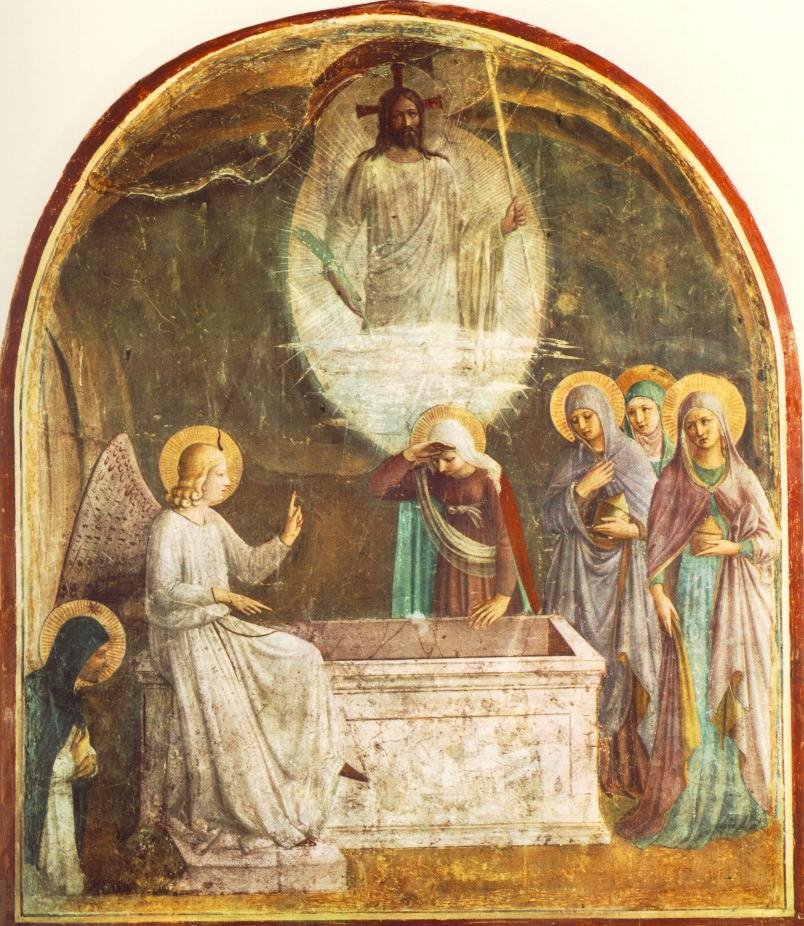
Empty Tomb


When Mary Magdalen came to the tomb and did not find the Lord's body, she thought it had been taken away and so informed the disciples.


After they came and saw the tomb, they too believed what Mary had told them. The text then says: "The disciples went back home," and it adds: "but Mary wept and remained standing outside the tomb."


We should reflect on Mary's attitude and the great love she felt for Christ; for though the disciples had left the tomb, she remained. She was still seeking the one she had not found, and while she sought she wept; burning with the fire of love, she longed for him who she thought had been taken away. And so it happened that the woman who stayed behind to seek Christ was the only one to see him. For perseverance is essential to any good deed, as the voice of truth tell us: "Whoever perseveres to the end will be saved."
--St. Gregory the Great

The Risen SON: Easter Sunday

Christos Anesti!

"I did not make you for the dungeon." In this Easter hour let us ask the Lord to visit the dungeons of this world; ... Let us ask him to enter into the spiritual prisons of this age, into the darkness of our lack of truth, revealing himself as the Victor who tears down the gates and says to us, "I, your God, have become your Son. Come out! I have not created you to be in prison for ever. I did not make you for the dungeon." In his play No Exit Jean Paul Sartre portrays man as a being who is hopelessly trapped. He sums up his gloomy picture of man in the words, "Hell is other people". This being so, hell is everywhere, and there is no exit, the doors are everywhere closed.

Christ, however, says to us, "I, your God, have become your Son. Come out!" Now the exact opposite is true: heaven is other people. Christ summons us to find heaven in him, to discover him in others and thus to be heaven to each other. He calls us to let heaven shine into this world, to build heaven here. Jesus stretches out his hand to us in his Easter message, in the mystery of the sacraments, so that Easter may be now, so that the light of heaven may shine forth in this world and the doors may be opened. Let us take his hand! Amen.

--Joseph Ratzinger (Pope BenedictXVI)

Alithos Anesti!

CHRISTOS ANESTI! Christ Is Risen

Only since Easter can we really utter the first article of faith; only on the basis of Easter is this profession rich and full of consolation: I believe in God, the Father Almighty. For it is only from the Lamb that we know that God is really Father, really Almighty.


This greatest festival of the Church's year encourages us, by looking at him who was slain and is risen, to discover the place where heaven is opened. If we comprehend the message of the Resurrection, we recognize that heaven is not completely sealed off above the earth. Then--gently and yet with immense power--something of the light of God penetrates our life. Then we shall feel the surge of joy ....
--Joseph Ratzinger (Pope BenedictXVI)

Christos Anesti!

The "Sun" Is Rising

The light shines in the darkness, and the darkness has not overcome it. (Jn 1:5)


Easter is concerned with something unimaginable. Initially the event of Easter comes to us solely through the word, not through the senses. So it is all the more important for us to be won over by the immensity of this word. Since, however, we can only think by employing sense images, the faith of the Church has always translated the Easter message into symbols which point to things that the word cannot express. The symbol of light ... plays a special part; the praise of the Paschal candle--a symbol of life in the midst of the darkened church--is actually a praise of him who proved victor over death. Thus the event of long ago is translated into our present time: where light conquers darkness, something of the Resurrection takes place.

--Joseph Ratzinger (Pope BenedictXVI)

Arise from the Dead


Awake, O sleeper, and arise from the dead, and Christ shall give you light. I have not created you to be in prison forever. I did not make you for the dungeon.
--Epiphanius

Saturday, April 07, 2007

Descent into Hell

The light shines in the darkness, and the darkness has not overcome it. (Jn 1:5)


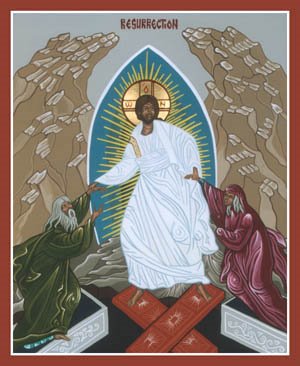
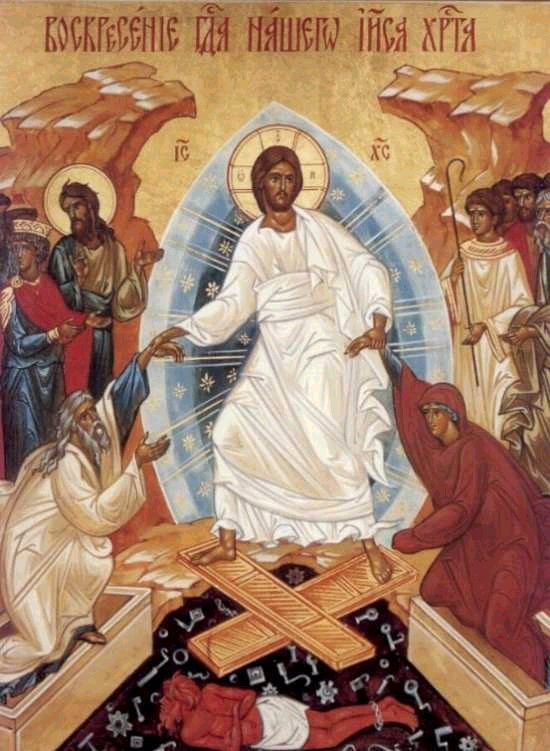
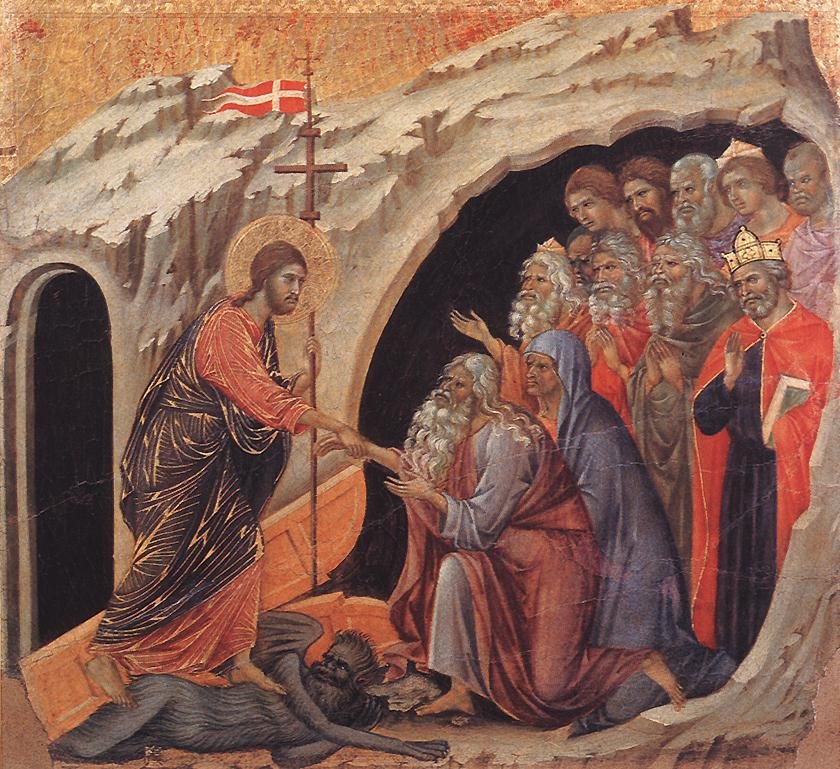
For the East the image of Redemption is the descent into Hades: the bursting open of the eternally-closed gate, when Christ stretches out his hand to the first Adam who, hardly trusting his eyes, sees the Easter light in the darkness of death.


He Descended into Hell

The icon ... represents as it were the mysterious inner dimension of the event of Easter which is indicated by a few words of Scripture and which we profess in the Creed when we say, "He descended into hell". In the perspective of the icon, this is an affirmation concerning Jesus' victory. The icon shows him having shattered the bolt of this world, having torn its gates from their hinges. It depicts him as the "stronger man" who has opened and penetrated the domain of the "strong man". It portrays him as the Victor, having burst through the supposedly impregnable fortress of death, such that death is now no longer a place of no return; its doors lie open. Christ, in the aura of his wounded love, stands in this doorway, addresses the still somnolent Adam and takes him by the hand to lead him forth. The liturgy of Holy Saturday circles around this event.
--Joseph Ratzinger (Pope BenedictXVI)

He brings consolation to this place of desolation, he brings warmth to this place of infernal cold.

Christ's suffering, the greatest one could conceive, was like that of the damned who cannot be damned any more. That is, his suffering went to the length of infernal punishment ... He alone through such a death entered into glory. He wanted to experience the poena sensus like the damned in Hell for the glorifying of his Father, and so as to show that one should obey the Father even to the utmost torture. That means: praising and glorifying God in every possible way for our justification--which is what Christ has done.

Friday, April 06, 2007

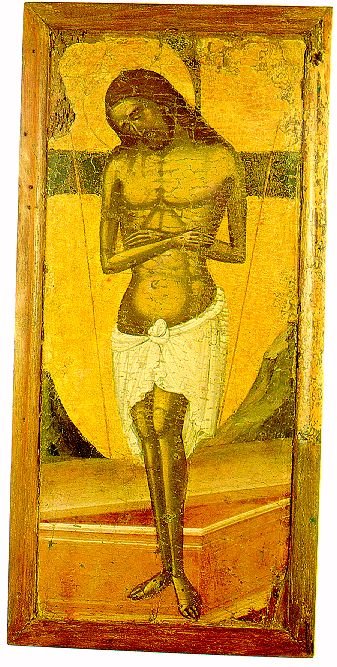
Entombment of Christ

This is what is known as a first-class funeral.
The solicitous ones seem to be chiefly intellectuals.
With solemn gestures they flourish gravecloths,
making a liturgy,
absorbing themselves in its dignity.
Nothing indicates they expect a resurrection.


The corpse is swathed according to custom.
Only the face cannot be subdued.
All suffering stares from that head.
Impossible to wrap it in a great and festive forgetting.


So already his unquiet image haunts heads and hearts.
Already the spirit is freed.
Already the Easter question takes shape...

But silently.
For tomorrow is only Holy Saturday.
The day when God is dead,
and the Church holds her breath.
The strange day that separates life and death

in order to join them in a marriage beyond all human thought.
The day which leads through hell,
and, after all the paths of the world,
into a pathless existence.

--Hans Urs von Balthasar

The Deposition of Christ

Jesus is taken down from the cross and his mother--accepting the pain that his Son bore for the sake of the world--is there to receive him in her bosom. Each of the seven swords which transfixed the heart of the mother was Mary's renewed assent to her Son's sufferings. It is beyond human comprehension that a person should say "yes" to everything, even to the most harrowing pain.

In her unconditional "yes" Mary becomes the "redeemed earth," capable of receiving on her lap the dead body of the Redeemer. This scene wrapped in silence reveals that Christ's Passion was not suffered in vain: Mary in this moment of weariness and infinite sorrow, represents humanity who accepts with gratitutde heaven's blessings. In the end her Son's body is not buried ina cold and inanimate matter ("matter" comes from the Latin word mater meaning "mother") but it is placed in the maternal and fruitful bosom of Mary, a prototype of incarnate love which finds its culmination in Mary. The Pieta therefore is not a fleeting image of sorrow but one engraved forever in human history: a mysterious image portraying maternal fecundity enshrouding the dead Son's body--the source of a new fecundity for the mother.

Christ on the Cross ... Some Thoughts

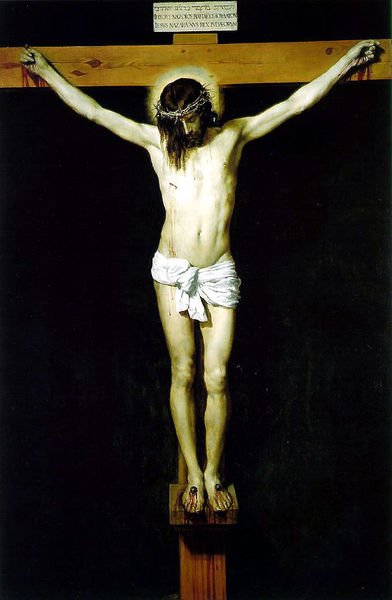
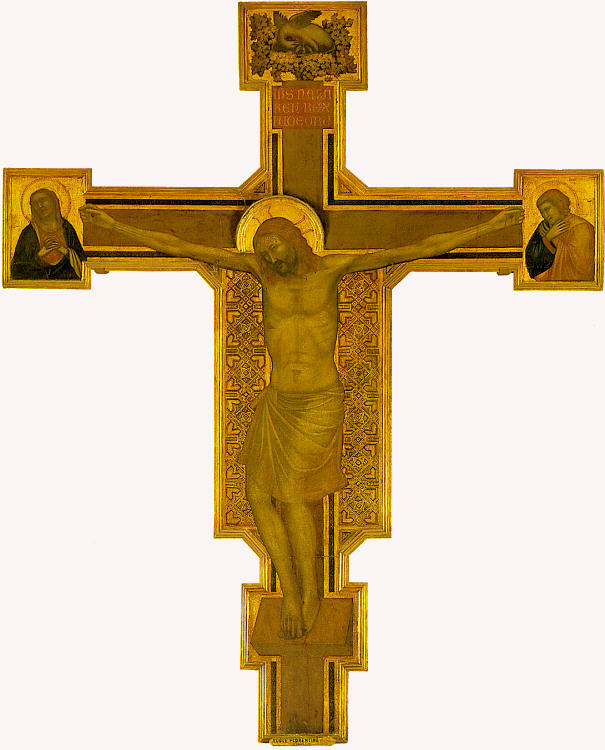
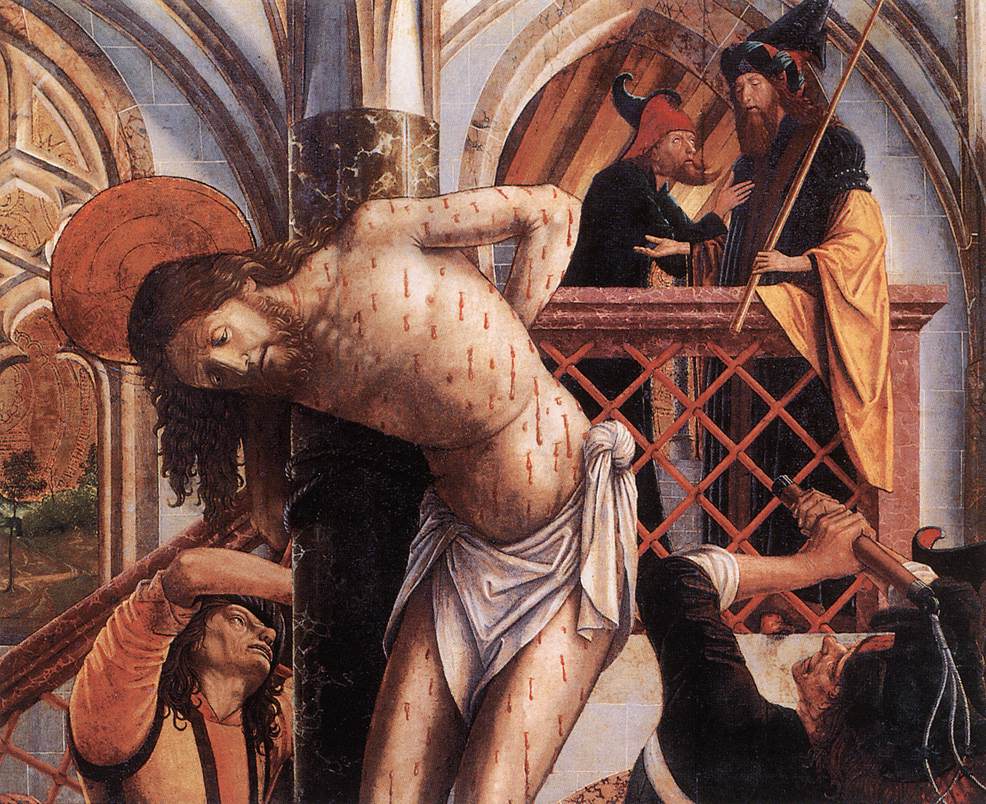
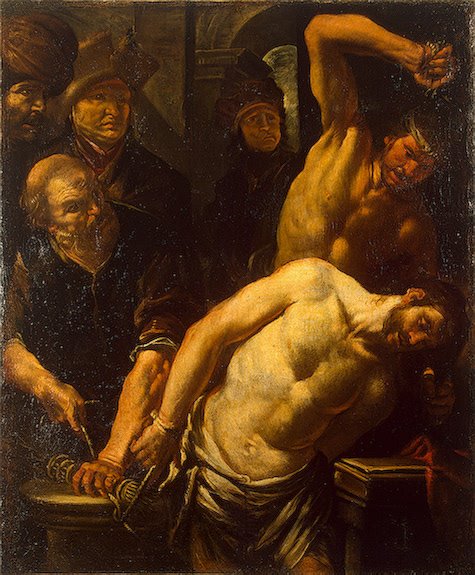
The entire life of Christ is with a view to "his hour." The hour of Jesus is the hour when he fully accomplishes his mission, which is to glorify the Father and save us. It is for this reason that he came. "Behold why I have come to this hour, Father, glorify your name." (John 12:27-28) "Father, the hour has come. Glorify your Son that your Son might glorify you." He came to glorify the Father and to save us. It is the mystery of the Cross which unites this contemplative gaze (glorifying the Father) with the apostolic work par excellence (saving us). It is the will of the Father that this be realized by means of the suffering of the Cross, and the suffering of the Agony where there is sadness (there is no true suffering without the interior sadness of the soul, Therese tells us), sadness such that Jesus could have died from it, "My soul is sad to the point of death." This sadness-- which takes hold of Christ's entire soul-is sadness caused by the weight of sin, by the horror of sin whereby man turns from God and turns in on himself: the sin of personal pride and/or the sin of collective pride (symbolized by the tower of Babel). The mystery of the Cross begins with the Agony and continues to Golgotha. Between the two there is the scourging at the pillar, the carrying of the cross, and the various forms of suffering that Jesus experienced because of the Crucifixion.

Why did God, in his wisdom, wish to unite, in the mystery of the Cross, love in its greatest, most powerful and purest aspect with suffering, with sadness? It is because of the wisdom of the Cross that the Little Flower [St. Therese] unites so closely and constantly love and suffering in an extremely practical and simple fashion. ... Why does the Father--who sends his Son to glorify and save us--establish a connection between love and suffering, extreme suffering, that is, suffering which leads to and implies death. Why does the Father unite love and the deadly sadness of the Agony? Why is this? It would have been more normal to unite love with joy, with success. Jesus would have been capable of succeeding. He would have been able to bring salvation to humanity with the triumphal entry into Jerusalem, or with the amazing procession shown in Chapter six of John's gospel, when Jesus is followed by a crowd of 5,000 men, not including the women and children. Salvation could have been given there. Indeed, none of these things are extrinsic to salvation, but they are not Jesus' "hour," the moment for which he came. His hour is an act of love realized by means of the sadness of the Agony, the suffering of the Cross and the offering of his earthly life, in obedience to the Father.

Let us understand that the Cross, with all the suffering it entails, is a passage whose end is joy. Its end is not sadness, its end is not suffering (that is why suffering does not finalize). Its end is love that blossoms in joy. This blossoming is the mystery of the Resurrection. "If Christ is not risen, vain is our faith" (1 Cor. 15:17). Exteriorly, the Cross is a failure, the most horrible failure that ever existed on earth: amongst the 12 disciples of Jesus there is a traitor, one whom Jesus chose to be his successor who betrays him, and the others flee...save one. Only one of 12, John, is present at the Cross. What would be said of a Novice Master who had formed 12 novices amongst whom only one remained faithful? We would pity him: "Poor novice master. What an idiot; he understood nothing." Exteriorly, the Cross is a horrible failure, and the devil is convinced it is his great victory. In reality, the Cross is the victory of love, a hidden victory: the grain of wheat must fall to the earth to bear much fruit. Here, one touches the fruitfulness of love-- not only love, but the fruitfulness of love. So that there be this fruitfulness of love, we must pass through the Cross, a difficult passage which Jesus indicates for us, but only a passage, whose end is the Resurrection.

Stabat Mater: At the Cross

[N.B. the Latin texts don't coincide, stanza-wise, with this English translation. I have to fix it. For reasons of time, I just pasted it as I found it. Give me some time.]

Stabat mater dolorosa
iuxta Crucem lacrimosa,
dum pendebat Filius.


At the Cross her station keeping,
stood the mournful Mother weeping,
close to Jesus to the last.


Cuius animam gementem,
contristatam et dolentem
pertransivit gladius.

Through her heart, His sorrow sharing,
all His bitter anguish bearing,
now at length the sword has passed.


O quam tristis et afflicta
fuit illa benedicta,
mater Unigeniti!

O how sad and sore distressed
was that Mother, highly blest,
of the sole-begotten One.


Quae maerebat et dolebat,
pia Mater, dum videbat
nati poenas inclyti.

Christ above in torment hangs,
she beneath beholds the pangs
of her dying glorious Son.


Quis est homo qui non fleret,
matrem Christi si videret
in tanto supplicio?

Is there one who would not weep,
whelmed in miseries so deep,
Christ's dear Mother to behold?


Quis non posset contristari
Christi Matrem contemplari
dolentem cum Filio?

Can the human heart refrain
from partaking in her pain,
in that Mother's pain untold?


Pro peccatis suae gentis
vidit Iesum in tormentis,
et flagellis subditum.

Bruised, derided, cursed, defiled,
she beheld her tender Child
All with scourges rent:


Vidit suum dulcem Natum
moriendo desolatum,
dum emisit spiritum.

For the sins of His own nation,
saw Him hang in desolation,
Till His spirit forth He sent.


Eia, Mater, fons amoris
me sentire vim doloris
fac, ut tecum lugeam.

O thou Mother! fount of love!
Touch my spirit from above,
make my heart with thine accord:


Fac, ut ardeat cor meum
in amando Christum Deum
ut sibi complaceam.

Make me feel as thou hast felt;
make my soul to glow and melt
with the love of Christ my Lord.


Sancta Mater, istud agas,
crucifixi fige plagas
cordi meo valide.

Holy Mother! pierce me through,
in my heart each wound renew
of my Savior crucified:


Tui Nati vulnerati,
tam dignati pro me pati,
poenas mecum divide.

Let me share with thee His pain,
who for all my sins was slain,
who for me in torments died.


Fac me tecum pie flere,
crucifixo condolere,
donec ego vixero.

Let me mingle tears with thee,
mourning Him who mourned for me,
all the days that I may live:


Iuxta Crucem tecum stare,
et me tibi sociare
in planctu desidero.

By the Cross with thee to stay,
there with thee to weep and pray,
is all I ask of thee to give.


Virgo virginum praeclara,
mihi iam non sis amara,
fac me tecum plangere.

Virgin of all virgins blest!,
Listen to my fond request:
let me share thy grief divine;


Fac, ut portem Christi mortem,
passionis fac consortem,
et plagas recolere.

Let me, to my latest breath,
in my body bear the death
of that dying Son of thine.


Fac me plagis vulnerari,
fac me Cruce inebriari,
et cruore Filii.

Wounded with His every wound,
steep my soul till it hath swooned,
in His very Blood away;


Flammis ne urar succensus,
per te, Virgo, sim defensus
in die iudicii.

Be to me, O Virgin, nigh,
lest in flames I burn and die,
in His awful Judgment Day.


Christe, cum sit hinc exire,
da per Matrem me venire
ad palmam victoriae.

Christ, when Thou shalt call me hence,
by Thy Mother my defense,
by Thy Cross my victory;


Quando corpus morietur,
fac, ut animae donetur
paradisi gloria. Amen.

When my body dies,
let my soul be granted
the glory of Paradise. Amen.

"Woman, Behold, Your Son"

We must constantly return to this last gaze that Jesus fixes upon Mary, His Mother. The Infant Jesus' first gaze upon His Mother remains in silence. The Infant Jesus' first smile for His Mother existed, yet we know nothing about it. What the Gospel does give us is this last look which is doubtless accompanied by a smile, the smile of Christ Crucified, wherein Jesus conveys all His love, looking at Mary and saying to her: "Woman." Under the motion of the Holy Spirit, we must hold this name in great esteem. We must not become accustomed to it. Rather, we must see what is so astonishing in it. This final gaze of a beloved son upon his mother--especially when that Beloved Son is God!--consists in His calling her: "Woman."

Let us understand that Christ is not using this term in the sense that is generally used when refferring to "man" or "woman." It is much deeper. Is it true that Christ uses the conventional term. Perhaps this is precisely becaue Mary at the Cross is the Woman par excellence. She is the Woman as God has seen her in all her strength, the Woman par excellence. She is the New Woman, entirely relative to Jesus in His Mystery par excellence: the mystery of the Cross. She is the one who suffers with Jesus. She is the one who lives the same mystery that Jesus lives, who lives it with Him. She is so closely united with the Heart of Jesus that she endures everything He endures at the Cross, with and in Him. They are "one" as Jesus is "one" with the Father. We can say that Mary is "one" with Jesus at the Cross and that she brings to completion what is lacking in His Passion. [Cf. Col. 1:24] Of course, nothing is lacking as far as intensity of love is concerned; however, there is a lack as far as extension is concerned. And it is the proper role of woman to enable love to assume everything. This is perhaps the mystery of woman: to enable love to take hold of everything--that is, body and sensitivity, intelligence and will--and to render this love fruitful, to allow this love to become the source of another love, another life. Perhaps this is the ultimate secret.

--Fr. Marie-Dominique Philippe, OP

Stealing Heaven: Christ and the Two Thieves


The good thief is a found sheep. ...

The one thief joined in the mockery with cutting scorn born of his own desperate plight. "Are you not the Christ? Save yourself and us!" Luke tells us that he "railed" against Jesus. ... In his dying he turned, and it seems he turned definitively, against the light.

Not so with the other one. The other thief rebuked the first, we are told. "Do you not fear God, since you are under the same sentence of condemnation? And we indeed justly; for we are receiving the due reward of our deeds; but this man has done nothing wrong." Painfully twisting his neck, he looked toward Jesus. "Jesus," he said, "remember me when you come into your kingdom." And Jesus said to him, "Truly, I say to you, today you will be with me in paradise." In his dying, the second thief turned toward the light.

On the Cross: Dictations from a State of "Hell"


The wages of sin is death. The death on the Cross now represents this wage. Death is the reward and result of my sin. Every sin leads to death. But who will see the connection? Who has any idea how much of what is positive is destroyed in men through sin? ...

[Stretching out her arms] Now the crown of thorns is put in place; now the nails are hammered in, and with every blow sins are hammered into the soul and body of the Lord. The crown is formed from existing sins, those I intend to commit or those I am not finished with. The nails are formed of those of the past, the forgotten ones, those one no longer wishes to acknowledge or remember. [Sighing] Ah, and he made up for it all. For everything, everything. For everyone.

When the nails penetrate, they burst into the body of Christ all at once. Imagine that all the sins of my whole life, even those of mere thought, become present and penetrate into me through my hands and feet. They penetrate through an unimaginiable painful recognition. And the sins of the crown do no penetrate but make their mark. And the more painful it is and the more tired one is, so much the more still follows after. Don't you see it?

This monstrous shame. Now one has to receive for every sin the wage that is called death. Imagine someone who would want to make reparation in his living flesh for everything, for example, for every murder. Every murderous intention as well. He would become mincemeat. Even taking on just one small category of sin would already be totally unthinkable. But the Lord bears all sins and, so, all the kinds of death one could think of. And he bears it not as victim, as blows from without; he does not merely offer his body but hands over his whole being. He bears every sin from within as if he himself had committed it, with all its shame. A shame that now does not admit of repentance. Repentance and confession belong together in a unity that originates from the Cross, beyond the Cross. On the Cross, the Lord only reaches the insight into the heinousness of sin.

This Son who has handed over his divinity, his whole spirit to the Father, in order to be only man, is that man who lived without experiencing sin otherwise than in others. But because he now wants to be only the Son of Man, the exemplar of man, he has to experience every sin in the same way men would if ...

There is nothing ever so intimate that does not now undergo profanation. Every possible form of love is wounded in every possible way. And the Son has here to discover himself with his pure soul: in the midst of the most secret malice. As if someone finds himself doing what he had sworn to himself he would never do. The Son feels the same abhorrence for every sin, but he does not repel it as something foreign; he allows it to settle on himself. There is no way of deadening the impact. One sin more or less does not matter to a sinner; he would not mind taking on one for another person occasionally. His conscience is blunted. But the Lord feels every sin with his whole soul and body. In his death he dies all deaths. He leaves no sin behind as something finished with. Each one causes his death. The sin that is intended, the sin that is willed, the sin committed, everything always up to the limit where repentance begins, up to total abhorrence. And by going the way of terrible, perfect recognition (by means of his purity) he opens for us the way to repentance and confession. He himself is now unable to confess; he has no time left. Everything clashes so monstrously together that in grasping one thing, he always grasps everything else with it.

And all this in obedience! What can that mean: "Into your hands I commend my spirit"? ... There are still more parts that have to die ... I thirst. ... Adieu.

--Adrienne von Speyr

Stabat Mater -3-

Stabat Mater -2-

Stabat Mater -1-

Wednesday, March 28, 2007

In Italia

I am in Italy until Good Friday, April 6. No posting till I return, and then I will finish this Lenten/Easter season series of posts. There will be quite a few going up each day once I am back so be sure to return for the culminating set of posts, which will end on the Octave of Easter.

Lent : Fr. Philippe and the Cross as Passage to the Resurrection


The entire life of Christ is with a view to "his hour." The hour of Jesus is the hour when he fully accomplishes his mission, which is to glorify the Father and save us. It is for this reason that he came. "Behold why I have come to this hour, Father, glorify your name." (John 12:27-28) "Father, the hour has come. Glorify your Son that your Son might glorify you." He came to glorify the Father and to save us. It is the mystery of the Cross which unites this contemplative gaze (glorifying the Father) with the apostolic work par excellence (saving us). It is the will of the Father that this be realized by means of the suffering of the Cross, and the suffering of the Agony where there is sadness (there is no true suffering without the interior sadness of the soul, Therese tells us), sadness such that Jesus could have died from it, "My soul is sad to the point of death." This sadness-- which takes hold of Christ's entire soul-is sadness caused by the weight of sin, by the horror of sin whereby man turns from God and turns in on himself: the sin of personal pride and/or the sin of collective pride (symbolized by the tower of Babel). The mystery of the Cross begins with the Agony and continues to Golgotha. Between the two there is the scourging at the pillar, the carrying of the cross, and the various forms of suffering that Jesus experienced because of the Crucifixion.

Why did God, in his wisdom, wish to unite, in the mystery of the Cross, love in its greatest, most powerful and purest aspect with suffering, with sadness? It is because of the wisdom of the Cross that the Little Flower [St. Therese] unites so closely and constantly love and suffering in an extremely practical and simple fashion. ... Why does the Father--who sends his Son to glorify and save us--establish a connection between love and suffering, extreme suffering, that is, suffering which leads to and implies death. Why does the Father unite love and the deadly sadness of the Agony? Why is this? It would have been more normal to unite love with joy, with success. Jesus would have been capable of succeeding. He would have been able to bring salvation to humanity with the triumphal entry into Jerusalem, or with the amazing procession shown in Chapter six of John's gospel, when Jesus is followed by a crowd of 5,000 men, not including the women and children. Salvation could have been given there. Indeed, none of these things are extrinsic to salvation, but they are not Jesus' "hour," the moment for which he came. His hour is an act of love realized by means of the sadness of the Agony, the suffering of the Cross and the offering of his earthly life, in obedience to the Father.

Let us understand that the Cross, with all the suffering it entails, is a passage whose end is joy. Its end is not sadness, its end is not suffering (that is why suffering does not finalize). Its end is love that blossoms in joy. This blossoming is the mystery of the Resurrection. "If Christ is not risen, vain is our faith" (1 Cor. 15:17). Exteriorly, the Cross is a failure, the most horrible failure that ever existed on earth: amongst the 12 disciples of Jesus there is a traitor, one whom Jesus chose to be his successor who betrays him, and the others flee...save one. Only one of 12, John, is present at the Cross. What would be said of a Novice Master who had formed 12 novices amongst whom only one remained faithful? We would pity him: "Poor novice master. What an idiot; he understood nothing." Exteriorly, the Cross is a horrible failure, and the devil is convinced it is his great victory. In reality, the Cross is the victory of love, a hidden victory: the grain of wheat must fall to the earth to bear much fruit. Here, one touches the fruitfulness of love-- not only love, but the fruitfulness of love. So that there be this fruitfulness of love, we must pass through the Cross, a difficult passage which Jesus indicates for us, but only a passage, whose end is the Resurrection.

Saturday, March 24, 2007

Lent & Ratzinger (Pope Benedict XVI) : The Desert a Place of Grace

The desert is the place of silence, of solitude; it is the absence of the exchanges of daily life, its noise and its superficiality. The desert is the place of the absolute, the place of freedom, which sets us before the ultimate demands. Not by chance is the desert the place where monotheism began. In that sense it is a place of grace. In putting aside all preoccupations we encounter our Creator.

Great things have their beginnings in the desert, in silence, in poverty. It is not possible to share in the mission of Jesus, in the mission of the Gospel, without sharing in the desert experience, its poverty, its hunger. That beautiful hunger for justice of which the Lord speaks in the Sermon on the Mount cannot be born in the fulness of satiety... And let us not forget that for Jesus the desert did not end with those forty days. His final, extreme, desert was to be that of Psalm 21: "My God, my God, why hast thou forsaken me?" And from that desert sprang up the waters of the life of the world.

--Then-Cardinal Joseph Ratzinger, Journey towards Easter (14) re-published as Journey to Easter

Friday, March 23, 2007

Lent : Bl. Elizabeth of the Trinity

I still remember the first secret you shared with me at Gemeaux, you were very little, but already the Master had taken your little heart captive, and my soul felt drawn toward yours! ... A Carmelite, my darling, is a soul who has gazed on the Crucified, who has seen Him offering Himself to His Father as a Victim for souls and, recollecting herself in this great vision of the charity of Christ, has understood the passionate love of His soul, and has wanted to give herself as He did! ... And on the mountain of Carmel, in silence, in solitude, in prayer that never ends, for it continues through everything, the Carmelite already lives as if in Heaven: "by God alone." The same One who will one day be her beatitude and will fully satisfy her in glory is already giving Himself to her. He never leaves her, He dwells within her soul; more than that, the two of them are but one. So she hungers for silence that she may always listen, penetrate ever deeper into His infinite Being. She is identified with Him whom she loves, she finds Him everywhere, she sees Him shining through all things! Is this not Heaven on earth! You carry this Heaven within your soul, my little Germaine, you can be a Carmelite already, for Jesus recognizes the Carmelite from within, by her soul. Don't ever leave Him, do everything beneath His divine gaze, and remain wholly joyful in His peace and love, making those around you happy!

Friday, March 16, 2007

Lent : Kneeling before the Lord

I know many words, O men, but today you must kneel--
Your knees are your wings.

--Gertrud von Le Fort, Hymns to the Church (50)


A leper comes to Jesus and begs him for help. He falls to his knees before him and says: "If you will, you can make me clean." (Mark 1.40)


The bodily gesture itself is the bearer of the spiritual meaning, which is precisely that of worship. Without the worship, the bodily gesture would be meaningless, while the spiritual act must of its very nature, because of the psychosomatic unity of man, express itself in the bodily gesture. The two aspects are united in the one word, because in a very profound way they belong together. When kneeling becomes merely external, a merely physical act, it becomes meaningless.

On the other hand, when someone tries to take worship back into the purely spiritual realm and refuses to give it embodied form, the act of worship evaporates, for what is purely spiritual is inappropriate to the nature of man. Worship is one of those fundamental acts that affect the whole man. That is why bending the knee before the presence of the living God is something we cannot abandon.

Again, there is a story that comes from the sayings of the Desert Fathers, according to which the devil was compelled by God to show himself to a certain Abba Apollo. He looked black and ugly, with frighteningly thin limbs, but most strikingly, he had no knees. The inability to kneel is seen as the very essence of the diabolical.

--Joseph Ratzinger (Pope Benedict XVI), The Spirit of the Liturgy (189-93)


I [...] fell upon my knees and spread out my hands to the Lord my God.

--Ezra 9.5

Tuesday, March 13, 2007

Lent and Matthew the Poor : Finding Comfort in the Good Samaritan

"The penitent is described by Christ as a stranger who has fallen into the hands of robbers in a foreign country. They strip him of his clothes, rob him, humiliate him, wound him, and leave him more dead than alive. The penitent is like a man stripped of the garment of his honor by the devil, whose will has therefore been stripped naked and whose members have been defiled. The devil robs him of his treasure--the treasure being the sanity of the mind, the light of insight, and the action of conscience--his person being humiliated, his fall disclosed, and his will shattered. Last of all, he wounds him deeply with lust to draw off his life quickly. At the end he leaves him a dead corpse unable to live! It is thus that the good Samaritan finds no occasion to ask questions or time to reproach, but immediately gathers him in his arms.


"The good Samaritan in the parable (Lk. 10.30-37) is Christ, and our interpretation hits the mark exactly, for He does not upbraid him or ask him to perform any action, but comes to him personally where he fell and stoops over him with His affection, washes and dresses his wound by His own wound, stops his bleeding by His own bleeding, and pours upon him the oil of His compassion and of His life, carrying him on the arms of His mercy, offering him a ride to the inn of His Church, asking His angels to serve him, and expending His grace on him till he recovers.


"Such is the penitent, a wretched man that has fallen on the way after being attacked by the oppression of man and the spite of the devil, and no longer able to do anything. After his strength has been drawn off, he finds room at the house of the Benign, room in His heart, room between His arms, on His beasts of burden, and in His Kingdom."


--Abouna Matta al-Meskeen (Matthew the Poor), "Repentant," Communion of Love (98)

Sunday, March 11, 2007

Lent and Leiva-Merikakis : Repentant Tears and Grasping the Incarnation

Tears are a mystical indication of true joy, as the Lord showed when He said, "Blessed are you that weep now, for you shall laugh."

Tears that spring from hope are part of the mystery of repentance; they are evidence that the penitent has entered into grace and a secret sign that the state of true joy has been attained.

[...] Tears are a clear sign of the process of inner change and also evidence of the truth and power of the mystery of repentance.

--Matta al-Meskeen (Matthew the Poor), Communion of Love, 88

One of the Pharisees asked [Jesus] to eat with him, and he went into the Pharisee's house, and sat at table. And behold, a woman of the city, who was a sinner, when she learned that he was sitting at table in the Pharisee's house, brought an alabaster flask of ointment, and standing behind him at his feet, weeping, she began to wet his feet with her tears, and wiped them with the hair of her head, and kissed his feet, and anointed them with the ointment. [...]

Then turning toward the woman he said to Simon, "Do you see this woman? I entered your house, you gave me no water for my feet, but she has wet my feet with her tears and wiped them with her hair. You gave me no kiss, but from the time I came in she has not ceased to kiss my feet. You did not anoint my head with oil, but she has anointed my feet with ointment. Therefore I tell you, her sins, which are many, are forgiven, for she loved much [...].

--Luke 7.36-50

Jesus' mere presence in the town mysteriously draws the sinful woman to him, magnet-like, and how different are her motivations from those of the hypocritical Pharisee! While Simon wants to use Jesus to enhance his own public image as a pious and holy man, the woman for her part feels that the simple presence of Jesus' holiness in her proximity is an instant judgment that reveals all the ugliness of her sins. How truthful and bold she is in her self-appraisal! But, instead of going to hide like Adam and Eve at feeling so shamefully naked before the glance of the Son of God, penetrating miraculously through all the walls of the town to arrive at her own heart, what does she do?

[...] In one moment of luminous intuition, this woman realizes that Jesus is at once the destroyer of her sins, the victor over all evil, and the Bridegroom of her soul.

--Erasmo Leiva-Merikakis, The Way of the Disciple, 89-90

Thus leaving her to say:

It is you, my Lord, who desired that we should grasp you and implore you. For, if you had not wanted us to grasp you, you would not have become incarnate. It is you who called me to come near you. I saw your beauty and ran toward you.

--Syriac Liturgy for the Feast of Saint Mary Magdalen (quoted in Leiva above, 90)

How impressive this woman who, despite the great emotions shaking her soul, does not utter a single word throughout the episode. Instead, she makes herself present to Jesus [...]. All the verbal dialogue takes place between Jesus and the Pharisee; what transpires between Jesus and the woman is the mute dialogue of love, in which only the gestures of the body and the expression of the eyes can communicate what is happening in the soul. Deep and overwhelming love is beyond words and arguments, beyond reason. The Pharisee's words have the effect of separating him from Jesus, of keeping Jesus far from his soul, while the woman's silence unites her to Jesus as the surest bridge and bond. She has understood the full meaning of the injunction, "Be still, and know that I am God!" (Ps. 46.10)

--Erasmo Leiva-Merikakis, The Way of the Disciple, 90-91

Truly, she has understood:

For, if you had not wanted us to grasp you, you would not have become incarnate. It is you who called me to come near you. I saw your beauty and ran toward you.

Saturday, March 10, 2007

Lent and Corbon : Kenosis of the Cross

In the kenosis of the Incarnation grace dawned; in the kenosis of the Cross it shines forth where the darkness is thickest. After all, when day dawns, what happens? Night is scattered. Night was simply an absence; it had no existence in itself; [...] and consequently when it is there nothing exists for anyone; people do not even recognize each other. Night as such is empty of meaning and strips everything else of meaning. Well, at the core of every human event, at the bottom of every human heart, there is a night of death and rupture, of nonmeaning and absence. "Flesh and blood", or mere human nature (Jn 1.13; 1 Cor 15.50), cannot dissipate this night; nothing outside man can introduce light into that blackness. It reigns in the heart and from that vantage point spreads its veil over everything, from the depths of the person to its most conscious structures. Only he who is Light can assume the human without damaging any part of it. And only this Man-God, in whom death finds no complicity with itself, can enter into the thickest darkness of death; that is what happens in the kenosis of the Cross.

[...] Did the executioners realize what they were doing when they raised the Lord of glory on his Cross? What happened when the Light was immersed in this darkness? Not a romantic dawn, but a struggle, the combat that decided the salvation of all men. Death feeds on lies and engenders lies; it feeds upon appearances and leaves emptiness behind it. Here, at the ninth hour, the hour when darkness reigns (Lk 22.53), death seizes its prey--only to be throttled by him whom it expects to swallow up. It is "gripped by terror", for he who enters into it is not mortal because caught in the nets of sin, but mortal out of love, mortal by grace and truth. Death has been deceived; its lies have been turned back upon it. When truth shines forth, all lying is shown up for what it is and is scattered like the night before the dawning day. Death is no longer: the Son of the Living God has crushed it by his own death.

--Fr. Jean Corbon, OP

Saturday, March 03, 2007

Lent : Temptation and the Will

Now the serpent was more cunning than any beast.

--Gen 3.1


Temptation properly so-called is rarely the exclusive work of the devil. Ordinarily he uses his knowledge of the dominant tendencies of a soul and his power over the senses in order to make an image more enticing, to stir up an impression, to intensify a pleasure, to quicken thus a desire, or make a solicitation more attractive and more actual, so that it will invade the field of conscience and win the consent of the will.

This kind can be cast out in no way except by prayer and fasting.

--Mark 9.28

Sunday, February 25, 2007

Matthew the Poor on Fasting

If we eat of a sacrificed body and do not sacrifice our own selves, how can we claim that a union takes place?
--Abouna Matta al-Meskeen (Matthew the Poor)

Fr. Matthew the Poor was a Coptic monk who affected the lives of many, both Coptic and non-Coptic Christians, especially Christoph Cardinal Schonborn, who writes that Father Matthew the Poor is "[o]ne of the great spiritual masters of our time." (201)

Well, one of the first writings I read from him is on fasting and it is in his book Communion of Love. This chapter, "The Deep Meaning of Fasting," can also be found here. Some selections from throughout the chapter:

Fasting, in the life and works of Christ, ranks as the first response to the act of unction and of being filled with the Holy Spirit. It represents the first battle in which Christ did away with His adversary, the prince of hte world. [...] For when a person enters into prayerful fasting, Satan departs from the flesh.

Fasting was to elevate the flesh to the level of war with the spirits of evil, those powers that hold sway over our weaker part, the flesh.

[B]aptism, being filled with the Holy Spirit, and fasting form a fundamental and inseparable series of acts in Christ’s life that culminated in perfect victory over Satan in preparation for his total annihilation by the cross.

The ultimate aim of [...] fasting is that Christ Himself may dwell in us: “It is no longer I who live, but Christ lives in me” (Ga. 2:20).

[F]asting is a divine act of life.

[F]asting is an extremely important stage between baptism and crucifixion. [...] He [Christ] thus raised the flesh to the stage of the cross.

He invites us to a total communion with Him in suffering and glory alike. We thus have to prove our communion with Him in faith by having communion with Him in His works; only works testify to the genuineness of our faith. Yet He, as a true Bridegroom, did not leave us to invent works for ourselves but laid down the course of our works and life: ‘I am the way.”

Fasting is a test in which the personality defies the self. [...] Fasting may therefore be considered an act of love of the highest order, a physical way of entering into the experience of the cross.

You know that the effort of fasting is felt primarily by the body, which is the physical area that contains the self where it reveals its nature and desires. Thus, when we fast we exhaust the body, and so, indirectly, subdue the self.(3) If we subdue the self through the subjugation of the body, we have in fact come close to the destruction of the self, at least partially. So it is that by fasting we fulfill the word of the Lord: “Whoever loses his life for my sake will save it” (Lk. 9:24).


As for the Lord Jesus, He fasted not to receive something but to make a free offering of Himself in an act of will and to manifest the coming sacrifice of the cross.

As for us, we fast not to receive anything or to offer anything, for we have received Christ, and in Him we have already received everything before we fast. In Him we receive everything even before we are born. No offering of ours, even if we go to our death, is of any avail in removing a single sin.


We fast and offer our bodies as a sacrifice; the outward form of this is bearing fatigue, but its essence is the intentional acceptance of death, that we may be counted fit to be mystically united in the flesh and blood of Christ. It is then that we become, in Christ’s sacrifice, a pure sacrifice, capable of interceding and redeeming.

Fasting [...] has to be consummated in Communion, partaking in the pure body and blood, to become a perfect sacrifice, efficacious in prayer and intercession. Every Holy Communion Has to be preceded by fasting, and every fast has to end with Holy Communion.

If we eat of a sacrificed body and do not sacrifice our own selves, how can we claim that a union takes place?

Whenever we eat of the body and drink of the blood, we are mystically prepared for preaching the death of the Lord and confessing His resurrection. Every testimony to the death and resurrection of the Lord carries with it a readiness for martyrdom. And every martyrdom carries with it a resurrection.

Monday, February 19, 2007

Global Warming, Gore's Scare Tactics, and Carter as the Worst Ex-President

In this article on (liberal) Penn professor of earth and environmental science Bob Giegengack, can it be true that "Al Gore Is a Greenhouse Gasbag"? And yes, Giegengack did vote for Al Gore.

On that note, in one of the most devasting articles I have read in some time, Joshua Muravchik strongly and clearly argues that President Jimmy Carter is "Our Worst Ex-President":

Ever since his presidency, there has been a wide gap between Carter’s estimation of himself and the esteem in which other Americans hold him. This has manifestly embittered him. For all his talk of “love,” the driving motives behind his post-presidential ventures seem, in fact, to be bitterness together with narcissism (as it happens, two prime ingredients of a martyr complex). But he has worked hard to earn the reputation he enjoys. In contravention of the elementary responsibilities of loyalty for one in his position, he has denigrated American policies and leaders in his public and private discussions in foreign lands. He has undertaken personal diplomacy to thwart the policies of the men elected to succeed him. And in doing so he has, at least in the case of North Korea, actively damaged our security.

Read the whole article.

Saturday, February 03, 2007

Schall Phenomenology and Mahfouz

What a day! My book orders finally came in. Fr. Schall's long-awaited (for me) The Sum Total of Human Happiness is here along with Phenomenology and the Theological Turn: The French Debate by Dominique Janicaud, Jean-Francois Courtine, Jean-Louis Chretien, Michel Henry, Jean-Luc Marion, Paul Ricoeur. The two both look like very rewarding reads.

In glancing at the latter, I was struck by the title of an essay from Jean-Louis Chrétien: "The Wounded Word: Phenomenology of Prayer." I will be reading this one tonight, then onto Jean-Luc Marion's "The Saturated Phenomenon" for my phenomenology class.

A word about Fr. Schall's book. The book begins with six citations which, according to Fr. Schall, express the "spirit of this book." They are from Augustine, Tolkien, Aquinas, then-Cardinal Ratzinger, Chesterton, and Plato. The citations are all worth reading and doing so pensively, for they are pregnant with so much that should lead one to the greater view of The Sum Total of Human Happiness.

The citation from Ratzinger is taken from his interview published in English as Salt of the Earth:

History as a whole is the struggle between love and the inability to love, between love and the refusal to love. This is also, in fact, something we are experiencing again today, when man’s independence is pushed to the point where he says: I don’t want to love at all because then I make myself dependent and that contradicts my freedom. Indeed, love means being dependant on something that perhaps can be taken away from me, and it therefore introduces a huge risk of suffering into my life.

And lastly, yes, that was Mahfouz up above. I also received his book, The Dreams, which Amazon describes as:

In this new collection of his shortest short stories, the Egyptian Nobel laureate has reduced fictional form to its most essential level, while retaining his justifiably famous mastery of the storytelling art.

A man finds that all the streets in this neighborhood have turned into a circus - but his joy at the sight changes to anger when he sees he cannot escape it anywhere, even in his own home. A group of lifelong friends meet to trade jokes in a familiar alley - only to face a sudden, deadly flood that echoes the revenge taken by an ancient Egyptian queen upon the men who murdered her husband. A girl from the dreamer’s childhood flies with him from his native land on a cart drawn by a winged horse, to become a star in the firmament above the Great Pyramid.

Such is the stuff of Naguib Mahfouz’s The Dreams - his first major work since a knife attack by a religious fanatic in 1994 left him unable to write for several years. First serialized in a Cairo magazine, The Dreams is a unique and haunting mixture of the deceptively quotidian, the seductively lyrical, and the savagely nightmarish - the richly condensed sum of more than nine decades of artistic genius and everyday experience.

From the few "Dreams" I have read already, this should live up to the expectations, the high ones, I had when I purchased the book. And just in case you are interested, most of his works are worth reading. Very glad (and increasingly intrigued) with this ongoing quest of mine to read Arabic- and/or Islamic-based texts, both fiction and non-fiction.

Faith and Reason : Schall on Benedict and John Paul and a Little Aquinas Too

I finally made the time to sit down and read the reflective essay by Fr. James V. Schall, SJ, on the synthesis of faith and reason: "Benedict on Aquinas: 'Faith Implies Reason.'" The occasion for the essay was Pope Benedict XVI's Angelus message for the feast of St. Thomas Aquinas.

The read is worth printing out, sitting down with a nice cup/glass/mug of something, and taking a pen to many lines.

Relying upon both Benedict and John Paul II, Fr. Schall has written another gem. Tolle lege:

[P]hilosophy is not philosophy if it is only philosophy, and theology is not theology if it is only theology. To be what they are at their best, both need the other, and more, both need in those who hold them the full experience of human living itself. [...] Revelation addresses itself to a reason that has its own unanswered philosophical questions. Philosophy, when it knows what it knows, realizes that it is but a "quest." Only the gods are wholly wise.