Thursday, December 21, 2006

Handel's Messiah and American Christianity

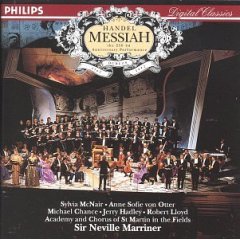
So I took Michael Linton's advice and went out and purchased a new and full (not the "selections" kind) version of Handel's Messiah. Got through most of the first CD last night and can't wait for the second CD today. Wish I had had the time to listen to both without any lapse of time in between.

Michael Linton has also written another essay/post on not just which versions of Handel's Messiah one should buy and listen to but an essay dealing with why no other piece of music is so linked with Christmas as Handel's oratorio:

For musicians, Christmas means Messiah. This is not a comment upon musicians’ religiosity, but rather upon their finances. Messiah, Handel’s Messiah, is to America’s choral societies and orchestras what La Bohème is to its opera houses and Nutcracker to its ballets: the guaranteed full house that can bankroll a whole season of deficits. Between Thanksgiving and New Year’s, Handel’s oratorio receives hundreds of performances, from church choirs with organ accompaniment to major symphonies with their professional choruses.

[...] While
Messiah is a masterpiece, it is but one of many from Handel’s pen, masterpieces that have not endured so steadfastly as Messiah. Why?

I think the answer lies in the fact that for the last two hundred years, English-speaking Christianity, and in particular, American Christianity, has found a singularly eloquent vehicle for self-reflection in Messiah. Despite much talk to the contrary, religion remains deeply important to most Americans. But as many writers have noted, that religiosity is not denominational or even confessional in nature. Instead, it is individualistic, a matter of personal belief and individual choice not dictated by bishops, mediated by ritual, or regulated by the state. Furthermore, American Christianity is deeply eschatological, the sense of the impending eschaton being not so much a dread premonition of a coming doom, but rather a purposeful optimism. Americans work for and expect the eventual establishment of the kingdom of God, that "city on a hill."


Messiah speaks to such a Christianity. Although reminiscent of the lectionary texts from Advent through Trinity from the Book of Common Prayer, the oratorio cannot be said to be denominational (although the lack of passages dealing with Mary certainly gives it a distinctly Protestant cast). Its biblical texts are equally accessible to Episcopalians and National Baptists, Methodists and Pentecostals, and until fairly recently, could be said to be known by heart by almost all. Unlike Bach’s cantatas and passions, the oratorio requires neither a liturgical setting nor a particular occasion for it to be grasped. And despite the current custom of abridged Christmas performances (an aberration largely the result of reduced attention spans), the oratorio is not seasonal. If the work points to anything at all, it is neither Christmas nor Easter but rather the Second Coming and the individual’s faith in Christ’s eventual triumph.

Messiah is a concert work for the concert hall, and very much in the mold of the modern Protestant sermon, which entertains its listener for the purpose of edifying him. Like his contemporary George Whitefield (who was also criticized for using theatrical devices for religious ends), Handel uses the conventions of the theater to compel his listener into a personal encounter with the scriptural texts. Messiah, contrary to most critics’ readings, is highly dramatic. But its drama is an interior one, a personal confrontation between the individual listener and the story of salvation that Handel unfolds before him. To a population where that confrontation is the fulcrum of their lives, performances of Messiah become almost autobiographical.

It is because of the religious character of Americans that Messiah is so important here. And because of that religious character, it can be said that Messiah forms the foundation of America’s art music culture. Not only do performances of the oratorio undergird the finances of many of the country’s performing organizations, the work itself is the entrance of tens of thousands into the realm of classical music. It is not only the one classical piece that almost everyone will recognize (hence Madison Avenue’s shameless exploitation of it), but in many cases it is the only major classical piece that most amateur musicians will themselves perform. My own case is not unusual. Messiah was the first piece of classical music I heard live, the first one I performed as an amateur singer, and the first one I conducted as a professional musician.

Vatican Soccer Team?

A Vatican soccer team? Vatican FC?

Secretary of State Cardinal Tarcisio Bertone told journalists in Rome on Sunday that he envisioned the Vatican someday putting together "a football team of great value, that could play on the same level as Roma, Inter Milan and Sampdoria."

Cardinal Bertone is an avid Juventus supporter and often provided local television commentary on Sampdoria games while Archbishop of Genoa. He said the Church's seminaries and Catholic youth clubs around Italy were full of talented players.

Wednesday, December 20, 2006

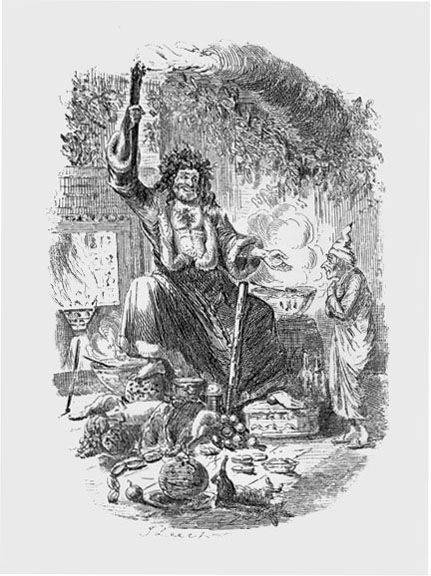
Dickens and A Christmas Carol

Just as I finished teaching Charles Dickens's A Christmas Carol, I found that maybe I should check my often-visited sites a bit more often.

Over at First Things, Joseph Bottum has posted an essay he wrote a few years ago. This "Christmas Rerun" is "an attempt to figure out why the mess of A Christmas Carol remains the greatest Christmas fiction ever written."

Then yesterday as I was listening to Hugh's show on A Christmas Carol (an interview with Mark D. Roberts), Hugh pointed out that Roberts had been posting thoughts/essays on Dickens's much-beloved work.

Roberts's posts to date are:
Part 1 My Favorite Book
Part 2 The Man Who Invented Christmas
Part 3 The Real Business of Christmas
Part 4 The First Ebenezer Scrooge
Part 5 What Made Scrooge Scrooge?
Part 6 Why Did Ebenezer Scrooge Change? Stave 1

Wish I had read some of these before starting but at least before finishing A Christmas Carol with my students.

I have my own thoughts on the book and on teaching it to high school students, but I will have to save those for another day. I will say, though, that many enjoyed the story and left looking forward to watching the movie editions again ... with greater insight into the literature behind those versions. They were particularly struck by Scrooge's transformation and the key moments/events that triggered his change.

It was especially fun, too, to play the board and trivia game A Christmas Carol as a way to review some of the highlights and perhaps too minute details of the story. We all enjoyed it nonetheless, especially with the hot chocolate, cookies, and candy canes.

Sunday, December 17, 2006

Iran's Nuclear Plans Continue: Thanks, Russia

This is not the kind of news I had hoped to read this morning: "Russia defies West and goes ahead with nuclear fuel sale to Iran." (H/T: CQ) What?! Exactly:

RUSSIA is to begin supplying Iran with nuclear fuel early next year despite mounting concern in the West that this could accelerate Tehran’s plans to build a nuclear bomb.

Good to know Russia is an ally. Right? Ally of whom? Its own pocketbook. Interesting this would be if Russia's own Islamist problem built ties to Iran. This is a point Captain Ed makes in his post about Russia's decision:

One would think that the threat of proliferation on the southern belly of Russia would give Putin and his regime some pause, but the Russian autocrat has his eyes on the wrong front. He sees his great conflict with Europe and the Western powers, which have come all the way to the doorstep of Russia, absorbing all of the buffer states that once shielded Russia from the West. That evolution of Westernization -- begun with the fall of the Berlin Wall -- has rattled Putin far more than it should, and it has kept his focus off of the real existential threat of a nuclear-armed radical Islam.

And we have no doubt that Ahmadinejad will share with his friends once he has a fully-developed nuclear process. His tip to the Kuwaitis only confirms his intentions to spread nuclear weapons throughout Southwest Asia in an attempt to eject the West from the area. He wants an end to the Israeli nuclear deterrent, and he's going to get it unless he's stopped. That would be true whether Putin hands him the fuel for his Messianic ambitions or not, but the day will come much more quickly now than before.

And if that wasn't enough to worry about, apparently the Saudis are a bit concerned these days, as the Hajj is approaching:

MILLIONS of Muslim pilgrims from all over the world begin trekking to Mecca for the annual Hajj ceremony next month - and officials in Saudi Arabia, where the "holy" city is located, are on tenterhooks. They fear that Iran's ultra-radical President Mahmoud Ahmadinejad will turn the Hajj into a political demonstration in support of his agenda for a "clash of civilizations" between Islam and what he calls "The Zionist-Crusader camp" led by the United States. (H/T: Hugh)

Sunday, December 10, 2006

The Separation between Church and State: Separating Fact from Fiction

Separation of Church and State or Separation of Church from State?
Does it matter?

In light of the recent controversy spurred on by Dennis Prager's column (and its follow-up), reading this should shed some light.

In light of the ongoing struggle to fend off the strict separationists from victory in the courts, reading this should help.

In light of the seeming never-ending claptrap that comes from some judges and justices, reading this should clarify the real issue.

In light of living in a world where many think the U.S. Constitution (and its Bill of Rights) was set up to keep religious-based ideas out of policy decision-making, out of public discourse, out of the government in any and all ways, out of the public square, reading this should give a sufficient amount of support for holding the view that the ACLU et al. are just plain wrong.

What is this?

It is “Origins and Dangers of the ‘Wall of Separation’ Between Church and State” by Daniel L. Dreisbach, published in the October 2006 issue of Imprimis (and the subscription is even free!):
There was a consensus among the founders that religion was indispensable to a system of republican self-government. The challenge the founders confronted was how to nurture personal responsibility and social order in a system of self-government. Tyrants and dictators can use the whip and rod to force people to behave as they desire, but clearly this is incompatible with a self-governing people. In response to this challenge the founders looked to religion (and morality informed by religious faith) to provide the internal moral compass that would prompt citizens to behave in a disciplined manner and thereby promote social order and political stability. The literature of the founding era is replete with this argument, no example more famous than George Washington’s statement in his Farewell Address of September 19, 1796:

Of all the dispositions and habits which lead to political prosperity, Religion and morality are indispensable supports. In vain would that man claim the tribute of Patriotism, who should labour to subvert these great Pillars of human happiness, these firmest props of the duties of Men and citizens . . . . And let us with caution indulge the supposition, that morality can be maintained without religion . . . . [R]eason and experience both forbid us to expect that National morality can prevail in exclusion of religious principle.

Believing that religion and morality were indispensable to social order and political prosperity, the founders championed religious liberty in order to foster a vibrant religious culture in which a beneficent religious ethos would inform the public ethic and to promote an environment in which religious and moral leaders could speak out boldly, without restraint or inhibition, against corruption and immorality in civic life. Religious liberty was not merely a benevolent grant of the civil state; rather, it reflected an awareness among the founders that the very survival of the civil state and a civil society was dependent on a vibrant religious culture, and religious liberty nurtured such a religious culture. In other words, the civil state’s respect for religious liberty is an act of self-preservation. The unfortunate consequence of 20th-century jurisprudence is that the First Amendment, designed to protect and promote a vital role for religion in public life, has been replaced with a wall of separation that, in the hands of the modern judiciary, has restricted religion’s place in the polity.

Friday, December 08, 2006

More Dennis and Ellison on Using the Koran in Oath

Dennis Prager's column from last week caused a lot of discussion and seeming controversy.
This week he has responded to many of the so-called arguments against his position. I say "so-called" because not a few responses were quite incendiary and more of an attack on him than on what he said. Though he may be wrong about the issue (I am still not convinced he isn't wrong; perhaps he is even right), so many have not dealt with his argument. Rather, as this week's column shows, in typical leftist fashion, many of his critics have resorted to calling him names instead of actually taking on his argument.

Though there are a few often recurring accusations against him, the most intellectually meaty is the following:

Accusation: I am advocating something unconstitutional by demanding that the Bible be included in oaths of office. I am reminded that Mr. Ellison has a right to practice the religion of his choice and that there shall be no religious test for candidates for office in America.

Dennis's answer:

Response: I never even hinted that there should be a religious test. It has never occurred to me that only Christians run for office in America. The idea is particularly laughable in my case since I am not now, nor ever have been, a Christian. I am a Jew (a non-denominational religious Jew, for the record), and I would vote for any Muslim, Christian, Buddhist, Mormon, atheist, Jew, Zoroastrian, Hindu, Wiccan, Confucian, Taoist or combination thereof whose social values I share. Conversely, I would not vote for a fellow Jew whose social values I did not share. I want people of every faith and of no faith who affirm the values I affirm to enter political life.

My belief that the Bible should be present at any oath (or affirmation) of office has nothing whatsoever to do with the religion of the office holder. And it never has until Keith Ellison's decision to substitute a different text for the Bible. Many office holders who do not believe in the Bible at all or who reject some part have nevertheless used the Bible at their swearing-in (I noted this in my column). Even the vast majority of Jews elected to office have used a Bible containing both the Old and New Testaments, even though Jews do not regard the New Testament as part of their Bible. A tiny number of Jews have used only the Old Testament. As a religious Jew, I of course understand their decision, but I disagree with it.

I agree with the tens of thousands of office holders in American history who have honored the American tradition -- I am well aware it is not a law, and I do not want it to be -- of bringing a Bible to their ceremonial or actual swearing-in. Keith Ellison is ending that powerful tradition, and it is he who has called the public's attention to his doing so. He obviously thinks this is important. I think it is important. My critics think it isn't.

Why wouldn't Ellison bring a Bible along with the Koran? That he chose not to is the narcissism of multiculturalism that I referred to: The individual's culture trumps the national culture.

You don't have to be Christian to acknowledge that the Bible is the source of America's values. Virtually every founder of this country knew that and acknowledged it. The argument that founders such as Thomas Jefferson and Benjamin Franklin were deists, even if accurate (it is greatly exaggerated), makes my point, not my opponents'. The founders who were not believing Christians venerated the Bible as the source of America's values just as much as practicing Christians did.

America derives its laws from its Constitution. It derives its values from the Bible. We don't get inalienable rights from the Constitution; we get them from God. Which is exactly what the signers of the Declaration of Independence wrote: We are endowed with inalienable rights by our Creator, not by government and not by any man-made document. And that Creator and those inalienable rights emanate from the Bible. Keith Ellison's freedom to openly believe and practice Islam and to run for elective office as a Muslim is a direct result of a society molded by the Bible and the people who believed in it, a fact he should be willing to honor as he is sworn in.

I cannot name any Western European country that does not have a document similar to the American Constitution and something akin to our Bill of Rights. It is, therefore, not the Constitution that has made America unique and a moral beacon to the world's downtrodden. What has made America unique is the combination of Enlightenment ideas with our underlying Judeo-Christian values. (I have described 24 of those values in 24 columns in 2005, all available on the Internet through
www.pragerradio.com.)

It was understood from the beginning of the republic that liberty is derived from God, not from man alone. That is why the Liberty Bell has an inscription from the Bible (from the Torah in the Old Testament) on it, not an inscription from any secular Enlightenment (or ancient Greek) source.

Sunday, December 03, 2006

Dennis Prager on Book Congressman Takes Oath on: Cutting More Flowers?

Dennis Prager has ignited a necessary discussion. In his latest column, "America, Not Keith Ellison, decides what book a congressman takes his oath on," Prager strongly makes the case that a newly elected Muslim congressman should not be allowed to take his official oath on the Koran but should do so on the Bible.

There is much to say about this, even the connection to then-Cardinal Ratzinger's caution on admitting Turkey to the EU. I hope to comment more about the issue of retaining the value of symbols and retaining an identity still attached to the roots and the foundation of a people, of a country, of a culture, but for now go and read his article: "America, Not Keith Ellison, decides what book a congressman takes his oath on."

He [Ellison] should not be allowed to do so -- not because of any American hostility to the Koran, but because the act undermines American civilization.
[...]
Forgive me, but America should not give a hoot what Keith Ellison's favorite book is. Insofar as a member of Congress taking an oath to serve America and uphold its values is concerned, America is interested in only one book, the Bible. If you are incapable of taking an oath on that book, don't serve in Congress. In your personal life, we will fight for your right to prefer any other book. We will even fight for your right to publish cartoons mocking our Bible. But, Mr. Ellison, America, not you, decides on what book its public servants take their oath.

Devotees of multiculturalism and political correctness who do not see how damaging to the fabric of American civilization it is to allow Ellison to choose his own book need only imagine a racist elected to Congress. Would they allow him to choose Hitler's "Mein Kampf," the Nazis' bible, for his oath? And if not, why not? On what grounds will those defending Ellison's right to choose his favorite book deny that same right to a racist who is elected to public office?

Of course, Ellison's defenders argue that Ellison is merely being honest; since he believes in the Koran and not in the Bible, he should be allowed, even encouraged, to put his hand on the book he believes in. But for all of American history, Jews elected to public office have taken their oath on the Bible, even though they do not believe in the New Testament, and the many secular elected officials have not believed in the Old Testament either. Yet those secular officials did not demand to take their oaths of office on, say, the collected works of Voltaire or on a volume of New York Times editorials, writings far more significant to some liberal members of Congress than the Bible. Nor has one Mormon official demanded to put his hand on the Book of Mormon. And it is hard to imagine a scientologist being allowed to take his oath of office on a copy of "Dianetics" by L. Ron Hubbard.

He closes with

When all elected officials take their oaths of office with their hands on the very same book, they all affirm that some unifying value system underlies American civilization. If Keith Ellison is allowed to change that, he will be doing more damage to the unity of America and to the value system that has formed this country than the terrorists of 9-11. It is hard to believe that this is the legacy most Muslim Americans want to bequeath to America. But if it is, it is not only Europe that is in trouble.

This reminds me of something Dennis introduced me to back in the early 90's. In a talk he gave on multiculturalism, Dennis spoke of the importance of retaining a connection to the roots that have been key in making us who we are today. In this talk, Dennis quoted the Jewish thinker Will Herberg from his book Judaism and Modern Man:

The moral principles of Western civilization are, in fact, all derived from the tradition rooted in Scriputre and have vital meaning only in the context of that tradition. The attempt made in recent decades by secularist thinkers to disengage these values from their religious context, in the assurance that they could live a life of their own as a "humanistic" ethic, has resulted in what one writer has called our "cut-clower" culture. Cut flowers retain their original beauty and fragrance, but only so long as they retain the vitality they have drawn from their now severed roots; after that is exhausted, they wither and die. So with freedom, brotherhood, justice and personal dignity--the values that form the moral foundation of our civilization. Without the life-giving power of the faith out of which they have sprung, they possess neither meaning nor vitality. Morality ungrounded in God is indeed a house built upon sand, unable to stand up against the vagaries of impulse and the brutal pressures of power and self-interest.

I second that. If we are to retain a connection to our roots, we as a people must understand this.

Continuing Thoughts on the War

Though posts these days are sporadic (too much prep and grading going on, not to mention the many afternoons and evenings--happy but cold, or should it be happy and cold--spent on the soccer field), there are some articles/essays that I cannot pass on linking to.

One must-read article is Andrew C. McCarthy's "Can We Talk? Well, we can, but we shouldn’t." Aside from the criticism of Bush-administration officials for their seemingly naive belief that the promise of democracy is the key element to conquering the enemy (rather than decisive force), he makes the point that we should not talk with Iran and Syria:

This is a war of will. If we lose it, the historians will marvel at how mulishly we resisted understanding the one thing we needed to understand in order to win. The enemy.
[...]
In the wake of 9/11, the American people did not care about democratizing the Muslim world. Or, for that matter, about the Muslim world in general. They still don’t. They want Islamic terrorists and their state sponsors crushed.
[...] Bush-administration officials — notwithstanding goo-gobs of evidence that terrorists have used the freedoms of Western democracies, including our own, the better to plot mass murder — have conned themselves into believing that democracy, not decisive force, is the key to conquering this enemy.

So deeply have they gulped the Kool-Aid that, to this day, they refuse to acknowledge what is plain to see: While only a small number of the world’s billion-plus Muslims (though a far larger number than we’d like to believe) is willing to commit acts of terrorism, a substantial percentage —meaning tens of millions — supports the terrorists’ anti-West, anti-democratic agenda.

Islamic countries, moreover, are not rejecting Western democracy because they haven’t experienced it. They reject it on principle. For them, the president’s euphonious rhetoric about democratic empowerment is offensive. They believe, sincerely, that authority to rule comes not from the people but from Allah; that there is no separation of religion and politics; that free people do not have authority to legislate contrary to Islamic law; that Muslims are superior to non-Muslims, and men to women; and that violent jihad is a duty whenever Muslims deem themselves under attack … no matter how speciously.

These people are not morons. They adhere to a highly developed belief system that is centuries old, wildly successful, and for which many are willing to die. They haven’t refused to democratize because the Federalist Papers are not yet out in Arabic. They decline because their leaders have freely chosen to decline. They see us as the mortal enemy of the life they believe Allah commands. Their demurral is wrong, but it is principled, not ignorant. And we insult them by suggesting otherwise.
[...]
So now comes James Baker’s Iraq Study Group, riding in on its bipartisan white horse to save the day. The democracy project having failed, this blue-ribbon panel’s solution is: Let’s talk.

Let’s talk with our enemies, Iran and Syria. Let’s talk with terror abettors as if they were good guys — just like us. As if they were just concerned neighbors trying to stop the bloodshed in Iraq … instead of the dons who’ve been commanding it all along.
[...]
What earthly logic that supports talking with these Islamic terrorists would not also support negotiating with al Qaeda — a demarche not even a Kennedy School grad would dare propose?

When I grew up in The Bronx, there were street gangs. You mostly stayed away from them, and, if you really had to, you fought with them. But I never remember anyone saying, “Gee, maybe if we just talk with them ...”

Nor do I remember, in two decades as a prosecutor, anyone saying, “Y’know, maybe if we just talk with these Mafia guys, we could achieve some kind of understanding ...”

Sitting down with evil legitimizes evil.
[...]
For our own sake, we need to respect the enemy. That means grasping that he’s implacable, that he means us only harm, and that he must be subdued, not appeased. Negotiating with such evil is always a mistake, for any accommodation with evil is, by definition, evil.

Rejecting the democracy project is about respecting the enemy. Declining to talk to the enemy is about respecting ourselves.

Thursday, November 23, 2006

WKRP - Thanksgiving Turkey Drop

Happy Thanksgiving!

H/t: Hugh.

Friday, November 17, 2006

Death of Milton Friedman

Some years ago, Young America's Foundation introduced me to a great promoter of freedom--real freedom. I had heard of him already and read bits and pieces, but once I became involved with YAF and Young America's Foundation (and ISI too) I began to understand on a deeper level the meaning and importance of this great champion of freedom. Milton Friedman passed away Thursday at the age of 94.

Two important and somewhat brief books of his are Capitalism and Freedom and Free To Choose: A Personal Statement. (Another book, somewhat similar in topic, which impacted me during this same time is The Road to Serfdom by Hayek. H/t: Philippe for correction.)

It's ironic, in a way, that he had been in the news the past few days ... at least the news at the Wall Street Journal and then their letters to the editor.

There are plenty of articles and essays paying homage to the man and his ideas. Some noteworthy ones are:

Wall Street Journal's "Capitalism and Friedman"
Young America's Foundation interview with Friedman on the merits of free-market economics
Iain Murray's "Friedman’s Legacy: Capitalism and a giant" over at National Review Online

Monday, November 13, 2006

HorrorFest

For horror fans, this looks like a fun weekend of getting the most for your money ... at least if you live near a theater showing the HorrorFest.

Saturday, November 11, 2006

8th of November

8th of November

A few days late, but what better day to remember the 8th of November.

2006 Election Thoughts: Hewitt Has a Point

Hugh has some post-election thoughts worth reading. What will become of the Republican party?

The post-mortems are accumulating, but I think the obvious has to be stated: John McCain and his colleagues in the Gang of 14 cost the GOP its Senate majority while the conduct of a handful of corrupt House members gave that body's leadership the Democrats.

After explaining a few key factors that led to the GOP losses (be sure to read them), Hugh closes with:

It is hard to conceive of how the past two years could have been managed worse on the Hill.

The presidential ambitions of three senators ended Tuesday night, though two of them will not face up to it.

The Republican Party sent them and their 52 colleagues to Washington D.C. to implement an agenda which could have been accomplished but that opportunity was frittered away.

The Republican Party raised the money and staffed the campaigns that had yielded a 55-45 seat majority, and the Republican Party expected the 55 to act like a majority. Confronted with obstruction, the Republicans first fretted and then caved on issue after issue. Had the 55 at least been seen to be trying --hard, and not in a senatorial kind of way-- Tuesday would have had a much different result. Independents, especially, might have seen why the majority mattered.

Will the GOP get back to a working majority again? Perhaps. And perhaps sooner than you think. The Democrats have at least six vulnerable senators running in 2008, while the situation looks pretty good for the GOP.

But the majority is not going to return unless the new minority leadership --however it is composed-- resolves to persuade the public, and to be firm in its convictions, not concerned for the praise of the Beltway-Manhattan media machine.

Saturday, November 04, 2006

Debating Abortion at Berkeley: An Interview with Dr. Dennehy

National Catholic Register has just posted a great interview with a real man of courage and honor: Dr. Raymond Dennehy. In "20 Years, 40 Semesters of Abortion Debates," Dr. Dennehy answers many questions related to his 20 years of debating abortion at Berkeley. Aside from being a great defender of the unborn, aside from being an eloquent debater, aside from being a very humorous person, he is also one of a core of people who helped make my undergraduate days some of the best imaginable.
Read the interview.
Here is a comment I posted over at the Ignatius Insight Scoop site about one of the incidents mentioned in the interview:

Dr. Dennehy mentions the time an opponent got very upset and interrupted the other pro-life debater. Dennehy adds that he "simply inserted himself between them." I remember that day. I was there with some friends from USF. From our perspective, it was much more than "simply." We kept talking about it for quite a few days. Most of us recalled that moment at our graduation and whenever we have recollected some of the (many) highlights of being a student at the then-St. Ignatius Institute at USF.

What Dennehy did was insert himself between two speakers, one of whom had the floor and the other of whom was disrespectfully interrupting the time of the first. The pro-life person was speaking, as Dennehy said, and then the pro-abortion person got so upset that he came across towards the pro-lifer and started raising his voice at her. He was obviously upset and seemed to have been affected strongly by the realities of what the pro-lifer was saying. He, the pro-abort guy, did not like it. He did not like the truth of what was/is really going on around the world with regards to abortion.

Then a scene broke out reminiscent of stories and movies where a bully is stood up to. Dr. Dennehy came forward just like a knight. This long-time defender of the unborn came to this lady's rescue. To most of us there, the attempt by the pro-abort to get in the pro-lifer's face and say what he did was an attempt to intimidate her through his strong verbal language, strong body language, and thus ultimately to shut her up or at least make her think twice about making such controversial (though true) statements as she was making.

Then Dr. Dennehy came over and stood strongly between the two, putting forth his body in a way that the pro-abort guy clearly got the message that any further rude actions and disrespectful behavior would have to go through Dr. Dennehy before they could reach the female pro-life debater. Not just a defender of the unborn, but even a defender of those who are rudely interrupted while trying to explain the consequences of abortion policies throughout the world. We were a bit shocked at the initial rudeness of the pro-abort guy, which actually caused him to lose respect in the minds of many there (even so-called "pro-choice" students, as they later told me).

Once Dennehy did what he did, a large cheer and applause broke out throughout the room ... and like I said ... even from the students who were in support of a woman's right to kill her unborn child. Minds were slowly realizing the different ways truth is attacked.

What Dennehy did may have been "simply" a normal act on his part, but to all of us there it was much more than that. It was another gesture of defending those who are being attacked, whether verbally or physically. It was another gesture from a man who has spent his life not only teaching others about truth and goodness but has followed it up with the continual witness and sometimes even knightly presence when needed as he defends (and encourages others to defend) the innocent and defenseless, as he even inspires others to join and continue the fight to protect these little ones of God.

Blacks and Whites: Halloween Hate

It is amazing that they survived.

Victims of attack share their story

"It was like animals, like a pack of hyenas," Michelle said.

Halloween gone bad.

Wednesday, November 01, 2006

Kerry Comments and the Fo-do


Here is the photo that so many are talking about. (H/T: Drudge)

Wednesday, October 25, 2006

All Saints and an Apt Literary Assignment

All Saints Day is just around the corner. Since you have been so helpful with the other times I have sought suggestions for class (British literature), I thought I would put out another post seeking your help.

All Saints Day. British literature. Any suggestions?

Whatever is done has to be done that day in class and that's all. Reading and discussing and analyzing.

A poem? Poems? A short story? Some story that deals with a communion of folks of some sort and the beauty of things when they work together, rely on each other, trust each other? Or perhaps when they don't? To show the failings of us here without being in the constant state of grace of those in the Communion of Saints?

Or something else?

All suggestions welcome. Comment in comment section below or send an email.

I have looked at quite a few poems and some sermons from those who have a literary bent to their art. Even a letter from Leon Bloy (I know, he's not British, but I like his writings a lot) that he wrote to his bride-to-be which dealt with their love and the still contested issue of the relics of saints and their (the saints) everlasting Communion. She was not yet Catholic.

Thanks.

Tuesday, October 17, 2006

Upcoming Election: Republican or Democrat?

Republican or Democrat?

Still trying to figure out which candidates (and thus which party) to vote for in the upcoming election?

Check this out to get some answers ... and have some laughs. All that, and some good music too!

Sunday, October 15, 2006

Ruff, Ruff: Do Dogs Go to Heaven?

On Dennis Prager's show Friday, a caller asked if Dennis believes dogs (or other pets) go to Heaven. Since the Torah does not stipulate one way or the other, Dennis said he was not sure. Then since it does not seem dogs have free-will, Dennis said he had doubts if non-volitional creatures could merit Heaven.

That said, this reminded me of the response the widely respected Catholic theologian Fr. John Hardon, SJ gave some time ago. In The Catholic Faith magazine (May/June 1999 ~ Vol. 5, No. 3), Fr. Hardon was asked the same question. His reply touches on aspects unaddressed by Dennis:

Pets, as pets, do not go to Heaven. But animals and such like beings may be said to be brought to Heaven because, after the Last Day, they can serve as part of the joys of Heaven. In other words, animals and such like creatures may be said to be brought to Heaven to serve as part of our Heavenly joys. Clearly, we do not need pets to provide happiness in Heaven. But pets and such like creatures will be brought to Heaven to become part of our creaturely happiness in the Heavenly kingdom. Consequently, we may say that animals and such like creatures may be brought to Heaven by God to enable us to enjoy them as part of our creaturely happiness in Heavenly beatitude.

This answer pleased quite a few children, especially the grown-up ones.

Survived by Us

Rick Moran at RightWingNutHouse has a tribute worth reading to Michael Monsoor, the Navy SEAL who gave his life to save others in his team:

His SEAL team was in support of a joint US-Iraqi operation in Ramadi when a grenade was thrown through the door of their sniper hideout. It bounced off Monsoor’s chest and fell to the floor mere feet from 4 of his comrades. With every natural instinct for self preservation in his body and mind screaming for him to flee, Michael Monsoor made a conscious, rational choice; he deliberately fell on the grenade sacrificing his life so that his comrades would live.


Rick closes with words that all should keep in mind:

Michael is also survived by us: A grateful nation who will recall his sacrifice and the sacrifices of all the others with awe and a sense of obligation for a debt that we can never repay, only vow never to forget.

Sunday, October 08, 2006

Continuing Thoughts on Ahmadinejad and the Holocaust

In "The Six-Million Person Question: Ahmadinejad and the Holocaust," Mark Bowden responds to Iranian President Ahmadinejad's comments about the Holocaust. Bowden closes with the following thoughts:

What the Holocaust demonstrates is the danger of a one-party state. It shows what can happen when a group of true believers, convinced of the superiority of their own ideas, have unchecked power. They are then free to rewrite history to suit their political ends, and crush those who disagree or protest . . . or who worship God in a different way.

Like, say, the mullahs in Iran.

How long will the West tolerate this guy and the mullahs behind him?

Sunday, October 01, 2006

British Novel: Some help needed

Ok, now I need some more assistance. I just found out that I have to add another novel (or play) to our syllabus for this year. I teach British lit (to twelfth graders) at a Catholic high school so any of you who have a suggestion, please send it my way.

We use a pretty good textbook that has quite a bit of the classics. I plan on using much of it. Then we will be reading A Christmas Carol just before Christmas and Animal Farm in the spring. I added Animal Farm because so many of the students have not yet read it. What a crime! So though it is something that should be read the first time in middle school (in my opinion), I want them to have the joy and pleasure of reading it with someone who really enjoys the book. If time permits, we will read Four Quartets by T. S. Eliot at the end of the year.

So what else would be a good British lit novel for twelfth graders (17 and 18 year old Catholic high school students) to read? Throughout the sections I teach, the reading levels are mixed: from high to middle to lower.

I have some on my mind, but I am not sure what kind of book I want them to read. I was thinking of some classics but they may end up being too serious or heavy. Then I thought that it might work better and be more enjoyable to read something fun and "comical" or entertaining (in a good literary sense) than the deeper cathartic type I initially thought of. Not sure yet, but it is something that would be read some time between February and May.

Thanks for your help. Put your suggestion(s) in the comment box below or in an email.

Books that I am thinking of:

Heart of Darkness by Joseph Conrad
Lord Jim by Joseph Conrad
The Power and the Glory by Graham Greene
How Right You Are, Jeeves by P.G. Wodehouse
The Man Who Was Thursday by G. K. Chesterton
Howards End by E. M. Forster
A Tale of Two Cities by Charles Dickens
King Lear by William Shakespeare
A Midsummer Night's Dream by William Shakespeare
The Tempest by William Shakespeare (leaning towards this)
As You Like It by William Shakespeare
Twelfth Night by William Shakespeare

Wednesday, September 27, 2006

Prager on Benedict & Pius

Once again, Dennis Prager's clarity shines through. In his latest column, "Pius attacked for not confronting evil, Benedict attacked for confronting evil," Dennis compares the recent criticism of Pope Benedict's comments on Islam, violence, and the role of reason with criticism of Pope Pius XII's alleged silence or even complicity regarding the Holocaust of the Jews: "But the attacks on Pope Benedict XVI may help shed new light on some of the motives for the attacks on Pius XII."

After all, has not Benedict done precisely what Pius's critics argue that Pius, and presumably any pope, should have done -- be a courageous moral voice and condemn the greatest evil and greatest manifestation of anti-Semitism of his time?

Take The New York Times editorial page, for example. It is written by people who condemn Pius for his alleged silence and now condemn Benedict for not being quiet. ...

He goes on to write:

Another example is Karen Armstrong, the widely read ex-nun scholar of religion. She has written of Pius XII that his "apparent failure to condemn the Nazis has become a notorious scandal." Moral and logical consistency suggest that she would welcome a pope who did confront today's greatest evil. But she has joined those condemning Pope Benedict. She wrote (putting these arguments in the mouths of affronted Muslims with whom she sympathizes): "the Catholic Church is ill-placed to condemn violent jihad when it has itself . . . under Pope Pius XII, tacitly condoned the Nazi Holocaust."

The argument is so illogical that only those who attended graduate school or Catholicism-bashers could find it persuasive. First, how do you condemn the silence of one pope when confronted with the greatest evil of his time and condemn another pope when confronting the greatest evil of his time? Second, if indeed the Church is guilty of condoning evil in the past, why does that render it "hypocritical" (her term for Benedict's condemnation of Islamic violence in God's name) to confront evil in the present? If my grandfather was a murderer, am I a hypocrite for condemning murder?

And closes with:

But the condemnations of Pope Benedict by virtually every major critic of Pius XII lead me to wonder whether the critics really want popes to confront evil or just want popes to think like they do.

Monday, September 25, 2006

Russia : Defender of Islam?

Huh? What could this mean?

Russia is the most reliable partner of the Islamic world and most faithful defender of its interests, Russian President Vladimir Putin said in Chechnya’s capital Grozny. Putin unexpectedly visited the war-ravaged republic to speak in the local parliament that opened for its first sitting on Monday.

“Russia has always been the most faithful, reliable and consistent defender of the interests of the Islamic world. Russia has always been the best and most reliable partner and ally. By destroying Russia, these people (terrorists) destroy one of the main pillars of the Islamic world in the struggle for rights (of Islamic states) in the international arena, the struggle for their legitimate rights,” Putin was quoted by Itar —Tass as saying, drawing applause from Chechen parliamentarians. [Emphasis added.]

(H/T: Gates of Vienna)

McCain Defends the Rights of Terrorists

PowerLine points out the latest "achievement" of Sen. John McCain: "John McCain seizes the moral high ground on behalf of his country":

Yesterday, Senator McCain listed some of the rights that terrorists now have thanks to his work. According to McCain, they have the right not to be subjected to water-boarding, extreme sleep deprivation, and forced hypothermia. Terrorist organizations also have the right, thanks to McCain, to know in advance which practices apparently are off-the-table.

With friends like this, ...

Sunday, September 24, 2006

Pope Benedict and Islam : Further Thoughts

Here are some further thoughts on Pope Benedict XVI, what he said, and Islam:

Benedict Takes the Next Step with Islam by Mark Brumley

Ratzinger and Regensburg: On What Is a University? by Father James V. Schall, SJ

Is Dialogue with Islam Possible? Some Reflections on Pope Benedict XVI's Address at the University of Regensburg by Father Joseph Fessio, SJ

All are good reads. As usual, Against the Grain has a detailed roundup of published thoughts on the matter.

On another note, it seems that Froggy might be back. Let's hope he is.

Colin Powell and Some Doubts about His Civil Service

Here is further proof that Colin Powell is not all that many have built him up to be: "Colin Powell fails Military History."

Some background is here: "Remind me why I liked Powell."

However great a soldier he may have been--and I don't doubt that--he has continually shown himself to be somewhat inept and at times a duplicitous diplomat and civil servant.

As Dennis said here (2nd half of audio), here, and here, since it has come out that Powell knew all along who the leak was (in the Plame case), then why didn't he say something, why didn't he speak up, why did he let Karl Rove take so much heat and unjust criticism, and more to the point, why did he let Scooter Libby twist in the wind, let Libby's career be jeopordized, let Libby suffer the humilities of legal action ... all these things if he knew the truth? Not the sign of an honorable civil servant. More like the actions of someone with a political ax to grind.

Reading "The Disloyalists" by Frank J. Gaffney, Jr. will help explain some of the shenanigans. So will "Plame Out: The ridiculous end to the scandal that distracted Washington" by Christopher Hitchens.

Here is a list of related news and commentary articles.

While I'm at it:
"The real story behind the Armitage story" by Robert Novak

"What a load of Armitage!" by Michael Barone

"Plamegate" by Michael Barone

"Just A Plame Waste Of Time" by Captain Ed

"The 'Hubris' Of Richard Armitage" by Tom Maguire

"Give Bush a Break" by Jonah Goldberg

UPDATE:
The Anchoress has weighed in too: "Colin Powell: the male Valerie Plame"

Sunday, September 17, 2006

Pope Benedict XVI and Islam: What Did He Say?

Last week, Pope Benedict XVI gave a talk at the university where he used to teach. His talk was on the greater role of reason in theological and philosophical dialogue, but one portion of the talk--the relation of reason to certain teachings or practices of Islam--is getting a lot of publicity.

Here's the talk: "Faith, Reason and the University: Memories and Reflections"

Mark Brumley offers a great summary:

This incident can be summarized: The pope says reason and religion must go together for each to be able to remain true to itself. Some Muslims object and throw a fit, thus proving the pope right.

Here are some links to those who have a whole lot of info, background, and up-to-date commentary on the continuing "controversy":

Pope Benedict XVI on "Faith, Reason and the University" - Regensburg, 2006 by Chris Blosser, who has once again compiled a great round-up of links

The Controversy over Pope Benedict's Remarks on Islam by Chris Blosser

The Regensburg Lecture: Thinking Rightly About God and Man Fr. James V. Schall, S.J.
Rioters' madness shames Muslim world by Fr. Raymond J. de Souza, a great priest I got to know during some Acton-related events in the 90's; make the time to read his essay

Italian nun killed;Pope sorry for Muslim reaction by Michelle Malkin

Pope Rage on the Internet;church bombings in Gaza by Michelle Malkin

I support the Pope by Michelle Malkin

"The Pope’s speech: lending Islam a helping hand to avoid a downward spiral" by Samir Khalil Samir, sj

And at Ignatius Press's blog: Insight Scoop:

Pope's Comments on his Regensburg Lecture

"radical Christianity is just as threatening as radical Islam..."

Vatican Statement on Muslim Anger At Pope's Speech

European leaders back Benedict

The Real Story

Our threats of violence prove how peaceful we really are

Vatican defends pope’s remarks on Islam

The Vatican has issued some statements since where the Pope and/or a spokesman offer a response to some of the criticism.

Aside from all that, do words--however much they may be interpreted in a negative way, even if rightly so--do words from one Christian, even a very important Christian, justify the violence from Muslims that has resulted?

What is it about these Muslims that no criticism, even if wrong, will be tolerated? Are they not proving the point of the quoted passage in the Pope's speech that Muslim use of violence in this way is contrary to reason? Why do they not pursue the road of reason as a response rather than the ways of violence and intimidation?

Monday, September 11, 2006

9/11 Patriot Day: Remember the Fallen and Those Who Defend Us

September 11

On this day, just as a few other key blogs have been doing such as Mudville, Blackfive, Hugh, it is important to remember folks like Rick Rescorla. You can find out about him here.

During the 2001-2002 school year, one of my students did his research project on 9/11. When it came time to pick someone for the biography section, I suggested he consider Rick Rescorla. He did and wrote about the hero. That student, the class, and I all benefited from the essay. We learned a lot about the man who saved many lives.

Saturday, September 09, 2006

Help Wanted: Best British Poems

I am trying to come up with a Top 9 of British poems and/or almost poems. I require my high school students to memorize one poem a month. Sometimes, it is technically not a poem but a selection from a larger work that I treat as a poem, such as the "Song of the Witches" from Macbeth: "Double, double toil and trouble; / Fire burn and caldron bubble."

Any suggestions you may have are very much welcome. Just post them or their titles in the comments section below or email me.

One a month for nine months.

I have a few already set because of the holiday/liturgical seasons.

Revisiting 9/11 with Fr. Schall, SJ

As usual, Fr. James V. Schall, SJ, has written a powerful and meaty essay, this one on 9/11 and how things look five years after that unforgettable day: "9/11 Revisited."

The fifth anniversary of the wanton destruction of the World Trade Center Towers is upon us. We ask ourselves: "Were the three thousand people killed somehow 'legitimate' targets?" and, "What was this attack about?" On the accuracy and clarity of our responses everything depends, including the purpose of reason itself. Yet, we are perplexed by the myriad of conflicting and contradictory explanations for the central cause of this day, now called, without further reference, "9/11."

The best anyone can do in these circumstances, it seems, is to provide a solid and well-considered opinion. This is what I shall try to do here. An "opinion" is an informed judgment based on suitable and available evidence concerning possible actions or explanations. The opinion on which one acts could be wrong, but we always act with some lack of clarity. We are irresponsible in many crucial instances, moreover, if we do not seek to find a plausible and accurate opinion about human events, about what they mean.

Saturday, September 02, 2006

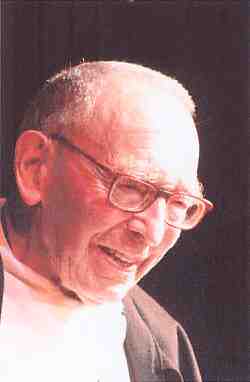
Fr. Marie-Dominique Philippe, Community of Saint John, and a Beautiful Day

Fr. Marie-Dominique Philippe passed away a week ago. His funeral was today in France and his body will be buried at Rimont (on the grounds of the motherhouse of the community he helped found: the Community of Saint John).

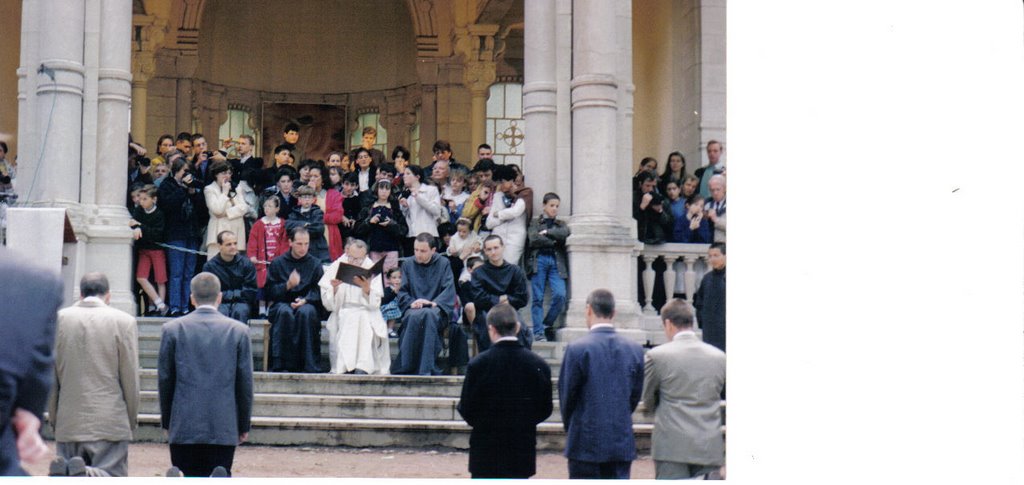
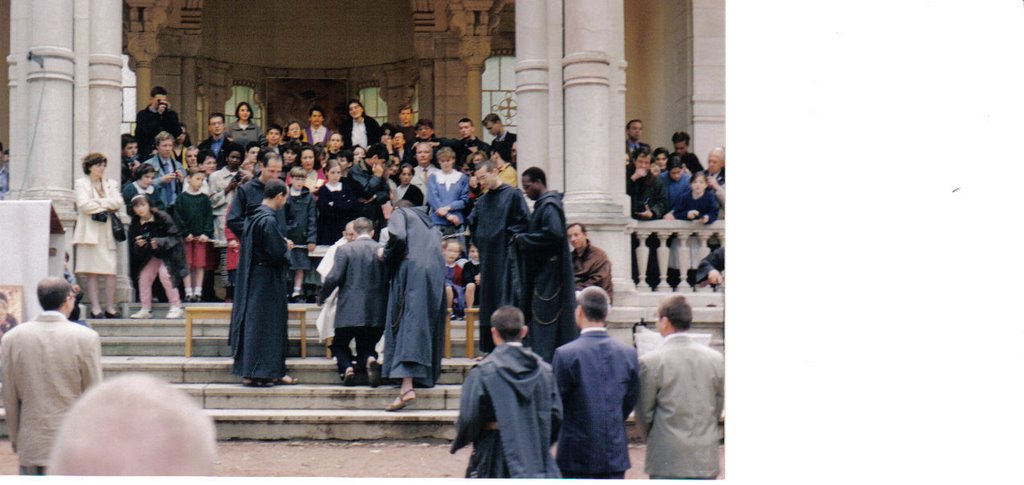
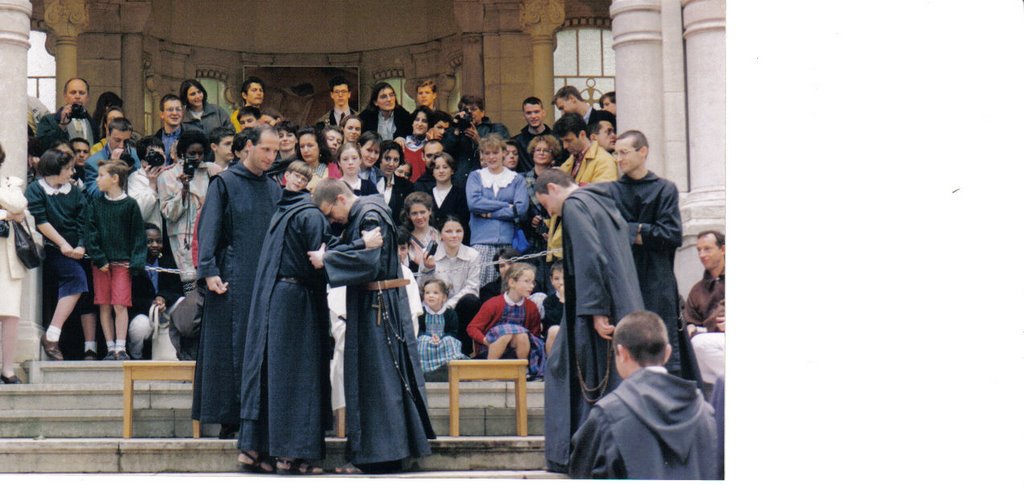
One of the most beautiful days I have experienced is the day I went to Paray le Monial for the profession of vows of some of the brothers. It was a day that some of them received their habit, the religious clothing of monks. The day was beautiful for many reasons, which some day I hope to write down, but for now the moment that directly involves Fr. Philippe is the moment, the event, of a man hearing for the first time and accepting his religious name (Brother so-and-so) ...

... coming up to the presiding superior and with the aid of his fellow brothers taking off an item (a coat) from his former non-monastic days ...

... as prayers are said to express what is going on with the removing of the item ... all with the assistance of his fellow brothers ...

... then the young man receives the habit ... the items are placed on him and his belt is buckled ... and the rosary is given which he places a part of it under his belt to keep it in place ... all this while prayers and explanations are reverently said to express the (monastic) significance of these items and also what they symbolize. The new brother then receives an embrace from his superior (here the founder Fr. Marie-Dominique Philippe) as they each give a monastic gesture: the touching of the side of the left temple of the head upon the other's.

The new brother then gets up and exchanges the gesture with his fellow brothers who helped him during this moment take off the old man and put on the new man.

Ah, the beautiful manifests itself in so many ways! There are few things, moments more beautiful to those who see and understand what is happening on the day one becomes a monastic brother.

Fr. Marie-Dominique Philippe Laid To Rest

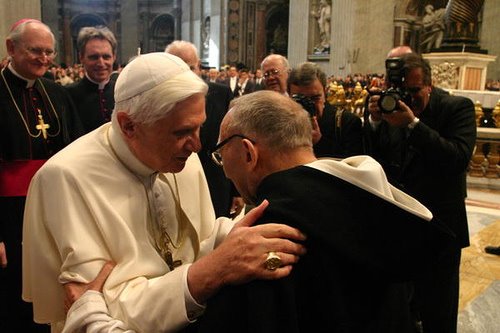
Today was the funeral of Fr. Marie-Dominique Philippe. This priest was a true man of the Church, one who contagiously expressed a real joy from living in the Church. Pope Benedict XVI's message on the passing can be found here.

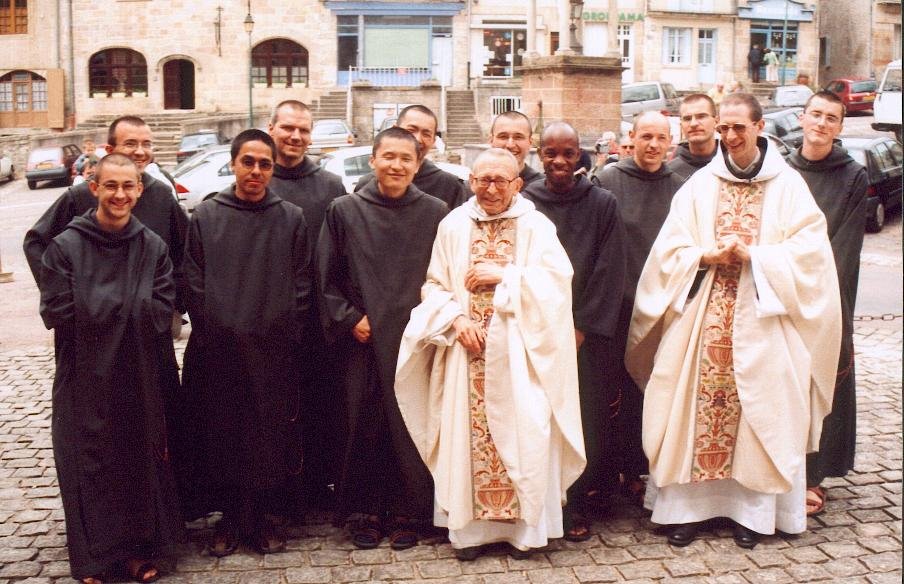
Below is a photo of Fr. Philippe with some of the brothers of the Community he helped found.

Sunday, August 27, 2006

Aristotle and the Mysteries of Mary: What! "That's Impossible!"

With the news of Fr. Philippe's passing, I decided to spend parts of today listening to Bach's Mass in B-minor and Mozart's Requiem. Both powerful pieces. The Requiem still being one of my favorite pieces to get lost in and fall into a spiritual dimension of play.

Well, I also decided to read some from Fr. Philippe. There is so much to choose from. You can see some of his works translated into English here.

The Community's site has a link to an anecdote that I heard some time ago while visiting them and is still one of my favorite stories about Fr. Philippe. Here it is:

Jean Guitton used to like to go to Châteauneuf-de-Galaure, a small village in the department of the Drôme, southern France, to see Marthe Robin, a mystic who suffered the stigmata and who was foundress of the Foyers de charité (Houses of Charity). A Dominican priest also used to go regularly to Châteauneuf-de-Galaure to give retreats and to meet with Marthe Robin. On one particular occasion someone mentioned to Jean Guitton that Father Marie-Dominique Philippe had just arrived. “Which one?” asked Guitton, “The author of The Mystery of Mary or the author of An Introduction to the Philosophy of Aristotle? Guitton’s friend replied that these authors were one and the same person. Amazed, Jean Guitton exclaimed, “But that’s impossible!”

This brief anecdote points to the unusual and little-known journey of a man who has often gone against the current, pursuing an intense philosophical research in an age when philosophy is no longer studied, and who, in an age when the religious life has fallen upon hard times in many ecclesiastical circles, has founded a new religious community that has spread throughout the world. Father Philippe, both as a thinker and as a religious, is not someone whom it is easy to classify. He closely follows developments in modern philosophical thought and for over forty years has maintained a fruitful dialogue with scientists, psychoanalysts and other intellectuals whose fields of research are quite different from his own. He has published books on mathematics, art and medicine, at the same time as preaching retreats to Carmelites on The Song of Songs and St. John’s Apocalypse. His undying loyalty to the Magisterium of the Catholic Church has often earned him the label “traditionalist”.

Many misunderstandings, in fact, arise from his attachment to St. Thomas Aquinas and to Aristotle. As a result of what seems to us a superficial reading of Father Philippe, many view his philosophical and theological thought as Scholastic Thomism. Some are delighted at this revival of the “good old Thomistic tradition” which has been beaten into the corner by the contemporary philosophies that have produced modern day atheism. Others deplore this out-of-date, obscure thought - which seems to confuse the radically different perspectives of the philosopher and the theologian - as totally ineffective in the modern world.

To our mind, a more attentive study of Father Marie-Dominique Philippe’s thought (of which this book offers the possibility) reveals that his personal reflections are consciously developed with the intention of distinguishing clearly the starting point of the philosopher’s work (i.e. experience) and the starting point of the theologian’s work (i.e. faith) - something which Scholastic Thomism has never done. It also seems that Father Philippe’s thought is characterised by a constant concern to return to the source, both to the source of western philosophy - in order to take up once more and continue the diligent search for truth begun by the ancient Greeks - and to the source of Faith, that is, the Gospels, seeking to develop a mystical theology based upon the writings of St. John.

Fr. Marie-Dominique Philippe, OP
1912-2006
Requiescat in pace

The Passing of a Saintly Priest: Fr. Marie-Dominique Philippe, OP


Fr. Marie-Dominique Philippe, OP, was the founder of one of the Church's strongest and rapidly growing religious communities: the Community of Saint John.

Yes, was.

He passed from this life yesterday, August 26:

Father Marie-Dominique Philippe, o.p., founder of the Community of Saint John, died peacefully on Saturday morning August 26, 2006, at the priory of Saint Jodard (France). He was being taken care of there since his stroke on July 20. He was going to be 94 years old on September 8.

Until the funeral day, the brothers and sisters keep vigil around him in the brother's chapel in Saint Jodard. The vigil is opened to all who wish to participate.

The funeral mass will be celebrated on Saturday September 2 at 10:30 am at the Cathedral of Lyons. It will be presided by Cardinal Philippe Barbarin, archbishop of Lyons.

In the afternoon, Father Marie-Dominique will be buried in the cimetery of Rimont, in the intimacy of the Family of Saint John (brothers, sisters and oblates).

In thanksgiving for all they have received through him, the memebrs of the Family of Saint John entrust him to the prayer of all.

As it says, he will be buried at Rimont, which is the mother house, the main house, for the Community. Some years ago, I was blessed to spend some time there and to meet and speak with Fr. Philippe. A very holy and wise man, and with that a great vivacity and jovial dynamic to him. He will be dearly missed ... and not just by those in France. His impact has been felt around the world.

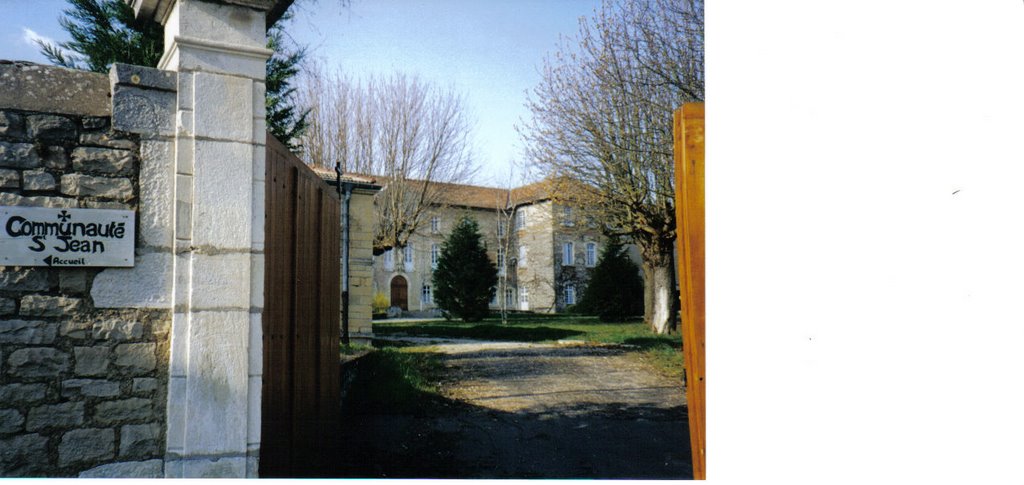
Here is the front gate to the house at Rimont.

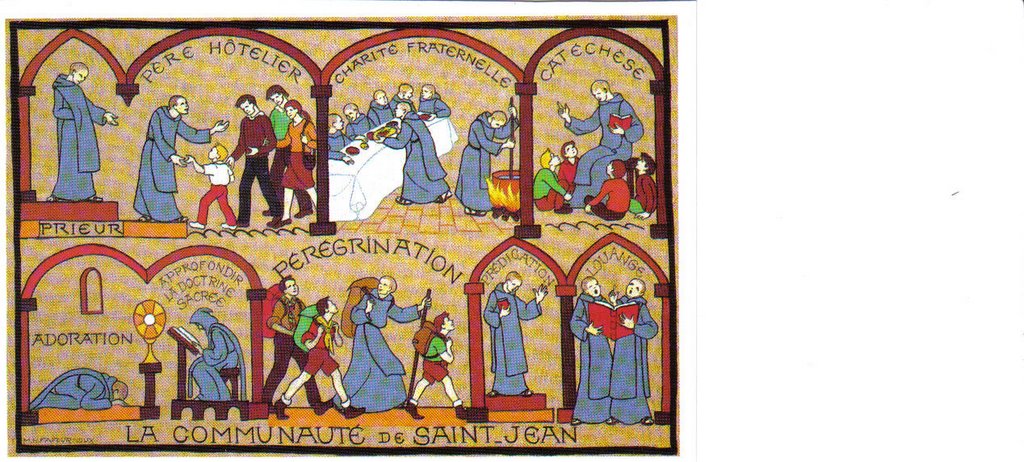
The Community of Saint John is known for many things, many apostolates. This postcard captures the many ways they follow the Lamb ... wherever He goes:

Friday, August 25, 2006

Back To School and Some Blogging

Life has been busy lately, which is why I haven't been posting that much. However, I am glad it has not been busy in the wrong way in Israel, regardless of how disappointed I and many others are that Israel did not do what we had hoped.

Like I said, at least and gladly so we are not talking about other types of news this week.

The busy part is being back to school ... right now teaching high school English and history.

Tuesday, August 08, 2006

Iran August 22

I am getting all sorts of inquiries about August 22 and Iran. I guess today's Wall Street Journal column by Bernard Lewis has sparked renewed curiosity in the Islamic significance of August 22. Well, here is the link to the post on the matter: "Welcoming the 12th Imam? Iran and August 22."
That should have all you need to know. If not, recall what Iran's president said recently:

Iranian President Mahmoud Ahmadinejad said Thursday the solution to the Middle East crisis is to destroy Israel. In a speech during an emergency meeting of Muslim leaders, Ahmadinejad also called for an immediate halt to fighting in Lebanon between Israel and the Iranian-backed militant group Hezbollah.

More need now to be and to stay standing with Israel.


I will rewrite a new post and update it with the latest as soon as I have a break from the busy schedule at Witherspoon, which by the way is going very well. I even met up with a fellow blogger: Trent at X-Catholics.

Friday, August 04, 2006

Studying Finnis, Rawls, Natural Law, and Political Liberalism

For the next week and a half or so, I will be at the Witherspoon Institute's First Principles Seminar: “Natural Law Theory and Political Liberalism: John Finnis and John Rawls." It should be a good, intellectually stimulating, and fun time. With the great good of wireless networking in the dorms, I will be posting throughout about the seminar and whatever else strikes my fancy ... like finishing my research project (which this seminar should help me do), FC Barcelona playing in the States, and the ever-approaching August 22.

Thursday, August 03, 2006

Iran Says Destroy Israel ... as August 22 Approaches

As August 22 approaches,

Iranian President Mahmoud Ahmadinejad said Thursday the solution to the Middle East crisis is to destroy Israel. In a speech during an emergency meeting of Muslim leaders, Ahmadinejad also called for an immediate halt to fighting in Lebanon between Israel and the Iranian-backed militant group Hezbollah.

"Although the main solution is for the elimination of the Zionist regime, at this stage an immediate cease-fire must be implemented," he said.

Ahmadinejad [...] said the Middle East would be better off "without the existence of the Zionist regime."

Israel "is an illegitimate regime, there is no legal basis for its existence," he said.

Read the whole AP article, "Ahmadinejad: Destroy Israel, End Crisis." (Emphases added above.)

Like I said ... all this as August 22 approaches. Read "Welcoming the 12th Imam? Iran and August 22."

Wednesday, August 02, 2006

Quit Trying To Help. You Only Hurt. The Gov't and Minimum Wage

Here is just one reason why I don't support government intervention to set a(n artificial) minimum wage: "The ‘Moral’ Minimum Wage Increase Hurts Teens and Minorities" by Anthony B. Bradley.

Forced government wage increases are supported when people forget that the money used to cover the increase does not magically materialize. It must come from somewhere. Since Americans love the best products for the lowest prices, businesses will not likely pass the cost of the wage increase on to consumers in the form of higher prices. They will, instead, reduce their costs by laying off workers with the lowest skills, relocating the jobs (or the entire business) to another country, or skirting the law altogether by paying employees “under the table” or by hiring illegal immigrants.
[...]
Those in favor of the increase believe that they stand on the moral high ground. Rev. Suzanne Meyer, president of All God’s People, a multi-faith social advocacy group located in St. Louis, calls the current $5.15 rate “a moral outrage. It effectively sentences millions of workers and their families to live in abject poverty.” Why is it not, instead, a moral outrage to increase teen unemployment, increase minority unemployment, and encourage the circumvention of the law by employing illegal immigrants and paying under the table?

Employees who become more productive by gaining experience and improving their education earn larger raises and salaries in the long term. A minimum wage set by agreement between employer and employee establishes the best entry point for people with few skills to gain experience and develop the abilities needed to advance. It is in keeping with both human dignity and economic reality to give employers and employees freedom to negotiate employment on terms set by themselves, not by politicians.

Tuesday, August 01, 2006

Yoni the Blogger

During this time of war for Israel, aside from Truth Laid Bear, check out Yoni the Blogger. He seems to have news/updates before anyone else. I guess it helps to have served 20 years in the Israeli military and to have many friends over there ... in the middle of the fight. Here is a bit about him.