Tuesday, June 06, 2006

Being Wrong, Believing Wrong, and Doing Wrong: Some Notes on a Review

My recent review of Kevin Seamus Hasson's book The Right To Be Wrong has generated the kind of response I figured would happen. I have received some emails from folks surprised I would endorse relativism. Me? Endorse relativism? Did I do that? Not intentionally.

With regard to the book review, please keep in mind that the limited number of words kept me from much criticism. They really just wanted me to convey what the book was about and if possible offer some critical commentary. I did the first, but my verbose self precluded me from getting to the second part, at least in the published version.

Because of editing down and having to meet a limited number of words, some key thoughts of mine were not in the review. So what better place to present them than here.

I agree with most of the comments I have received.

Keep in mind that Hasson primarily is talking about one having the right to conscience and to holding religious views and expressing them when they are solely personal acts or acts that don't do violence to another. Even if one is wrong, this person still has the right to hold such beliefs.

That said, he acknowledges that some believers, he talks about Islamists and Communists here, do take their faith/ideology to the point of doing violence to another and he does say that they have gone too far. It is here that the right to be(lieve) wrong(ly) is no right at all. It is an abuse of someone else's rights. This is the line he says cannot be crossed and is the line the Park Rangers should truly be spending their time monitoring. Not the other benign religious expressions.

Perhaps I should have made the effort to include the distinctions: be wrong, believing something wrong, and doing wrong. By the response in my emails, apparently so.

In between the last two paragraphs, I originally wrote but had to cut out because of limited space:

Supplying a rational foundation for religious liberty is important for Hasson. The constitutional and legal arguments matter, but as Mary Dyer found out, something can be legally justified without necessarily being morally justified. Consider the case of Gedhun Choekyi Nyima. Arrested as a six-year-old in 1995, he has been in the custody of the Chinese government ever since. His charge? Tibetan Buddhists believe that he is the reincarnation of the Panchen Lama, second to the Dalai Lama. The American State Department has complained numerous times that this is a violation of religious liberty. The Chinese respond with a legal argument, of sorts. American or any foreign “protests,” it is said, “are an improper interference in their internal affairs.” Under Chinese law, Hasson reports, “the decision to detain one of their citizens, whether six years old or sixty, for any reason or no reason, is theirs to make.” If all that matters is the legal argument, then yes the Chinese government is justified. However, as Hasson argues, the moral argument for religious liberty matters too. Freedom is “a human right, not just a constitutional one.” As a human right, it is

a universal moral limit on the government’s power. It doesn’t come from Chinese law in the first place, so Chinese law, while it may violate religious freedom, can never really repeal it. Religious liberty is as much a human right in China as it is here, regardless of what China’s law says.

In other words, just as it was morally wrong for the Pilgrims to hang Mary Dyer and just as it was wrong for the teacher to implement the Park Rangers’ code in disallowing Zach to read from his Beginner’s Bible in front of the entire class, it is also wrong for the Chinese government to imprison anyone solely on account of belonging to a religious community. Freedom matters. The right to religious freedom is a basic one. Regardless of what governments do, they should especially respect the rights that are prior to them and that they are supposed to protect. Though these rights may be violated, as Hasson points out, “they can’t be eliminated.”

One void in this otherwise worthy read is a consideration of what Hasson’s solution would look like in today’s America. Would there still be a federal holiday for Christmas? Would federal offices shut down on Good Friday? Would any special or preferential treatment be given to Christian events or even to the public recognition of a God, as is with our motto, our coinage, the Pledge, and among other things the prayer that begins the Congressional session? Hasson argues for “an authentic pluralism that allows all faiths into the public square.” He says this “follows from who we are.” How about who we are as Americans and our cultural heritage? This country was founded and has flourished as one with strong roots and continual ties to its Christian heritage and its Judeo-Christian ethic. The faith of many Christians is one strong factor in the identity of America and it has played a significant role in the culture of the country. If Hasson’s argument is built upon who we are as humans, then why not incorporate who we are and have been as Americans into his solution? Is it improbable? If so, I would like to have read why.

With this and the above distinction in mind, then maybe my closing would not have sounded as relativistic as some have pointed out:

The story of America begins with the Pilgrims. It is not just a history of a people, however. It is more than that. The story of America has unfolded as a drama, one with many sub-plots but one over-riding theme: the desire for freedom. Though at times she has fallen short of her ideals, America has grown to be a place where religious freedom has found a home. Though the final act has yet to be played out, freedom is safer as long as we all recognize that in this pluralistic society no matter how right we think we are our neighbor still has the right to be wrong.

Thursday, June 01, 2006

The Right To Be Wrong


I reviewed a book that I also recommend: The Right To Be Wrong: Ending the Culture War over Religion in America by Kevin Seamus Hasson, the founder and chairman of the Becket Fund for Religious Liberty. I had to keep the review to a limited number of words so, as usual, I did not say all I wanted to. Who does? I do have some comments, though, about the book that did not make it into the review so I will post them soon. Until then, I give you the opening paragraphs and you can go check out the rest here.

Mary Dyer was regarded as a “very proper and comely young woman”—that is, before she broke the law and was hanged. Her crime: being a Quaker in Massachusetts Bay Colony. Laws against this were on the books and notice had been given. Everything was legal. Was it moral?

Three hundred years later, Zach, a first-grade student, was excited to learn that his teacher was going to let him read in front of the class for the first time. She added a personal touch to the experience by allowing him to read from his favorite book, which Zach brought the next day: the Beginner's Bible. The teacher told him he could not read it in front of the class and would have to read it to her in private. Is this right?

These are just two of the many anecdotes Kevin Seamus Hasson relates in The Right To Be Wrong: Ending the Culture War over Religion in America, his narrative account of the struggle over religious liberty. The work explains how certain events and laws helped to shape the codification of religious liberty in the United States—for good and for bad.

Tuesday, May 30, 2006

Best American Novel? You Decide

PowerLine is hosting a poll on the best American novel. Go here and scroll down just a bit on the right side, looking for "POWERLINE POLL."

Right now, the top five are:

Huckleberry Finn 26.4%
To Kill A Mockingbird 20.0%
Moby-Dick 13.3%
The Great Gatsby 7.6%
Catch-22 5.5%

Go cast your vote.

Wishing I Had Been in Vienna

George Weigel writes a gem ... again: "Tales from the Vienna woods." (HT: Ignatius Insight Scoop)

During a conversation in Cracow last July, Cardinal Christoph Schoenborn, O.P., the archbishop of Vienna, proposed that he and I organize a conference to discuss the growing gap between America and Europe, the roots of that gap as analyzed in my book The Cube and the Cathedral, and the possibilities of strengthening the trans-Atlantic Catholic dialogue and the new evangelization on both continents. I readily agreed, and the conference, which included some fifty public intellectuals from “Old Europe,” “New Europe,” and the United States, met in April in the archbishop’s palace in Vienna.

And at the conference was Rémi Brague:

Picking up on a phrase I had used in The Cube and the Cathedral, that Europe is “dying from a false story,” Brague suggested a fascinating way of looking at the last two centuries of western history. The 19th century, he proposed, was focused on the question of good-and-evil: the “social question,” posed by the industrial revolution, the emergence of an urban working class, and the demise of traditional society, dominated the landscape. The 20th century, he argued, had been the century of the question of true-and-false: totalitarian ideologies, built on perverse misunderstandings of the human person, defined the contest for the human future that drove history from the aftermath of World War I until the Soviet crack-up in 1991.

And the 21st century? Ours, Professor Brague said, is the century of the question of being-and-nothingness — the century of the metaphysical question.

Which may sound extremely abstract, but is, in fact, very concrete. For if nothing is “given” in the human condition, then everything is up-for-grabs. If, to take a salient example on both sides of the Atlantic, maleness and femaleness are mere “social constructs,” then “marriage” can mean anything someone wants it to mean, including not only “gay marriage” but polygamy and polyandry — and to deny that is an act of irrational bigotry.

Brague, who knows a great deal about Islamic philosophy, knows all about the threat to the West from jihadist Islam. In Vienna, however, he insisted that nihilism – a soured cynicism about the mystery and wonder of being — is the prior enemy-within-the-gates. For nihilism leads to deep skepticism about the human capacity to know the truth of anything; skepticism leads to what Cardinal Joseph Ratzinger described on April 18, 2005, as the “dictatorship of relativism;” and relativism is a solvent eating away the foundations of western self-understanding, western civilizational morale — and the western capacity for intelligent self-defense.

An Enlightenment intellectual, cited by Professor Brague, once said that he didn’t have children because begetting children was a criminal act — a matter of condemning another human being to death, to oblivion. That is the kind of nihilism that lies beneath Europe’s demographic suicide of recent decades. That is the kind of nihilism that occupies some of the commanding heights of American culture. That is the kind of nihilism that makes the defense of western civilization difficult today — and would make it impossible tomorrow, were it to triumph culturally.

The very goodness of life, the goodness of being — that is The Issue beneath all the other issues of the 21st century. So suggested Rémi Brague. I’m afraid he’s right.

I agree. With thoughts like these and the weapon of truth on their side, is it merely a coincidence that the event took place in Vienna? Hmm. Which side of the gate will you be on?

And then take a look at Weigel's longer essay in Commentary, "Europe's Two Culture Wars," wherein he writes:
It remains to be seen whether initiatives similar to Marcello Pera’s, or analyses similar to those he has advanced in intellectual tandem with Pope Benedict, can begin to get a purchase on the cultural high ground in Europe. Some would argue that it is already too late, that the demographic tipping point has been reached and that, as Mark Steyn puts it, with “the successor population [i.e., Islam] already in place, . . . the only question is how bloody the transfer of real estate will be.” But if Europe’s two culture wars are not to result in the accelerated emergence of “Eurabia” (in Bat Ye’or’s coinage), something resembling Pera’s initiative will have to lead the way, and soon.

The alternative approach to Europe’s future was graphically on display last August upon the death of Robin Cook, the former British foreign secretary (and critic of the Iraq war). The funeral service was held in the historic “High Kirk” of Edinburgh, St. Giles, and led by Bishop Richard Holloway, the erstwhile Anglican primate of Scotland, who some years ago wrote a book attempting to reconcile his readers to what he termed the “massive indifference of the universe.” Holloway later described the funeral in these words: “Here was I, an agnostic Anglican, taking the service in a Presbyterian church, for a dead atheist politician. And I thought that was just marvelous.”

Nihilism rooted in skepticism, issuing in the bad faith of moral relativism and Western self-loathing, comforting itself with a vacuous humanitarianism: not only is this not marvelous, it has contributed to killing Europe demographically, and to paralyzing Europe in the face of an aggressive ideology aimed at the eradication of Western humanism in the name of a lethally distorted understanding of God’s will. Those who love Europe and what it has meant and still could mean for the world had better hope that Marcello Pera and his allies among believers, and not Bishop Holloway and his fellow debonair nihilists, are the ones who will prevail in the contest to resolve Europe’s two culture wars.
Go and read the whole thing.

Monday, May 29, 2006

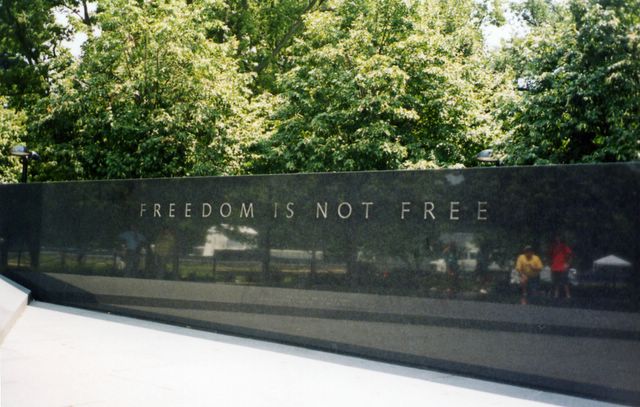
Wall of Freedom


Freedom is not free.

Thank a veteran.

Say a prayer for and honor those who gave all.

Posted by Hello

[Worth visiting are One Marine's View, Byrd, and Blackfive--keep scrolling down for many posts on Memorial Day--just to name a few.]

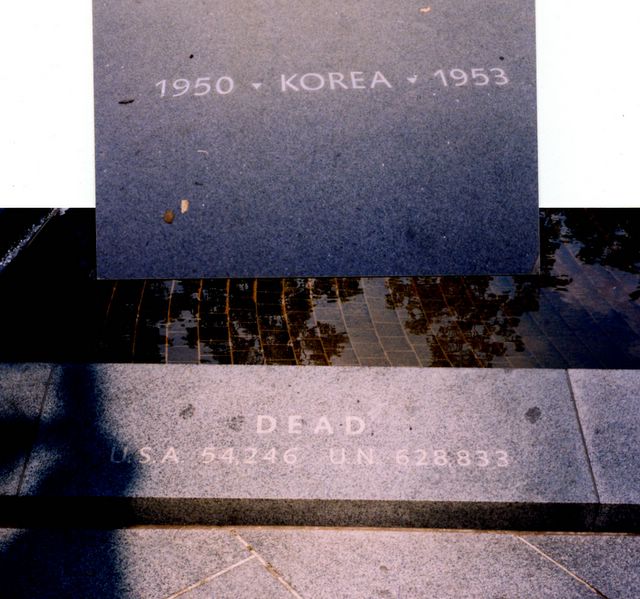
Korean War Memorial

Posted by Hello

The Price of Freedom: Some Gave All


US troops killed in action: 54, 246

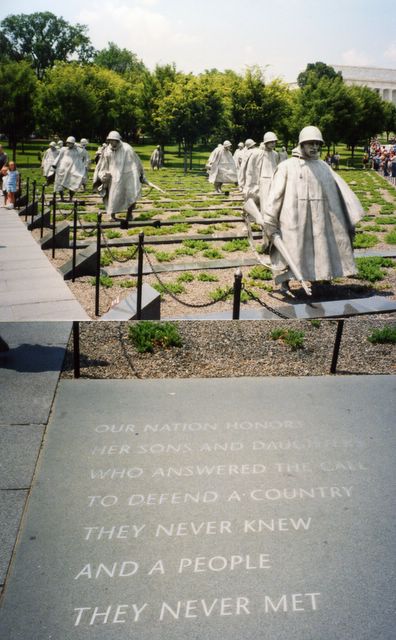
... for a country they did not know and a people they never met.

All gave some. Some gave ALL.

Posted by Hello


"OUR NATION HONORS
HER SONS AND DAUGHTERS
WHO ANSWERED THE CALL
TO DEFEND A COUNTRY
THEY NEVER KNEW
AND A PEOPLE
THEY NEVER MET."

KOREAN WAR MEMORIAL

Posted by Hello

Saturday, May 20, 2006

Getting Married

I hear my Beloved. See how he comes leaping on the mountains, bounding over the hills. My Beloved is like a gazelle, like a young stag. See where he stands behind our wall. He looks in at the window, he peers through the lattice. My Beloved lifts up his voice, he says to me, 'Come then, my love, my lovely one, come. My dove, hiding in the clefts of the rock. In the coverts of the cliff, show me your face, let me hear your voice; for your voice is sweetand your face is beautiful. 'My beloved is mine and I am his. Set me like a seal on your heart, like a seal on your arm. For love is strong as Death, jealousy relentless as Sheol. The flash of it is a flash of fire, a flame of the Lord himself. Love no flood can quench, no torrents drown.

--Song of Songs 2:8-10.14.16; 8:6-7


On the evening of their marriage, Tobias said to Sarah, `You and I must pray and petition our Lord to win his grace and protection.' They began praying for protection, and this was how he began:'You are blessed, O God of our fathers; blessed, too, is your name for ever and ever. Let the heavens bless you and all things you have made for evermore. It was you who created Adam, you who created Eve his wife to be his help and support; and from these two the human race was born. It was you who said, "It is not good that the man should be alone; let us make him a helpmate like himself." And so I do not take my sister for any lustful motive; I do it in singleness of heart. Be kind enough to have pity on her and on me and bring us to old age together.' And together they said, `Amen, Amen'.

--Tobit 8:4-8

The time is approaching. Today, in fact: Saturday, May 20. Keep us in your prayers.

Tuesday, May 16, 2006

Killing, Murder, 5th Commandment, & Biblical Teaching: Continuing a Discussion

Is all killing wrong? Is any deliberate killing ever justified? Can a Christian or even a Jewish believer justifiably hold to the fifth commandment (or sixth for Jews) and also support any type of killing? What does the fifth commandment really say?

I have been involved in a good exchange over at Against the Grain. Though the original post is titled "Fr. Sirico, The Zwicks, and the Compendium of the Social Doctrine of the Church," the dialogue in the comments section has turned to all sorts of somewhat--or perhaps I should say "somehow"--related issues.

You can read the comments here and continue the discussion on this blog in the comment section below.

Friday, May 12, 2006

Watching United 93

I just finished watching United 93 with my daughter. She was fine. No fits. No uncontrollable emotional outbursts. In other words, no trauma like some of the pundits forecasted and hyped.

In fact, she was interested and attentive throughout. Asking questions at times and at the end. It gave me a good opportunity to explain some things, such as the nature of the enemy we are fighting in some parts of the world--most notably, not here on our land--airline safety, and the different forms or versions of Islam: both the peaceful or at least non-threatening Muslims and the extreme Islamists (the fascistic terrorist-minded Muslims who seek the end of the Western Judeo-Christian and secular humanist ways).

Teenage and older children in particular should see this film. If the younger teens have nightmares, comfort them. But young Americans need to know the nature of whom we are fighting. If they are attending a typical American high school or college, they probably don't know.

That said, you should see the movie and get others to see it too.

A point Dennis made this week is that if large numbers are not seeing this movie, then what message is that sending to the movie industry: not to make movies that highlight or dramatize the struggle, the war, we are in? not to make movies that inspire Americans to greater patriotism? not to make movies that promote and respectfully portray modern-day American heroes?

Is that what you want?

I hope not.

Go see the movie.

If that is not enough, read "All Americans must see 'United 93,'" Dennis Prager's column wherein he calls on all of us to

go and see "United 93," to see why some Americans still take "Home of the brave" seriously; and to see why we have to win this war more than any since World War II. That's how bad our enemy is. You have an unfortunately rare chance to see that enemy at work when you see what happened to everyone who boarded United Airlines Flight 93 that left Newark on September 11, 2001.


Then go and read this collection of excerpts of essays/articles/posts on the film: "Flight 93: Remembering Heroes."

Thursday, May 11, 2006

Being Equally Just? Justly Equal? What It Takes To Be Free: My summer research plans

Just got approval for my summer research plans. I am going to work on a paper dealing with the different types of equality bandied about, how justice regulates the according claims, and explain how all this is directed towards the human person's desire for freedom.

TITLE (for now) OF RESEARCH: “Equality’s Just Place in the Human Person’s Quest for Freedom: Investigating the Interplay of Equality, Justice, and Freedom”

Description:

In both the contemporary literature on political philosophy and in the daily discourse of many Americans, there is an ongoing debate over the meaning and role that equality should play in our lives, both as private citizens and as members of a society. One person advocates political changes in order to achieve greater equality for a certain group. Another seeks revocation of current laws in an attempt to rectify alleged unjust policies. All these are done while referencing “equality,” “justice,” and even “freedom,” though these demands come from quite polarized political viewpoints. Various notions of equality are applied in these discussions. In addition, there are differences in what people think a government’s role and purpose is. Some view equality and a more contemporary notion of justice as the goals of government whereas others view a more traditional understanding of justice as government’s goal in its attempt to provide the framework so its citizens may reach their own political end: liberty.[1] Equality. Justice. Liberty. They are inter-related, indeed. The question is how. The problem is knowing their limits.

In this project, I plan to discuss the major disputes over equality. I will investigate the various and often opposing views on the matter, engaging the works of liberal, conservative, communitarian, and libertarian thinkers. In an effort to understand better the value and place of equality, I will further probe the meaning and scope of justice. With a clear definition of justice, it will then be easier to discuss the main types of equality. Through this discussion, I hope to make clear which forms of equality a government, political theorist, or civic-minded person should be concerned with when discussing what is best for a people called to be free and to do so in a way that respects the dignity of the human person.

This is part of a larger goal of mine, one that seeks to develop and communicate an approach to society that provides for the best conditions in which the human person may not only experience structural equality and justice but also live out the freedom we are called to. Whether this calling is from God or just the dynamism of human nature is not immediately essential to the political discussion on what is best for a society. What is best is that we find a workable solution to continue in this country’s ongoing project of the “pursuit of happiness,” a happiness that finds its roots and its ends in the dignity of the human person.

Though I do believe God cares about what we do and how we treat others, I know that living in a pluralist society means that one has to come up with sensitive language that is both rational and convincing. This language must be understandable and acceptable to the theist and the non-theist, to the Christian and the Jew, to the faithful and the secular. As a result, even religious-minded advocates of justice should find a way to speak across the denominational and non-religious aisles. Theological arguments are good and have their place, but in our society, we do need a language that addresses the same social concerns (as theological mandates for justice) and we need one that does so mindful of the many traditions within our midst. It is unfortunate but a fact of our reality that explicitly theological/confessional language in the public square often turns people off to the message advocated, however worthy the content is. This is where philosophy and the use of reason can come into play. This is where my current proposal can aid: in an effort to supply a rational and human dignity-respecting answer to the problem of the relationship of equality, justice, and freedom.


[1] Cf. John Emerich Edward Dalberg-Acton, Essays in the History of Liberty, Vol. I (Indianapolis, IN: Liberty Fund, 1985), 22.

Friday, May 05, 2006

In the Dawn of Our New Lives: The Christian Event

Last night at SoC, we discussed a few pages from Msgr. Giussani's Why the Church?, a book wherein (according to the back cover) "Giussani explores the Church's definition of itself as both human and divine, arguing that a different type of existence is born in those who try to live the life of the Church." The closing lines of our reading express and offer an image to understand with greater clarity (we hope) just what precisely an event is or feels like, which is something that will definitely help one of my ongoing "projects." Msgr. Giussani writes:

In the Christian, the newness is called to awaken and, no matter how dimly, to manifest itself like the dawn of a new day. The comparison I like to make is, in fact, the dawn. Imagine a person who has always lived in darkness. If he were to see, for the first time, the first half-light of day, he would realize that what was unfolding before his eyes was something new. It was no longer darkness. And, even though he could never imagine the sight of the midday sun, he would certainly be attracted by this phenomenon, which for him would be so unexpected and indefinable--that the dawning would have dispelled the darkness, introducing him to something different from the obscurity to which he was accustomed. This person would gaze in fascination at that prelude of light, waiting for an even greater newness, even though he could not imagine its form.

This is Christianity in history, the Church in the society of the times, a Christian community in its environment, a Christian man in the circumstances of his day-to-day living; the dawning of a different humanity, of a different human community, a community that is, new, truer. [pp. 182-183]

This is the happening of an event, the Christian event, which is:

an encounter with a human reality that channels the evidence of a correspondence between the divine that has stooped to enter our lives and what we are. This encounter opens my eyes to myself, spurs on an unveiling of me, shows that it corresponds to what I am: it makes me aware of what I am, of what I want, because it makes me understand that what it brings is just what I want, that it corresponds to what I am. [...] In a sequence of his film Andrei Rubliev, Tarkovski has one of his characters say, "You know very well: you fail at something, you are tired and you can take no more. And suddenly in the crowd you meet a person's gaze-a human gaze-and it is as if a hidden divine presence had approached you. And suddenly everything becomes simpler." The Christian event shows itself, reveals itself in the encounter with the superficiality, the shallowness and the apparent inconsistency of a face in the crowd, a face like all the others yet so different from the others that, when you meet it, it is as if everything becomes simple. You see it for an instant and as you walk away you carry the impact of that gaze within you, as if to say, "I would like to see that face again!" [...] We are here because of an encounter that happened [...]. From the instant the encounter happens, Christianity takes on a different meaning: Something Other has revealed itself to be important for the core of life.

Thus we have the words of the Roman rhetorician Gaius Marius Victorinus upon his conversion to Christianity: "When I encountered Christ I discovered that I was a man."

And the words of Pope Benedict XVI in Deus Caritas Est:

Being Christian is not the result of an ethical choice or a lofty idea, but the encounter with an event, a Person, which gives life a new horizon and a decisive direction.

Friday, April 28, 2006

Flight 93: Remembering Heroes (Updated May 3)

[See below for continual updates.]

It tells the story of the day through a meticulous re-enactment of events surrounding United 93, the last of the four hijacked aircraft, in the belief that by examining this single event something much larger can be found - the shape of our world today.

It's about time. Almost 5 years later. The film opens April 28 and the trailer is here. Director Paul Greengrass's statement continues:
The terrible dilemma those passengers faced is the same we have been struggling with ever since. Do we sit passively and hope this all turns out okay? Or do we fight back and strike at them before they strike at us? And what will be the consequences if we do?
When the film Da Vinci Code comes out a couple weeks afterward, I will be sure to go to the movies ... just not that one. I will be watching (for at least the second time) and spending my money on United 93.

UPDATES:
Kathy at One Clear Call writes an inspirational review, "The Soul of America:"
The amazing film United 93 is many things.

It is a time machine. As you watch the grim events unfolding, from the first-on-the-scene perspectives of aviation personnel, you are inexorably pulled back into those disastrous moments in our nation’s history. As I watched the smoke billowing from the Twin Towers, I was transported once again to my living room, wrapped in a bath towel and dripping wet from my morning shower. At the sound of Pete’s thunderous cry of disbelief, I had raced there and stopped dead in my tracks at the image on the television screen. My first two words in the post-9/11 world were Our Lord’s name.

The movie is also a timely reminder of what we are up against in this protracted, unavoidable war. ...

United 93 is, above all, a microcosm of the United States of America. ...

They [the passengers aboard Flight 93] also held up a mirror to us, to help us see and recognize what lies deep within. This film reminds us, through the brave actions of these ordinary people, what it means to be Americans. Through their valiant efforts to regain control of their doomed aircraft, we see the soul of America at work. Today, nearly five years later, it is a soul in distress and sorely in need of such a visceral reminder.

[...] Every American should see this film. [...] United 93 is a razor-sharp cut into our national soul that should jolt many of us into a renewed awareness of our purpose in fighting the global War on Terror.

It should also inspire renewed national pride and honor for those very first warrior-citizens who stood and fought back against our enemy. [Bold emphases added.]
I believe that everyone should see this film, but not because of any political point of view. In fact, the film steers away from engaging politics at all, not even regarding the Islamist nature of the attacks, and that's as it should be. No one depicted in this movie really knew of that aspect of 9/11 during the attack, or what it meant. The only reference to what would follow is a statement by the FAA operations manager Ben Sliney (playing himself) ordering all planes in the US to be grounded and all international traffic turned away because "we're at war with someone out there". No other reference is made to anything happening after 12:06 ET on 9/11.

The reason we all should see this film, at least once, is for the passengers of United 93. Alone, frightened, and under the knife, they stood up and fought back. They died trying to beat the terrorists and made clear that we would not go quietly. We owe them for their sacrifice and the lives they undoubtedly saved in their desperate attempt to regain control of United 93. That, I am absolutely certain, is something which will unite most Americans regardless of how we feel about what came afterwards.
Sadly or ironically or perhaps some other adverb might do to explain what Capt. Ed refers to in this addendum to his post:

Addendum: Someone needs to scold the normally excellent folks at IMDB. One of the categories in which they've placed this film is "Fantasy".
Fantasy?!!! What kind of $%@#$% is that!

Smash is a must-read, many including me feel. His post, "The Flight," captures a lot and encourages us all that
Every adult in America should see this film.
After which, he has a good roundup of key bloggers.

Allahpundit has a similar (to this) collection of links to reviews and thoughts on the movie: "Bloggers Review 'United 93':"
I won’t see it. Saw this yesterday on Google Video and realized it was enough. The first reviews are being posted around the blogosphere this morning, though, and I’m going to try to round them up. [HT: MaryKatharine]
Rick Moran, at RightWingNutHouse, has written "United 93: A Review:"
Whether intended or not, Greengrass reveals the faces of men at war. And even though there are no grand, overarching truths about humanity, or good and evil, or the superiority of one set of beliefs over another in U-93 (there is a short scene toward the end of the film that shows both passengers and terrorists praying), the singular fact that “they” attacked us and “we” fought back cannot be denied, cannot be hidden despite the desperate attempt by some over the last 5 years to do so. We are at war.
...
In the end, Greengrass lets the story do all his talking. A wise choice since the it would have been a relatively simple matter to have made a histrionic, flag waving spectacular instead of the intensely personal drama U-93 turned out to be. For some, that intensity will open old emotional wounds from 9/11 making it very difficult for them to see this film. I would urge them to make the effort anyway. For United 93 will not heal the hurt but rather recall in a vividly personal, emotionally charged manner who and what caused our souls to be scorched that terrible day.

The farther we get from 9/11, the more urgent that reminder becomes. We’ve already had one wake-up call. Is it necessary for the fanatics to give us another? [HT: Allah]
Rick has also published his own list of reviews, many of which find their own way to throw a dig at the film and/or what it stands for.

I also wanted to see for myself how the movie handled the memory of the people on flight 93. On that score, I'm pleased. The passengers and crew are real people, with real fear and uncertainty.
Some want to hold back action, others realize they have to do something. It's not headliner to the rescue - it's real people deciding that in the end, they'd rather die trying than die without trying. I hope I never get tested in this way - but I hope if I am, that I do as well.

This is not a happy movie, but it's an important one. The message is powerful, and we need to send one of our own to Hollywood --- Keep making movies about real heroes! If we go out in droves to see this movie - they will get the right message.
"9/11 Unvarnished: United 93" is Rich Lowry's perspective on the movie, well summed up with his ending:
... The passengers of Flight 93 were the first Americans to fight back. United 93 wisely avoids focusing too exclusively on any of the individual passengers. Instead, they are presented as an ensemble exemplifying many of the virtues of the American character: a great improvisational intelligence, as they quickly understand and cope with the radically new, horrifying circumstances they are presented with; an extraordinary civic facility, demonstrated by their ability to formulate rapidly a plan of action among themselves; and a fierceness when provoked. In preparation for the assault on the terrorists, one passenger tells a flight attendant: "Get every weapon you can find. We need weapons."

The heroism of those passengers is now forever part of our story as a nation. It's not too soon for a major Hollywood film that portrays it brilliantly. It's about time.
Then also ever at National Review Online, associate editor Alston B. Ramsay has "An Extraordinary Flight: United 93 is for the individual, not the critic:"
In order to cope, we cannot live everyday in the presence of our worst moments, those memories that tear at the very fabric of our souls. September 11 is one of those memories: In some respects it seems so distant, yet in others it is only yesterday. It is hard to delve deep enough to recall the horrors most of us felt as the tragedy unfolded. United 93 draws those emotions out, and it does so with a reserved modesty. Again, whether this is a good or bad thing is a determination you should make for yourself.
"Let's Roll." Most of us remember these words as the call to battle from Todd Beamer, one of the heroes of United Flight 93. His father David Beamer gives his own thoughts about the movie: "United 93: The filmmakers got it right. " (HT: Hugh)
This film further reminds us of the nature of the enemy we face. An enemy who will stop at nothing to achieve world domination and force a life devoid of freedom upon all. Their methods are inhumane and their targets are the innocent and unsuspecting. We call this conflict the "War on Terror." This film is a wake-up call. And although we abhor terrorism as a tactic, we are at war with a real enemy and it is personal.

There are those who would hope to escape the pain of war. Can't we just live and let live and pretend every thing is OK? Let's discuss, negotiate, reason together. The film accurately shows an enemy who will stop at nothing in a quest for control. This enemy does not seek our resources, our land or our materials, but rather to alter our very way of life.

I encourage my fellow Americans and free people everywhere to see "United 93."
... Resolve to give thanks and support to those men, women, leaders and commanders who to this day (1,687 days since Sept. 11, 2001) continue the counterattacks on our enemy and in so doing keep us safe and our freedoms intact.
The enemy we face does not have the word "surrender" in their dictionary. We must not have the word "retreat" in ours. We surely want our troops home as soon as possible. That said, they cannot come home in retreat. They must come home victoriously. Pray for them.
People regularly go see movies with killing, and kids play violent video games. What people are adverse to is the reality of United Flight 93. But, if we don't engage in reality, we put it in a place that no longer affects our everyday thoughts, activities, and decisions. In doing so, we risk losing our grip on reality.

What happened on Flight 93 was pure evil and we must be reminded that this evil still exists and seeks to destroy us today. We can't get into our SUV's and drive to the mall or relax in front our 42" LCD TV's watching Sex in the City and be deluded that because it didn't happen to "me", I am safe. Any one of us could have been on that plane or could be a target in the future. These are hard issues to deal with, but we must take time out of our lives to feel the pain and remember.

It is my hope that during the upcoming Memorial Day, more people take time to reflect on why this country is so great—we rely on ordinary men and women to make extraordinary sacrifices.

From the Revolutionary War through our War on Terror, it is the dedication and love that Americans have for their country that drives them to answer our nation’s call to duty, whether it is serving in the Armed Forces, the government, or in local communities.

We must recall and remember United Flight 93, for if we don’t, we risk forgetting the millions that have stood for this country during our nation’s history.
In the film's final 32 minutes, the passengers and crew become, as Greengrass has said, "the first people to live in the post-9/11 world." They gather information quickly, including word that a third plane has struck the Pentagon. The men who choose to storm the cockpit don't give speeches about their intentions. They simply decide they must do something, and they know there is a pilot among the passengers who might be able to land the plane. They don't intend to die. They intend to win.

And in world-historical terms, they do win. When Jarrah sits down in the pilot's seat, he tapes a photo of the Capitol to his controls. We don't know where, exactly, United 93 was headed, but it was surely either the Capitol or the White House. By doing what they did, Greengrass reminds us, the passengers saved America from political decapitation.
And then closes with:
There's a lot of talk about whether Americans are "ready" to see a movie about 9/11. Some of that talk is doubtless due to the same attitude that says Americans can't possibly stomach seeing footage of the crashes, or the buildings falling. Such infantilization is an insult both to Americans, who are perfectly capable of handling such things, and to the memories of those who perished in the attacks, whose public murders are being treated as though they had been quiet and private deaths.

There's no reason to fear United 93. It is a riveting examination of an unbearable moment. Not only can we take it, we can also rise to the challenge it presents--both to us, and to those who would treat Americans as though they were hothouse flowers incapable of feeling the "right way" about September 11. [HT: Hugh]
Over at Hugh Hewitt's site, Mary Katharine Ham offers her thoughts after viewing a screening of the movie:
I'm not sure if I can use this word as an adjective, but it keeps coming to mind, so here goes. It was shaking. I was shaken. I was shaky. However you want to say it, that's what it did.
She notes that United 93 "brings back that morning in a very real way. All the disbelief, the confusion, the incredulity, the fear, the panic, the sadness, the stunned silence." She goes on to say:
On top of that, you've got the incredible weight of about 14 tons of dramatic irony as you watch air traffic controllers in four locations try to piece together radio transmissions and green blips, and flight plans.

Controller 1: "I lost American 11. It just disappeared! It just fell right off my screen."
Controller 2: "Where did you lose it?"
Controller 1: "Somewhere over Manhattan."


Ham continues:
I won't tell all the action, but I will say that when they beat down that first terrorist, it was quite possibly the most satisfying, cinematic moment I've ever experienced. I'm not sure what that says about me, but it felt good.
She closes with words we all should heed:
The movie is stark, unadorned. The story speaks for itself. And, the people of Flight 93 and the rest of the victims of 9/11 deserve to have it told.

For all those reasons, it is hard to watch, but you should watch it. [Emphasis added.]
Dennis Prager answers the question of whether or not Americans are ready to see United 93, "a film based on the phone conversations of the passengers and flight attendants, on the flight recorder tape, and approved by the families of all 40 passengers -- one of the most terrible and heroic events in American history."
If anything should be controversial, it is Hollywood going AWOL while its country fights the scourge of our time, Islamic totalitarianism. For five years, America has been battling people who are dedicated to destroying every value that Hollywood claims to care most about -- freedom, tolerance, women's rights, secular government, equality for gays -- and Hollywood has yet to make a film depicting, let alone honoring, this war.

Finally, a major studio comes out with a film reminding Americans about the nature of our enemy, about what really happened (to the best of our ability to reconstruct) on one of the 9-11 planes, and the press wonders if Americans are "ready" to see the movie.
...
The only people likely to object to this film are those who don't want Americans to become aware of just how conscienceless, cruel and depraved our enemy is, or those who think that our enemies can always be negotiated with and therefore object to depicting Americans actually fighting back.

Teenage and older children in particular should see this film. If the younger teens have nightmares, comfort them. But young Americans need to know the nature of whom we are fighting. If they are attending a typical American high school or college, they probably don't know.
Dennis answers in the affirmative: yes, see the film:
In the meantime, go and see "United 93," to see why some Americans still take "Home of the brave" seriously; and to see why we have to win this war more than any since World War II. That's how bad our enemy is. You have an unfortunately rare chance to see that enemy at work when you see what happened to everyone who boarded United Airlines Flight 93 that left Newark on September 11, 2001.
Jim Geraghty at NR has an initial post on United 93 and "Two More Points"


Rick Moran at The American Thinker writes "Dreams and Myths: Hollywood and 9/11" and then at Rightwing Nuthouse he writes "IT’S TIME: MEDALS OF HONOR FOR THE PASSENGERS OF FLIGHT #93"

The hawkish and liberal Jewish perspective at Kesher Talk has a forum going on at "An Army of Davids: Flight 93" and then at Winds of Change she also writes "Flight 93: The Movie" where she responds in the comment section:
I have a feeling this movie will quietly "separate the men from the boys," as it were. It will make the moonbats more moonbatty, and it will strengthen the resolve of those inclined that way. It will draw a line in the sand. It will do medium boxoffice and medium DVD sales but become kind of a "cult classic" in that it will be a cultural identifier for the group of people who want to win this war and feel surrounded by those who are hostile or indifferent. So it will be a quiet steady propaganda/morale booster for our side.
Which is followed by a quote from a Strategy Page article written in 2002, "The Giants of Flight 93" by Tom Holsinger:
Students of American character should pay close attention to Flight 93. A random sample of American adults was subjected to the highest possible stress and organized themselves in a terribly brief period, without benefit of training or group tradition other than their inherent national consciousness, to foil a well planned and executed terrorist attack. Recordings show the passengers and cabin crew of Flight 93 - ordinary Americans all - exemplified the virtues Americans hold most dear.

Certain death came for them by surprise but they did not panic and instead immediately organized, fought and robbed terror of its victory. They died but were not defeated. Ordinary Americans confronted by enemies behaved exactly like the citizen-soldiers eulogized in Victor Davis Hanson's Carnage and Culture.

Herman Wouk called the heroic sacrifice of the USS Enterprise's Torpedo 8 squadron at the Battle of Midway "... the soul of America in action." Flight 93 was the soul of America, and the American people know it. They spontaneously created a shrine at the crash site to express what is in their hearts and minds but not their mouths. They are waiting for a poet. Normally a President fills this role.

But Americans feel it now. They don't need a government or leader for that, and didn't to guide their actions on Flight 93, because they really are America. Go to the crash shrine and talk to people there. Something significant resonates through them which is different from, and possibly greater than, the shock of suffering a Pearl Harbor attack at home.

Pearl Harbor remains a useful analogy given Admiral Isokoru Yamamoto's statement on December 7, 1941 - "I fear we have woken a sleeping giant and filled him with a terrible resolve." They were giants on Flight 93.
Carol Platt Liebau's "We'd Better Be Ready" (HT: Hugh)
Decades of liberalization has made our people and both political parties soft to the point that we are more concerned with making friends with our enemies and worried about how their supporters perceive us than we are with protecting ourselves. And now, the left will do anything, including censorship through “outrage” to prevent it.

When you see the images of 9/11, are you upset about what you are seeing, or at what you have allowed yourself to forget?
Go and read. Then on April 28, go and watch.

And always: Never Forget.

Wednesday, April 26, 2006

Why We Fight: Answering the Critics of the War

War is an ugly thing, but not the ugliest of things. The decayed and degraded state of moral and patriotic feeling which thinks that nothing is worth war is much worse. The person who has nothing for which he is willing to fight, nothing which is more important than his own personal safety, is a miserable creature and has no chance of being free unless made and kept so by the exertions of better men than himself.
--John Stuart Mill
This post continually will be updated to provide links to some of the best articles dealing with why we are fighting in this war against "radical Islam," "Islamic terrorists," "Islamism," or whatever else you want to call the enemy that fights in the name of Islam and uses barbaric, savage, and brutal methods (e.g., the butcher of Nicholas Berg) against many innocent civilians, a large portion of whom are their fellow Arab Muslims.

---

Victor Davis Hanson is a good place to start. Both here at his NR archive and on his own page.


The Latest:

"The New York Times Surrenders: A Monument to Defeatism on the Editorial Page" (12 July2007) by Victor Davis Hanson is a point by point refutation of the NY Times editorial which called for immediate withdrawal from Iraq. Hanson did a yeoman's job, though perhaps refuting the NY Times these days is not that hard, especially when one has the historical depth and military knowledge of a VDH:

Both houses of Congress voted for 23 writs authorizing the war with Iraq — a post-9/11 confirmation of the official policy of regime change in Iraq that President Clinton originated. Supporters of the war included 70 percent of the American public in April 2003; the majority of NATO members; a coalition with more participants than the United Nations alliance had in the Korean War; and a host of politicians and pundits as diverse as Joe Biden, William F. Buckley, Wesley Clark, Hillary Clinton, Francis Fukuyama, Kenneth Pollack, Harry Reid, Andrew Sullivan, Thomas Friedman, and George Will.

And there was a Pentagon postwar plan to stabilize the country, but it assumed a decisive defeat and elimination of enemy forces, not a three-week war in which the majority of Baathists and their terrorist allies fled into the shadows to await a more opportune time to reemerge, under quite different rules of engagement.

[...]

The Times wonders what Bush’s cause was. Easy to explain, if not easy to achieve: to help foster a constitutional government in the place of a genocidal regime that had engaged in a de facto war with the United States since 1991, and harbored or subsidized terrorists like Abu Nidal, Abu Abbas, at least one plotter of the 1993 World Trade Center bombing, Abu Musab al Zarqawi, al Qaeda affiliates in Kurdistan, and suicide bombers in Gaza and the West Bank. It was a bold attempt to break with the West’s previous practices, both liberal (appeasement of terrorists) and conservative (doing business with Saddam, selling arms to Iran, and overlooking the House of Saud’s funding of terrorists).

[...]

We promised General Petraeus a hearing in September; it would be the height of folly to preempt that agreement by giving in to our summer of panic and despair. Critics called for the resignation of Secretary of Defense Donald Rumsfeld, a change in command in Iraq and at Centcom, new strategies, and more troops. But now that we have a new secretary, a new command in Iraq and at Centcom, new strategies, and more troops, suddenly we have a renewed demand for withdrawal before the agreed-upon September accounting — suggesting that the only constant in such harping was the assumption that Iraq was either hopeless or not worth the effort.

The truth is that Iraq has upped the ante in the war against terrorists. Our enemies’ worst nightmare is a constitutional government in the heart of the ancient caliphate, surrounded by consensual rule in Afghanistan, Lebanon, and Turkey; ours is a new terror heaven, but with oil, a strategic location, and the zeal born of a humiliating defeat of the United States on a theater scale. The Islamists believe we can’t win; so does the New York Times. But it falls to the American people to decide the issue.

In "Deserting Petraeus" (13 July 2007) Charles Krauthammer explains why now--just as the "surge" is working--is not the time to withdraw or signal withdrawal:

Finally, after four terribly long years, we know what works. Or what can work. A year ago, a confidential Marine intelligence report declared Anbar province (which comprises about a third of Iraq's territory) lost to al-Qaeda. Now, in what the Times's John Burns calls an "astonishing success," the tribal sheiks have joined our side and committed large numbers of fighters that, in concert with American and Iraqi forces, have largely driven out al-Qaeda and turned its former stronghold of Ramadi into one of most secure cities in Iraq.

It began with a U.S.-led offensive that killed or wounded more than 200 enemy fighters and captured 600. Most important was the follow-up. Not a retreat back to American bases but the setting up of small posts within the population that, together with the Iraqi national and tribal forces, have brought relative stability to Anbar.

The same has started happening in many of the Sunni areas around Baghdad, including Diyala province -- just a year ago considered as lost as Anbar -- where, for example, the Sunni insurgent 1920 Revolution Brigades has turned against al-Qaeda and joined the fight on the side of U.S. and Iraqi government forces.

[...]

Just this week, Petraeus said that the one thing he needs more than anything else is time. To cut off Petraeus's plan just as it is beginning -- the last surge troops arrived only last month -- on the assumption that we cannot succeed is to declare Petraeus either deluded or dishonorable. Deluded in that, as the best-positioned American in Baghdad, he still believes we can succeed. Or dishonorable in pretending to believe in victory and sending soldiers to die in what he really knows is an already failed strategy.

That's the logic of the wobbly Republicans' position. [...]


Senator Joseph Lieberman discusses Iran's involvement in "Iran's Proxy War: Tehran is on the offensive against us throughout the Middle East" (6 July 2007)

Upon returning from Iraq, Senator Joseph Lieberman discusses what he saw: "What I Saw in Iraq: Iran remains a problem, but Anbar has joined the fight against terror" (15 June 2007)

"A Letter to Our Soldiers in Iraq" by Dennis Prager (8 May 2007)


"The best are killed in every generation" by Dennis Prager (10 Oct 2006)


"Who thought Iraq had WMD? Most everybody" by Larry Elder (25 May 2006)

"Defeating Terror" by Ralph Peters (23 May 2006)

"Revisionist History: Antiwar myths about Iraq, debunked" by Peter Wehner (23 May 2006)


"Spies, Lies, and Weapons: What Went Wrong" by Kenneth M. Pollack (Jan/Feb 2004)


What about WMD? Did Bush lie? What about "Dem" other folks? A bit from Larry Elder's column:

Clinton Secretary of State Madeleine Albright, February 1998: "Iraq is a long way from [here], but what happens there matters a great deal here. For the risks that the leaders of a rogue state will use nuclear, chemical or biological weapons against us or our allies is the greatest security threat we face."

Clinton National Security Adviser Sandy Berger, February 1998: "He will use those weapons of mass destruction again, as he has 10 times since 1983."

Portuguese Prime Minister Jose Manuel Durao Barroso, October 2003: "When [former President Bill] Clinton was here recently he told me was absolutely convinced, given his years in the White House and the access to privileged information which he had, that Iraq possessed weapons of mass destruction until the end of the Saddam regime."

French President Jacques Chirac, February 2003: "There is a problem -- the probable possession of weapons of mass destruction by an uncontrollable country, Iraq. The international community is right . . . in having decided Iraq should be disarmed."

President Bill Clinton, December 1998: "Other countries possess weapons of mass destruction and ballistic missiles. With Saddam, there is one big difference: He has used them, not once, but repeatedly -- unleashing chemical weapons against Iranian troops during a decade-long war, not only against soldiers, but against civilians; firing Scud missiles at the citizens of Israel, Saudi Arabia, Bahrain and Iran. Not only against a foreign enemy, but even against his own people, gassing Kurdish civilians in Northern Iraq. . . . I have no doubt today that, left unchecked, Saddam Hussein will use these terrible weapons again. . . . "

Clinton, July 2003: " . . . [I]t is incontestable that on the day I left office, there were unaccounted for stocks of biological and chemical weapons. We might have destroyed them in '98. We tried to, but we sure as heck didn't know it because we never got to go back there."

Gen. Wesley Clark, September 2002, testimony before the House Armed Services Committee: "There's no question that Saddam Hussein is a threat. . . . Yes, he has chemical and biological weapons. . . . He is, as far as we know, actively pursuing nuclear capabilities, though he doesn't have nuclear warheads yet. If he were to acquire nuclear weapons, I think our friends in the region would face greatly increased risks, as would we."

Vermont Gov. Howard Dean [D], September 2002: "There's no question that Saddam Hussein is a threat to the United States and to our allies."

Dean, February 2003: "I agree with President Bush -- he has said that Saddam Hussein is evil. And he is. [Hussein] is a vicious dictator and a documented deceiver. He has invaded his neighbors, used chemical arms, and failed to account for all the chemical and biological weapons he had before the Gulf War. He has murdered dissidents and refused to comply with his obligations under UN Security Council Resolutions. And he has tried to build a nuclear bomb. Anyone who believes in the importance of limiting the spread of weapons of mass killing, the value of democracy and the centrality of human rights must agree that Saddam Hussein is a menace. The world would be a better place if he were in a different place other than the seat of power in Baghdad or any other country."

Dean, March 2003: "[Iraq] is automatically an imminent threat to the countries that surround it because of the possession of these weapons."

Robert Einhorn, Clinton assistant secretary of state for nonproliferation, March 2002: "How close is the peril of Iraqi WMD? Today, or at most within a few months, Iraq could launch missile attacks with chemical or biological weapons against its neighbors (albeit attacks that would be ragged, inaccurate and limited in size). Within four or five years it could have the capability to threaten most of the Middle East and parts of Europe with missiles armed with nuclear weapons containing fissile material produced indigenously -- and to threaten U.S. territory with such weapons delivered by nonconventional means, such as commercial shipping containers. If it managed to get its hands on sufficient quantities of already produced fissile material, these threats could arrive much sooner."

Sen. Bob Graham, D-Fla., and others, in a letter to President Bush, December 2001: "There is no doubt that . . . Saddam Hussein has invigorated his weapons programs. . . . In addition, Saddam continues to redefine delivery systems and is doubtless using the cover of a licit missile program to develop longer-range missiles that will threaten the United States and our allies."

Rep. Nancy Pelosi, D-Calif., December 1998: "Saddam Hussein has been engaged in the development of weapons of mass destruction technology, which is a threat to countries in the region, and he has made a mockery of the weapons inspection process."

Sen. John Rockefeller, D-W.Va., ranking minority Intelligence Committee member, October 2002: "There is unmistakable evidence that Saddam Hussein is working aggressively to develop nuclear weapons and will likely have nuclear weapons within the next five years."

Any questions?

"Sacred Words" at Mudville Gazette is something all should read.


Tuesday, April 11, 2006

FIFA Too? Anti-Semitism Spreads

FIFA has condemned Israel for an air strike on an empty soccer field in the Gaza Strip that was used for training exercises by Islamic Jihad and the al-Aqsa Martyrs Brigade. This strike did not cause any injuries. But at the same time FIFA has refused to condemn a Palestinian rocket attack on an Israeli soccer field last week which did cause injuries.