Friday, April 28, 2006

Flight 93: Remembering Heroes (Updated May 3)

[See below for continual updates.]

It tells the story of the day through a meticulous re-enactment of events surrounding United 93, the last of the four hijacked aircraft, in the belief that by examining this single event something much larger can be found - the shape of our world today.

It's about time. Almost 5 years later. The film opens April 28 and the trailer is here. Director Paul Greengrass's statement continues:
The terrible dilemma those passengers faced is the same we have been struggling with ever since. Do we sit passively and hope this all turns out okay? Or do we fight back and strike at them before they strike at us? And what will be the consequences if we do?
When the film Da Vinci Code comes out a couple weeks afterward, I will be sure to go to the movies ... just not that one. I will be watching (for at least the second time) and spending my money on United 93.

UPDATES:
Kathy at One Clear Call writes an inspirational review, "The Soul of America:"
The amazing film United 93 is many things.

It is a time machine. As you watch the grim events unfolding, from the first-on-the-scene perspectives of aviation personnel, you are inexorably pulled back into those disastrous moments in our nation’s history. As I watched the smoke billowing from the Twin Towers, I was transported once again to my living room, wrapped in a bath towel and dripping wet from my morning shower. At the sound of Pete’s thunderous cry of disbelief, I had raced there and stopped dead in my tracks at the image on the television screen. My first two words in the post-9/11 world were Our Lord’s name.

The movie is also a timely reminder of what we are up against in this protracted, unavoidable war. ...

United 93 is, above all, a microcosm of the United States of America. ...

They [the passengers aboard Flight 93] also held up a mirror to us, to help us see and recognize what lies deep within. This film reminds us, through the brave actions of these ordinary people, what it means to be Americans. Through their valiant efforts to regain control of their doomed aircraft, we see the soul of America at work. Today, nearly five years later, it is a soul in distress and sorely in need of such a visceral reminder.

[...] Every American should see this film. [...] United 93 is a razor-sharp cut into our national soul that should jolt many of us into a renewed awareness of our purpose in fighting the global War on Terror.

It should also inspire renewed national pride and honor for those very first warrior-citizens who stood and fought back against our enemy. [Bold emphases added.]
I believe that everyone should see this film, but not because of any political point of view. In fact, the film steers away from engaging politics at all, not even regarding the Islamist nature of the attacks, and that's as it should be. No one depicted in this movie really knew of that aspect of 9/11 during the attack, or what it meant. The only reference to what would follow is a statement by the FAA operations manager Ben Sliney (playing himself) ordering all planes in the US to be grounded and all international traffic turned away because "we're at war with someone out there". No other reference is made to anything happening after 12:06 ET on 9/11.

The reason we all should see this film, at least once, is for the passengers of United 93. Alone, frightened, and under the knife, they stood up and fought back. They died trying to beat the terrorists and made clear that we would not go quietly. We owe them for their sacrifice and the lives they undoubtedly saved in their desperate attempt to regain control of United 93. That, I am absolutely certain, is something which will unite most Americans regardless of how we feel about what came afterwards.
Sadly or ironically or perhaps some other adverb might do to explain what Capt. Ed refers to in this addendum to his post:

Addendum: Someone needs to scold the normally excellent folks at IMDB. One of the categories in which they've placed this film is "Fantasy".
Fantasy?!!! What kind of $%@#$% is that!

Smash is a must-read, many including me feel. His post, "The Flight," captures a lot and encourages us all that
Every adult in America should see this film.
After which, he has a good roundup of key bloggers.

Allahpundit has a similar (to this) collection of links to reviews and thoughts on the movie: "Bloggers Review 'United 93':"
I won’t see it. Saw this yesterday on Google Video and realized it was enough. The first reviews are being posted around the blogosphere this morning, though, and I’m going to try to round them up. [HT: MaryKatharine]
Rick Moran, at RightWingNutHouse, has written "United 93: A Review:"
Whether intended or not, Greengrass reveals the faces of men at war. And even though there are no grand, overarching truths about humanity, or good and evil, or the superiority of one set of beliefs over another in U-93 (there is a short scene toward the end of the film that shows both passengers and terrorists praying), the singular fact that “they” attacked us and “we” fought back cannot be denied, cannot be hidden despite the desperate attempt by some over the last 5 years to do so. We are at war.
...
In the end, Greengrass lets the story do all his talking. A wise choice since the it would have been a relatively simple matter to have made a histrionic, flag waving spectacular instead of the intensely personal drama U-93 turned out to be. For some, that intensity will open old emotional wounds from 9/11 making it very difficult for them to see this film. I would urge them to make the effort anyway. For United 93 will not heal the hurt but rather recall in a vividly personal, emotionally charged manner who and what caused our souls to be scorched that terrible day.

The farther we get from 9/11, the more urgent that reminder becomes. We’ve already had one wake-up call. Is it necessary for the fanatics to give us another? [HT: Allah]
Rick has also published his own list of reviews, many of which find their own way to throw a dig at the film and/or what it stands for.

I also wanted to see for myself how the movie handled the memory of the people on flight 93. On that score, I'm pleased. The passengers and crew are real people, with real fear and uncertainty.
Some want to hold back action, others realize they have to do something. It's not headliner to the rescue - it's real people deciding that in the end, they'd rather die trying than die without trying. I hope I never get tested in this way - but I hope if I am, that I do as well.

This is not a happy movie, but it's an important one. The message is powerful, and we need to send one of our own to Hollywood --- Keep making movies about real heroes! If we go out in droves to see this movie - they will get the right message.
"9/11 Unvarnished: United 93" is Rich Lowry's perspective on the movie, well summed up with his ending:
... The passengers of Flight 93 were the first Americans to fight back. United 93 wisely avoids focusing too exclusively on any of the individual passengers. Instead, they are presented as an ensemble exemplifying many of the virtues of the American character: a great improvisational intelligence, as they quickly understand and cope with the radically new, horrifying circumstances they are presented with; an extraordinary civic facility, demonstrated by their ability to formulate rapidly a plan of action among themselves; and a fierceness when provoked. In preparation for the assault on the terrorists, one passenger tells a flight attendant: "Get every weapon you can find. We need weapons."

The heroism of those passengers is now forever part of our story as a nation. It's not too soon for a major Hollywood film that portrays it brilliantly. It's about time.
Then also ever at National Review Online, associate editor Alston B. Ramsay has "An Extraordinary Flight: United 93 is for the individual, not the critic:"
In order to cope, we cannot live everyday in the presence of our worst moments, those memories that tear at the very fabric of our souls. September 11 is one of those memories: In some respects it seems so distant, yet in others it is only yesterday. It is hard to delve deep enough to recall the horrors most of us felt as the tragedy unfolded. United 93 draws those emotions out, and it does so with a reserved modesty. Again, whether this is a good or bad thing is a determination you should make for yourself.
"Let's Roll." Most of us remember these words as the call to battle from Todd Beamer, one of the heroes of United Flight 93. His father David Beamer gives his own thoughts about the movie: "United 93: The filmmakers got it right. " (HT: Hugh)
This film further reminds us of the nature of the enemy we face. An enemy who will stop at nothing to achieve world domination and force a life devoid of freedom upon all. Their methods are inhumane and their targets are the innocent and unsuspecting. We call this conflict the "War on Terror." This film is a wake-up call. And although we abhor terrorism as a tactic, we are at war with a real enemy and it is personal.

There are those who would hope to escape the pain of war. Can't we just live and let live and pretend every thing is OK? Let's discuss, negotiate, reason together. The film accurately shows an enemy who will stop at nothing in a quest for control. This enemy does not seek our resources, our land or our materials, but rather to alter our very way of life.

I encourage my fellow Americans and free people everywhere to see "United 93."
... Resolve to give thanks and support to those men, women, leaders and commanders who to this day (1,687 days since Sept. 11, 2001) continue the counterattacks on our enemy and in so doing keep us safe and our freedoms intact.
The enemy we face does not have the word "surrender" in their dictionary. We must not have the word "retreat" in ours. We surely want our troops home as soon as possible. That said, they cannot come home in retreat. They must come home victoriously. Pray for them.
People regularly go see movies with killing, and kids play violent video games. What people are adverse to is the reality of United Flight 93. But, if we don't engage in reality, we put it in a place that no longer affects our everyday thoughts, activities, and decisions. In doing so, we risk losing our grip on reality.

What happened on Flight 93 was pure evil and we must be reminded that this evil still exists and seeks to destroy us today. We can't get into our SUV's and drive to the mall or relax in front our 42" LCD TV's watching Sex in the City and be deluded that because it didn't happen to "me", I am safe. Any one of us could have been on that plane or could be a target in the future. These are hard issues to deal with, but we must take time out of our lives to feel the pain and remember.

It is my hope that during the upcoming Memorial Day, more people take time to reflect on why this country is so great—we rely on ordinary men and women to make extraordinary sacrifices.

From the Revolutionary War through our War on Terror, it is the dedication and love that Americans have for their country that drives them to answer our nation’s call to duty, whether it is serving in the Armed Forces, the government, or in local communities.

We must recall and remember United Flight 93, for if we don’t, we risk forgetting the millions that have stood for this country during our nation’s history.
In the film's final 32 minutes, the passengers and crew become, as Greengrass has said, "the first people to live in the post-9/11 world." They gather information quickly, including word that a third plane has struck the Pentagon. The men who choose to storm the cockpit don't give speeches about their intentions. They simply decide they must do something, and they know there is a pilot among the passengers who might be able to land the plane. They don't intend to die. They intend to win.

And in world-historical terms, they do win. When Jarrah sits down in the pilot's seat, he tapes a photo of the Capitol to his controls. We don't know where, exactly, United 93 was headed, but it was surely either the Capitol or the White House. By doing what they did, Greengrass reminds us, the passengers saved America from political decapitation.
And then closes with:
There's a lot of talk about whether Americans are "ready" to see a movie about 9/11. Some of that talk is doubtless due to the same attitude that says Americans can't possibly stomach seeing footage of the crashes, or the buildings falling. Such infantilization is an insult both to Americans, who are perfectly capable of handling such things, and to the memories of those who perished in the attacks, whose public murders are being treated as though they had been quiet and private deaths.

There's no reason to fear United 93. It is a riveting examination of an unbearable moment. Not only can we take it, we can also rise to the challenge it presents--both to us, and to those who would treat Americans as though they were hothouse flowers incapable of feeling the "right way" about September 11. [HT: Hugh]
Over at Hugh Hewitt's site, Mary Katharine Ham offers her thoughts after viewing a screening of the movie:
I'm not sure if I can use this word as an adjective, but it keeps coming to mind, so here goes. It was shaking. I was shaken. I was shaky. However you want to say it, that's what it did.
She notes that United 93 "brings back that morning in a very real way. All the disbelief, the confusion, the incredulity, the fear, the panic, the sadness, the stunned silence." She goes on to say:
On top of that, you've got the incredible weight of about 14 tons of dramatic irony as you watch air traffic controllers in four locations try to piece together radio transmissions and green blips, and flight plans.

Controller 1: "I lost American 11. It just disappeared! It just fell right off my screen."
Controller 2: "Where did you lose it?"
Controller 1: "Somewhere over Manhattan."


Ham continues:
I won't tell all the action, but I will say that when they beat down that first terrorist, it was quite possibly the most satisfying, cinematic moment I've ever experienced. I'm not sure what that says about me, but it felt good.
She closes with words we all should heed:
The movie is stark, unadorned. The story speaks for itself. And, the people of Flight 93 and the rest of the victims of 9/11 deserve to have it told.

For all those reasons, it is hard to watch, but you should watch it. [Emphasis added.]
Dennis Prager answers the question of whether or not Americans are ready to see United 93, "a film based on the phone conversations of the passengers and flight attendants, on the flight recorder tape, and approved by the families of all 40 passengers -- one of the most terrible and heroic events in American history."
If anything should be controversial, it is Hollywood going AWOL while its country fights the scourge of our time, Islamic totalitarianism. For five years, America has been battling people who are dedicated to destroying every value that Hollywood claims to care most about -- freedom, tolerance, women's rights, secular government, equality for gays -- and Hollywood has yet to make a film depicting, let alone honoring, this war.

Finally, a major studio comes out with a film reminding Americans about the nature of our enemy, about what really happened (to the best of our ability to reconstruct) on one of the 9-11 planes, and the press wonders if Americans are "ready" to see the movie.
...
The only people likely to object to this film are those who don't want Americans to become aware of just how conscienceless, cruel and depraved our enemy is, or those who think that our enemies can always be negotiated with and therefore object to depicting Americans actually fighting back.

Teenage and older children in particular should see this film. If the younger teens have nightmares, comfort them. But young Americans need to know the nature of whom we are fighting. If they are attending a typical American high school or college, they probably don't know.
Dennis answers in the affirmative: yes, see the film:
In the meantime, go and see "United 93," to see why some Americans still take "Home of the brave" seriously; and to see why we have to win this war more than any since World War II. That's how bad our enemy is. You have an unfortunately rare chance to see that enemy at work when you see what happened to everyone who boarded United Airlines Flight 93 that left Newark on September 11, 2001.
Jim Geraghty at NR has an initial post on United 93 and "Two More Points"


Rick Moran at The American Thinker writes "Dreams and Myths: Hollywood and 9/11" and then at Rightwing Nuthouse he writes "IT’S TIME: MEDALS OF HONOR FOR THE PASSENGERS OF FLIGHT #93"

The hawkish and liberal Jewish perspective at Kesher Talk has a forum going on at "An Army of Davids: Flight 93" and then at Winds of Change she also writes "Flight 93: The Movie" where she responds in the comment section:
I have a feeling this movie will quietly "separate the men from the boys," as it were. It will make the moonbats more moonbatty, and it will strengthen the resolve of those inclined that way. It will draw a line in the sand. It will do medium boxoffice and medium DVD sales but become kind of a "cult classic" in that it will be a cultural identifier for the group of people who want to win this war and feel surrounded by those who are hostile or indifferent. So it will be a quiet steady propaganda/morale booster for our side.
Which is followed by a quote from a Strategy Page article written in 2002, "The Giants of Flight 93" by Tom Holsinger:
Students of American character should pay close attention to Flight 93. A random sample of American adults was subjected to the highest possible stress and organized themselves in a terribly brief period, without benefit of training or group tradition other than their inherent national consciousness, to foil a well planned and executed terrorist attack. Recordings show the passengers and cabin crew of Flight 93 - ordinary Americans all - exemplified the virtues Americans hold most dear.

Certain death came for them by surprise but they did not panic and instead immediately organized, fought and robbed terror of its victory. They died but were not defeated. Ordinary Americans confronted by enemies behaved exactly like the citizen-soldiers eulogized in Victor Davis Hanson's Carnage and Culture.

Herman Wouk called the heroic sacrifice of the USS Enterprise's Torpedo 8 squadron at the Battle of Midway "... the soul of America in action." Flight 93 was the soul of America, and the American people know it. They spontaneously created a shrine at the crash site to express what is in their hearts and minds but not their mouths. They are waiting for a poet. Normally a President fills this role.

But Americans feel it now. They don't need a government or leader for that, and didn't to guide their actions on Flight 93, because they really are America. Go to the crash shrine and talk to people there. Something significant resonates through them which is different from, and possibly greater than, the shock of suffering a Pearl Harbor attack at home.

Pearl Harbor remains a useful analogy given Admiral Isokoru Yamamoto's statement on December 7, 1941 - "I fear we have woken a sleeping giant and filled him with a terrible resolve." They were giants on Flight 93.
Carol Platt Liebau's "We'd Better Be Ready" (HT: Hugh)
Decades of liberalization has made our people and both political parties soft to the point that we are more concerned with making friends with our enemies and worried about how their supporters perceive us than we are with protecting ourselves. And now, the left will do anything, including censorship through “outrage” to prevent it.

When you see the images of 9/11, are you upset about what you are seeing, or at what you have allowed yourself to forget?
Go and read. Then on April 28, go and watch.
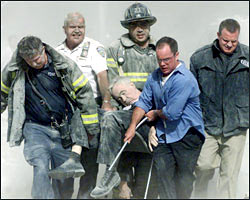
And always: Never Forget.

Wednesday, April 26, 2006

Why We Fight: Answering the Critics of the War

War is an ugly thing, but not the ugliest of things. The decayed and degraded state of moral and patriotic feeling which thinks that nothing is worth war is much worse. The person who has nothing for which he is willing to fight, nothing which is more important than his own personal safety, is a miserable creature and has no chance of being free unless made and kept so by the exertions of better men than himself.
--John Stuart Mill
This post continually will be updated to provide links to some of the best articles dealing with why we are fighting in this war against "radical Islam," "Islamic terrorists," "Islamism," or whatever else you want to call the enemy that fights in the name of Islam and uses barbaric, savage, and brutal methods (e.g., the butcher of Nicholas Berg) against many innocent civilians, a large portion of whom are their fellow Arab Muslims.

---

Victor Davis Hanson is a good place to start. Both here at his NR archive and on his own page.


The Latest:

"The New York Times Surrenders: A Monument to Defeatism on the Editorial Page" (12 July2007) by Victor Davis Hanson is a point by point refutation of the NY Times editorial which called for immediate withdrawal from Iraq. Hanson did a yeoman's job, though perhaps refuting the NY Times these days is not that hard, especially when one has the historical depth and military knowledge of a VDH:

Both houses of Congress voted for 23 writs authorizing the war with Iraq — a post-9/11 confirmation of the official policy of regime change in Iraq that President Clinton originated. Supporters of the war included 70 percent of the American public in April 2003; the majority of NATO members; a coalition with more participants than the United Nations alliance had in the Korean War; and a host of politicians and pundits as diverse as Joe Biden, William F. Buckley, Wesley Clark, Hillary Clinton, Francis Fukuyama, Kenneth Pollack, Harry Reid, Andrew Sullivan, Thomas Friedman, and George Will.

And there was a Pentagon postwar plan to stabilize the country, but it assumed a decisive defeat and elimination of enemy forces, not a three-week war in which the majority of Baathists and their terrorist allies fled into the shadows to await a more opportune time to reemerge, under quite different rules of engagement.

[...]

The Times wonders what Bush’s cause was. Easy to explain, if not easy to achieve: to help foster a constitutional government in the place of a genocidal regime that had engaged in a de facto war with the United States since 1991, and harbored or subsidized terrorists like Abu Nidal, Abu Abbas, at least one plotter of the 1993 World Trade Center bombing, Abu Musab al Zarqawi, al Qaeda affiliates in Kurdistan, and suicide bombers in Gaza and the West Bank. It was a bold attempt to break with the West’s previous practices, both liberal (appeasement of terrorists) and conservative (doing business with Saddam, selling arms to Iran, and overlooking the House of Saud’s funding of terrorists).

[...]

We promised General Petraeus a hearing in September; it would be the height of folly to preempt that agreement by giving in to our summer of panic and despair. Critics called for the resignation of Secretary of Defense Donald Rumsfeld, a change in command in Iraq and at Centcom, new strategies, and more troops. But now that we have a new secretary, a new command in Iraq and at Centcom, new strategies, and more troops, suddenly we have a renewed demand for withdrawal before the agreed-upon September accounting — suggesting that the only constant in such harping was the assumption that Iraq was either hopeless or not worth the effort.

The truth is that Iraq has upped the ante in the war against terrorists. Our enemies’ worst nightmare is a constitutional government in the heart of the ancient caliphate, surrounded by consensual rule in Afghanistan, Lebanon, and Turkey; ours is a new terror heaven, but with oil, a strategic location, and the zeal born of a humiliating defeat of the United States on a theater scale. The Islamists believe we can’t win; so does the New York Times. But it falls to the American people to decide the issue.

In "Deserting Petraeus" (13 July 2007) Charles Krauthammer explains why now--just as the "surge" is working--is not the time to withdraw or signal withdrawal:

Finally, after four terribly long years, we know what works. Or what can work. A year ago, a confidential Marine intelligence report declared Anbar province (which comprises about a third of Iraq's territory) lost to al-Qaeda. Now, in what the Times's John Burns calls an "astonishing success," the tribal sheiks have joined our side and committed large numbers of fighters that, in concert with American and Iraqi forces, have largely driven out al-Qaeda and turned its former stronghold of Ramadi into one of most secure cities in Iraq.

It began with a U.S.-led offensive that killed or wounded more than 200 enemy fighters and captured 600. Most important was the follow-up. Not a retreat back to American bases but the setting up of small posts within the population that, together with the Iraqi national and tribal forces, have brought relative stability to Anbar.

The same has started happening in many of the Sunni areas around Baghdad, including Diyala province -- just a year ago considered as lost as Anbar -- where, for example, the Sunni insurgent 1920 Revolution Brigades has turned against al-Qaeda and joined the fight on the side of U.S. and Iraqi government forces.

[...]

Just this week, Petraeus said that the one thing he needs more than anything else is time. To cut off Petraeus's plan just as it is beginning -- the last surge troops arrived only last month -- on the assumption that we cannot succeed is to declare Petraeus either deluded or dishonorable. Deluded in that, as the best-positioned American in Baghdad, he still believes we can succeed. Or dishonorable in pretending to believe in victory and sending soldiers to die in what he really knows is an already failed strategy.

That's the logic of the wobbly Republicans' position. [...]


Senator Joseph Lieberman discusses Iran's involvement in "Iran's Proxy War: Tehran is on the offensive against us throughout the Middle East" (6 July 2007)

Upon returning from Iraq, Senator Joseph Lieberman discusses what he saw: "What I Saw in Iraq: Iran remains a problem, but Anbar has joined the fight against terror" (15 June 2007)

"A Letter to Our Soldiers in Iraq" by Dennis Prager (8 May 2007)


"The best are killed in every generation" by Dennis Prager (10 Oct 2006)


"Who thought Iraq had WMD? Most everybody" by Larry Elder (25 May 2006)

"Defeating Terror" by Ralph Peters (23 May 2006)

"Revisionist History: Antiwar myths about Iraq, debunked" by Peter Wehner (23 May 2006)


"Spies, Lies, and Weapons: What Went Wrong" by Kenneth M. Pollack (Jan/Feb 2004)


What about WMD? Did Bush lie? What about "Dem" other folks? A bit from Larry Elder's column:

Clinton Secretary of State Madeleine Albright, February 1998: "Iraq is a long way from [here], but what happens there matters a great deal here. For the risks that the leaders of a rogue state will use nuclear, chemical or biological weapons against us or our allies is the greatest security threat we face."

Clinton National Security Adviser Sandy Berger, February 1998: "He will use those weapons of mass destruction again, as he has 10 times since 1983."

Portuguese Prime Minister Jose Manuel Durao Barroso, October 2003: "When [former President Bill] Clinton was here recently he told me was absolutely convinced, given his years in the White House and the access to privileged information which he had, that Iraq possessed weapons of mass destruction until the end of the Saddam regime."

French President Jacques Chirac, February 2003: "There is a problem -- the probable possession of weapons of mass destruction by an uncontrollable country, Iraq. The international community is right . . . in having decided Iraq should be disarmed."

President Bill Clinton, December 1998: "Other countries possess weapons of mass destruction and ballistic missiles. With Saddam, there is one big difference: He has used them, not once, but repeatedly -- unleashing chemical weapons against Iranian troops during a decade-long war, not only against soldiers, but against civilians; firing Scud missiles at the citizens of Israel, Saudi Arabia, Bahrain and Iran. Not only against a foreign enemy, but even against his own people, gassing Kurdish civilians in Northern Iraq. . . . I have no doubt today that, left unchecked, Saddam Hussein will use these terrible weapons again. . . . "

Clinton, July 2003: " . . . [I]t is incontestable that on the day I left office, there were unaccounted for stocks of biological and chemical weapons. We might have destroyed them in '98. We tried to, but we sure as heck didn't know it because we never got to go back there."

Gen. Wesley Clark, September 2002, testimony before the House Armed Services Committee: "There's no question that Saddam Hussein is a threat. . . . Yes, he has chemical and biological weapons. . . . He is, as far as we know, actively pursuing nuclear capabilities, though he doesn't have nuclear warheads yet. If he were to acquire nuclear weapons, I think our friends in the region would face greatly increased risks, as would we."

Vermont Gov. Howard Dean [D], September 2002: "There's no question that Saddam Hussein is a threat to the United States and to our allies."

Dean, February 2003: "I agree with President Bush -- he has said that Saddam Hussein is evil. And he is. [Hussein] is a vicious dictator and a documented deceiver. He has invaded his neighbors, used chemical arms, and failed to account for all the chemical and biological weapons he had before the Gulf War. He has murdered dissidents and refused to comply with his obligations under UN Security Council Resolutions. And he has tried to build a nuclear bomb. Anyone who believes in the importance of limiting the spread of weapons of mass killing, the value of democracy and the centrality of human rights must agree that Saddam Hussein is a menace. The world would be a better place if he were in a different place other than the seat of power in Baghdad or any other country."

Dean, March 2003: "[Iraq] is automatically an imminent threat to the countries that surround it because of the possession of these weapons."

Robert Einhorn, Clinton assistant secretary of state for nonproliferation, March 2002: "How close is the peril of Iraqi WMD? Today, or at most within a few months, Iraq could launch missile attacks with chemical or biological weapons against its neighbors (albeit attacks that would be ragged, inaccurate and limited in size). Within four or five years it could have the capability to threaten most of the Middle East and parts of Europe with missiles armed with nuclear weapons containing fissile material produced indigenously -- and to threaten U.S. territory with such weapons delivered by nonconventional means, such as commercial shipping containers. If it managed to get its hands on sufficient quantities of already produced fissile material, these threats could arrive much sooner."

Sen. Bob Graham, D-Fla., and others, in a letter to President Bush, December 2001: "There is no doubt that . . . Saddam Hussein has invigorated his weapons programs. . . . In addition, Saddam continues to redefine delivery systems and is doubtless using the cover of a licit missile program to develop longer-range missiles that will threaten the United States and our allies."

Rep. Nancy Pelosi, D-Calif., December 1998: "Saddam Hussein has been engaged in the development of weapons of mass destruction technology, which is a threat to countries in the region, and he has made a mockery of the weapons inspection process."

Sen. John Rockefeller, D-W.Va., ranking minority Intelligence Committee member, October 2002: "There is unmistakable evidence that Saddam Hussein is working aggressively to develop nuclear weapons and will likely have nuclear weapons within the next five years."

Any questions?

"Sacred Words" at Mudville Gazette is something all should read.


Tuesday, April 11, 2006

FIFA Too? Anti-Semitism Spreads

FIFA has condemned Israel for an air strike on an empty soccer field in the Gaza Strip that was used for training exercises by Islamic Jihad and the al-Aqsa Martyrs Brigade. This strike did not cause any injuries. But at the same time FIFA has refused to condemn a Palestinian rocket attack on an Israeli soccer field last week which did cause injuries.

Sunday, April 09, 2006

Holy Week: "7 Days that Shook the World"

The Anchoress posts a good read:

"7 Days that Shook the World" by Greg Kandra

After spending the last few weeks in the desert of Lent, suddenly we find ourselves in an oasis, clutching long leaves of palms.

But like so many things you see after being in the desert, it’s a mirage. What we see, or think we see, is about to shift before our eyes.

Soon enough, the palms will be whips. The leaves will be thorns. Jubilation will become jeers. That is the paradox and the mystery of Holy Week.

The liturgies of this week are powerful and primal. In the days to come, there is silence and smoke, fire and water, shadow and light. We are a part of something both ancient and new, and what we do this week reminds us of that. The altar will be stripped. The cross will be venerated. The tabernacle will be emptied. The Blessed Sacrament will be moved. Bells will be stilled.

And yet here we stand, at the gates to Jerusalem, palms in our hands and hosannas on our lips, beginning the arduous trek to Calvary.

...

This week, take the time to wonder about what we are doing, and what we are remembering. For close to two thousand years, we have gathered like this, in places like this, to light candles and chant prayers and read again the ancient stories of our deliverance and redemption.

But are we aware of what we are doing? Do we understand what it means? Do we realize the price that was paid? A proper accounting is impossible. The ledger—His life, for our souls—seems woefully unbalanced.

So try this. This week, take a moment in each day that passes to wonder: What was He doing during this time of that one week all those centuries ago? What was crossing His mind on Monday, on Tuesday, on Wednesday? What sort of anguish? What kind of dread?

...

He was a man like us in all things but sin. He must have been terrified, His mind buzzing with questions. Long after the others had drifted off to sleep, did He stay awake and worry? Maybe He sat up alone, late at night, whittling a piece of wood, the way His father had taught Him, until a splinter sliced His skin, drawing a rivulet of blood. He might have flinched and thought: Well, this is nothing. And still it stings. How intense would the pain of death become? How long would it last? How much humiliation would He be forced to endure, stripped and bleeding? And: What about His mother? Is there anything He could do to spare her from this?

As you shop for Easter baskets and dye, think of this. Ponder this. Wonder about it. Make it a kind of prayer.

And then, remember what we are doing, and why.

Because, of all the calendars in all of human history, this is the week that changed the world.

Thursday, April 06, 2006

Aquinas and the Ontological Argument

From time to time, I have heard people say that one of St. Thomas Aquinas's proofs for the existence of God is the ontological argument. Each time, I wonder where this person got that info because Aquinas, in some prominent places, makes it quite clear that he disagrees with the ontological argument ... and the ontological argument itself is based upon a way of thinking, a set of philosophical principles, that are antithetical to Aquinas's own philosophy and approach to life.

In light of that I thought I would gather some citations from Aquinas where he disagrees with versions of what is now called the ontological argument. After Anselm, the other big medieval thinkers who some say posit a form of the ontological argument are Bonaventure in his Commentary on I Sentences (d. 8, p. I, a. I, q.2) and in his De Mysterio Trinitatis (q. I, a. I) and Duns Scotus in his Ordinatio (I, 2, 1-2, nos. 137-139). I say “some” because with regard to Scotus others say his proof starts from what is experienced and therefore should not be categorized as “ontological” in the way that word is now understood.

The basic argument of Aquinas is that we cannot argue from a knowledge of essence of something, even God, to the conclusion that it exists. It exists only as a mental being, kind of like Kant's ens rationis.

The places where Aquinas argues against ontological-type proofs for God’s existence are:

Summa contra Gentiles, I, 11 (especially nos. 3-4). This chapter comes after having presented various forms of (“ontological”) arguments that are based upon the notion that once one understands what the name “God” means one will have to conclude God’s existence is self-evident, being a necessity of what the essence “God” contains. (cf. SCG, I, 10) It could be the case that because Aquinas presents his opponents’ arguments with great charity that some conclude they are his arguments. If one keeps reading his texts, however, it becomes apparent that he was just presenting an argument that some make because he then refutes them. Here is SCG, I, 11:

1. THE above opinion [ontological-type arguments that were stated in SCG, I, 10] arises partly from custom, men being accustomed from the beginning to hear and invoke the name of God. Custom, especially that which is from the beginning, takes the place of nature; hence notions wherewith the mind is imbued from childhood are held as firmly as if they were naturally known and self-evident.

2. Partly also it owes its origin to the neglect of a distinction between what is self-evident
of itself absolutely and what is self-evident relatively to us. Absolutely indeed the existence of God is self-evident, since God's essence is His existence. But since we cannot mentally conceive God's essence, his existence is not self-evident relatively to us. …

3. Nor is the existence of God necessarily self-evident as soon as the meaning of the name 'God' is known. First, because it is not evident, even to all who admit the existence of God, that God is something greater than which nothing can be conceived, since many of the ancients said that this world was God. Then granting that universal usage understands by the name 'God' something greater than which nothing can be conceived, it will not follow that there exists in rerum natura something greater than which nothing can be conceived. For 'thing' and "notion implied in the name of the thing" must answer to one another. From the conception in the mind of what is declared by this name 'God' it does not follow that God exists otherwise than in the mind. Hence there will be no necessity either of that something, greater than which nothing can be conceived, existing otherwise than in the mind; and from this it does not follow that there is anything in rerum natura greater than which nothing can be conceived. And so the supposition of the nonexistence of God goes untouched. For the possibility of our thought outrunning the greatness of any given object, whether of the actual or of the ideal order, has nothing in it to vex the soul of any one except of him alone who already grants the existence in rerum natura of something than which nothing can be conceived greater.

In a footnote in one edition of the translation, the editor writes:

St Thomas means: 'If I form a notion of a thing, and then get a name to express that notion, it does not follow that the thing, answering to such name and notion, exists.' St Anselm's disciples reply: 'True of the notions of all other things, as islands or dollars, which may or may not be; but not true of the notion of that one thing, whereof existence is a very part of the notion.' In other words, whereas St Thomas denies the lawfulness of the transition from the ideal to the actual order, they maintain that the transition is lawful in arguing the existence of that one Being, who is the actuality of all that is ideal. 'But is such actuality possible?' 'It is conceivable, therefore possible.' 'It may be conceivable, only because it is conceived inadequately, without insight into the inconsistencies which it involves.' 'You have no right to assume inconsistencies where you discern none,' rejoins Leibnitz. And so this 'ontological argument' will be tossed up and down, as an apple of discord, to the end.

Aquinas continues:

4. Nor is it necessary for something greater than God to be conceivable, if His non-existence is conceivable. For the possibility of conceiving Him not to exist does not arise from the imperfection or uncertainty of His Being, since His Being is of itself most manifest, but from the infirmity of our understanding, which cannot discern Him as He is of Himself, but only by the effects which He produces; and so it is brought by reasoning to the knowledge of Him.

Summa Theologica, Ia, 2, I, ad 2. Here he gives a summary of part of the above argument, saying that the claim “God’s existence is self-evident” is not true for us. In Objection 2, he gives his opponents’ argument, once again leading some to think it is his.

Objection 2. Further, those things are said to be self-evident which are known as soon as the terms are known, which the Philosopher (1 Poster. iii) says is true of the first principles of demonstration. Thus, when the nature of a whole and of a part is known, it is at once recognized that every whole is greater than its part. But as soon as the signification of the word "God" is understood, it is at once seen that God exists. For by this word is signified that thing than which nothing greater can be conceived. But that which exists actually and mentally is greater than that which exists only mentally. Therefore, since as soon as the word "God" is understood it exists mentally, it also follows that it exists actually. Therefore the proposition "God exists" is self-evident.

In the main body of the article, he argues against such claims, saying that since we are limited creatures and cannot see the divine essence in itself, knowledge of what the name “God” means does not convert into knowledge of God’s existence.

I answer that, A thing can be self-evident in either of two ways: on the one hand, self-evident in itself, though not to us; on the other, self-evident in itself, and to us. A proposition is self-evident because the predicate is included in the essence of the subject, as "Man is an animal," for animal is contained in the essence of man. If, therefore the essence of the predicate and subject be known to all, the proposition will be self-evident to all; as is clear with regard to the first principles of demonstration, the terms of which are common things that no one is ignorant of, such as being and non-being, whole and part, and such like. If, however, there are some to whom the essence of the predicate and subject is unknown, the proposition will be self-evident in itself, but not to those who do not know the meaning of the predicate and subject of the proposition. Therefore, it happens, as Boethius says (Hebdom., the title of which is: "Whether all that is, is good"), "that there are some mental concepts self-evident only to the learned, as that incorporeal substances are not in space." Therefore I say that this proposition, "God exists," of itself is self-evident, for the predicate is the same as the subject, because God is His own existence as will be hereafter shown (3, 4). Now because we do not know the essence of God, the proposition is not self-evident to us; but needs to be demonstrated by things that are more known to us, though less known in their nature--namely, by effects.

Then in a response to “Objection 2” above, Aquinas offers a criticism of what is called the ontological argument. He argues similarly as he did in SCG:

Reply to Objection 2. Perhaps not everyone who hears this word "God" understands it to signify something than which nothing greater can be thought, seeing that some have believed God to be a body. Yet, granted that everyone understands that by this word "God" is signified something than which nothing greater can be thought, nevertheless, it does not therefore follow that he understands that what the word signifies exists actually, but only that it exists mentally. Nor can it be argued that it actually exists, unless it be admitted that there actually exists something than which nothing greater can be thought; and this precisely is not admitted by those who hold that God does not exist.

Well, I think you get the idea of Aquinas’s view of the ontological argument or forms of it: he does not think they are possible for our minds. He deals with it also to some extent in In I Sent., d. 3, q. 1, a. 2, ad 4m; De Veritate, X, 12, ad 2m; and offers the principles used to argue against ontological arguments in On Being and Essence, especially chapter 4 where he also gives an argument for God’s existence based on the essence-existence (esse) distinction in composed beings.

I included the texts so you could see and verify for yourself that Aquinas disagrees with those who put forth any form of an ontological argument. Kant and Aquinas are not too far apart in their rejection of this type of argument for God's existence, however much they disagree with other arguments for the existence of God.

Thursday, March 30, 2006

Summer Project: Equality, Justice, and Freedom

I just submitted a proposal for summer research. Here is what I intend to do this summer:

TITLE OF PROPOSED RESEARCH: “Equality’s Just Place in the Human Person’s Quest for Freedom: Investigating the Interplay of Equality, Justice, and Freedom”

Description:

In both the contemporary literature on political philosophy and in the daily discourse of many Americans, there is an ongoing debate over the meaning and role that equality should play in our lives, both as private citizens and as members of a public society. One person advocates political changes in order to achieve greater equality for a certain group. Another seeks revocation of current laws in an attempt to rectify alleged unjust policies. All these are done while referencing “equality,” “justice,” and even “freedom,” though these demands come from quite polarized political viewpoints. Various notions of equality are applied in these discussions. In addition, there are differences in what people think a government’s role and purpose is. Some view equality and a more contemporary notion of justice as the goals of government whereas others view a more traditional understanding of justice as government’s goal in its attempt to provide the framework so its citizens may reach their own political end: liberty.[1] Equality. Justice. Liberty. They are inter-related, indeed. The question is how. The problem is knowing their limits.

In this project, I plan to discuss the major disputes over equality. I will investigate the various and often opposing views on the matter, engaging the works of liberal, conservative, communitarian, and libertarian thinkers. In an effort to understand better the value and place of equality, I will further probe the meaning and scope of justice. With a clear definition of justice, it will then be easier to discuss the main types of equality. Through this discussion, I hope to make clear which forms of equality a government, political theorist, or civic-minded person should be concerned with when discussing what is best for a people called to be free and to do so in a way that respects the dignity of the human person.

This is part of a larger goal of mine, one that seeks to develop and communicate an approach to society that provides for the best conditions in which the human person may not only experience structural equality and justice but also live out the freedom we are called to. Whether this calling is from God or just the dynamism of human nature is not immediately essential to the political discussion on what is best for a society. What is best is that we find a workable solution to continue in this country’s ongoing project of the “pursuit of happiness,” a happiness that finds its roots and its ends in the dignity of the human person.

Though I do believe God cares about what we do and how we treat others, I know that living in a pluralist society means that one has to come up with sensitive language that is both rational and convincing. This language must be understandable and acceptable to the theist and the non-theist, to the Christian and the Jew, to the faithful and the secular. As a result, even religious-minded advocates of justice should find a way to speak across the denominational and non-religious aisles. Theological arguments are good and have their place, but in our society, we do need a language that addresses the same social concerns (as theological mandates for justice) and we need one that does so mindful of the many traditions within our midst. It is unfortunate but a fact of our reality that explicitly theological/confessional language in the public square often turns people off to the message advocated, however worthy the content is. This is where philosophy and the use of reason can come into play. This is where my current proposal can aid: in an effort to supply a rational and human dignity-respecting answer to the problem of the relationship of equality, justice, and freedom.

Lastly, I plan to relate these concerns and the conclusion to the mission of Loyola Marymount University, specifically its Jesuit character and stress on “the promotion of justice in the concern of the Hebrew scriptures for ‘the widow, the orphan, and the stranger in the land’ and the preference of the gospels for the ‘least’ of Jesus’ brothers and sisters.”[2] In doing so, I will also have shown that faith and reason actually are “like two wings on which the human spirit rises to the contemplation of truth”[3] as they find agreement on the necessary political conditions for a society that truly serves the individual and common goods of a people in characterized with a certain human dignity.

[1] Cf. John Emerich Edward Dalberg-Acton, Essays in the History of Liberty, Vol. I (Indianapolis, IN: Liberty Fund, 1985), 22.
[2] Robert V. Caro, SJ, “Introduction: Understanding Our Identity,” Mission and Catholic Identity, Loyola Marymount University. 3 December 1990. . 28 March 2006.
[3] Pope John Paul II, Fides et Ratio, Introductory “Blessing.” 14 September 1998. . 28 March 2006.

Wednesday, March 29, 2006

Event: Help me make it happen

Much of my reading, thinking, and praying has led me to attempts at a deeper understanding of "event." What is it? What constitutes it? What are the elements or necessary conditions of an event? The conditions of the possibility. And so on. Imagine the impact on a Christian existence if one were to apply this to the Last Supper, the Crucifixion, and the Resurrection, not to mention all the other happenings we take for granted in the history of the Church or in our own personal and local lives.

Aside from the essays I am already working on, I am beginning a more systematic research of "event." The philosophy of event. The theology of event. And all that good stuff. I have read a few thinkers on this: Msgr. Luigi Giussani, Hans Urs von Balthasar, Heidegger, Albacete. I am looking for discussion of this from Jean-Luc Marion (know of a few places but am looking for more), Josef Pieper, Romano Guardini, Fr. James V. Schall, Fr. Norris Clarke, Robert Sokolowski, Pope Benedict XVI (probably in his writings as Cardinal Ratzinger), and anyone else who can aid in the understanding and then living of the fact of events in our life.

I have found out about what seems to be a good article on this topic from Marion, but I can't find a copy of it. The article is from the Graduate Faculty Philosophy Journal, vol. 26, no. 1, and is titled, "Phenomenon and Event." If you have it, please send me a copy. Contact me via email or in comments.

As well, if you know of any other sources, please let me know. This will be part of my summer research.

"Being Fully Human"

Fr. Schall, SJ--once again--writes a good read as he reviews a new book by Monsignor Robert Sokolowski:

His Christian Faith & Human Understanding, just published by the Catholic University of America Press, is a masterpiece of good sense, clarity, profundity, and accuracy of expression.

Fr. Schall's article, "'Mystifying Indeed': On Being Fully Human," brings up an array of good points and things to consider in order to live a more "Fully Human" existence. He opens with a passage from page 161 of Sokolowski's new book:

"It is a curious thing that human beings spend so much energy denying their own spiritual and rational nature. No other being tries with such effort to deny that it is what it is. No dog or horse would ever try to show that it is not a dog or horse but only a mixture of matter, force, and accident. Man’s attempt to deny his own spirituality is itself a spiritual act, one that transcends space, time, and the limitations of matter. The motivations behind this self-denial are mystifying indeed." — Robert Sokolowski, "Soul and the Transcendent Meaning of Persons."

Then closes the essay referring back to the quoted passage:

In the beginning, I cited a passage from Sokolowski that remarked on how odd it is, "mystifying indeed," that man would take such efforts to deny what he is. If you want to know what modern man is most often denying, nothing will help you more than this book on faith and understanding. Sokolowski, referring to the German philosopher, Robert Spaemann, also cited Socrates and Christ as if they both belonged to the same overall discourse. He intimates that the understanding of both Socrates, the philosopher, and Christ, the Word made flesh, is necessary for the wonder of our intellectual lives, for our knowing the fullness of what is. To be a theologian means to be able to describe the content of revelation as handed down in precise and accurate terms. John Paul II said in Fides et Ratio that one needs also to be something of a philosopher. And to be a philosopher means to be open to what is, including to the something called revelation as referring to realities we must confront if we are to neglect nothing in being. No one in academic life embodies these two aspects of what a thinker is better than Robert Sokolowski.

Having read some of Sokolowski's works, I agree.

Friday, March 24, 2006

Jews and the Eucharist: Cardinal Ratzinger and a Lenten Retreat

Israel concelebrated the Eucharist with Jesus, in that they shared in the sufferings of the Servant of God.
In the book Journey towards Easter, a collection of retreat talks then-Cardinal Ratzinger gave in the Vatican in the presence of Pope John Paul II during the Lenten season of 1983, there is a chapter well worth reading and especially so during this time of the liturgical year. "Chapter 4: The Paschal Mystery." It is divided into four sections:

1. Holy Thursday
2. The Washing of the Feet
3. The Connection between the Last Supper, the Cross and the Resurrection
4. Risen on the Third Day.

I just finished the third section. There are some powerful and provocative thoughts here. Discussing the relation and root of the Songs of the Servant of God to understanding Jesus' death, Ratzinger writes:

He made of his death an act of prayer, an act of adoration. ... [H]e cried "with a loud voice" the opening words of Psalm 21, the great Psalm of the just man suffering and set free: "My God, my God, why hast thou forsaken me?"

... [T]his dying cry of Jesus was the messianic prayer of the great Psalm of Israel's suffering and hope, which concludes with the vision of the poor satisfied and all the ends of the earth returning to the Lord. ... [T]he whole story of the passion is shot through with the threads of this Psalm, weaving in and out continually in an interchange between words and reality. ... It thus becomes clear that Jesus is the true subject of this Psalm ....

... [W]hat took place at the Last Supper is an anticipation of the death, the transformation of the death into an act of love. ...

The death without the Supper would be empty, without meaning; the Supper without the actual realisation of the death it anticipated would be a gesture without reality. Supper and Cross together ... The Eucharist does not spring from the Supper alone; it springs from this oneness of Supper and Cross ....

Therefore the Eucharist is not simply Supper .... The Eucharist is the presence of Christ's Sacrifice, ... it is Christ distributing himself under the figure of bread and wine.

... "given for you", "poured out for many for the remission of sins". These words are found in the Songs of the Servant of God handed down to us in the book of the prophet Isaiah. These Songs presuppose the exilic period: Israel no longer has its Temple, the only legitimate place in which to adore God. So it seems exiled from God also--forlorn in the desert. No longer can sacrifices or expiation and praise be offered. The inevitable question arises: how can there now exist any relationship with God, on which depends the salvation of the people and of the world? In this passion, in this suffering of a life lived away from their homeland, a life far from their own culture, Israel underwent a new experience: the solemn praises of God could no longer be celebrated. The only possibility for drawing near to God was suffering for God. Inspired by the Holy Spirit, the Prophets understood that the suffering of believing Israel was the true sacrifice, the new liturgy, and that in this true liturgy Israel represented the world before the face of God. ... The hope found in their passion was that the suffering people were an anticipation of the true servant of God, and so, as 'sacramentum futuri' [a sacrament of things to come] , shared in his grace. By applying to the Last Supper these words about the Servant of God, Jesus says: I am this Servant of God. My passion and death are that definitive liturgy, that glorification of God which is the light and salvation of the world.

Here is where one experiences the preceding as a crescendo of sorts as Ratzinger builds up to then deliver the powerful and--to some or perhaps even to many--provocative lines about the people of Israel and their relation to the sacrifice of Christ in the Eucharist:

Here we touch upon an important point for the celebration of the Eucharist. Israel concelebrated the Eucharist with Jesus, in that they shared in the sufferings of the Servant of God. To participate in the Eucharist, to communicate with the body and blood of Christ, demands the liturgy of our life, a sharing in the passion of the Servant of God. In this participation our sufferings become 'sacrifice' and so we can complete "in [our] flesh what is lacking in Christ's affliction" (Col 1, 24).

--Journey towards Easter, pp. 103-107. Emphases added.

Thursday, March 23, 2006

"What Casey Sheehan Died For." A Must-See Video.

Buck Sargent at American Citizen Soldier posts some great thoughts and a must-see video (click here for video) on one reason for why we fight, on "What Casey Sheehan Died For."

Buck writes:

What did my son die for?” A question better left to Iraqis themselves to answer. Take the mayor of Tall’Afar, Najim Abdullah Abid al-Jibouri:

“To the families of those who have given their holy blood for our land, we all bow to you in reverence and to the souls of your loved ones. Their sacrifice was not in vain. They are not dead, but alive, and their souls hovering around us every second of every minute. They will never be forgotten for giving their precious lives. They have sacrificed that which is most valuable. We see them in the smile of every child, and in every flower growing in this land. Let America, their families, and the world be proud of their sacrifice for humanity and life.”

Casey Sheehan was killed defending freedom on Palm Sunday.

Cindy, says Mayor Najim,
let not your heart be hardened. Be not bitter, but proud. None that walk among us are immortal, and to bury a child is forever a tragedy. Yet your son lost his life in the most honorable manner possible. He died so that others may live.

I’d say that puts him in
pretty good company.

No doubt. Very good company, indeed.

Catholic-Baptist Rivalries Heat Up ... Again

"Church Sign Smackdown!" is hilarious.

(HT: Mary Katharine Ham at Hugh)

Sunday, March 19, 2006

Philosophical Kissing ... I think

This brings another meaning to: "O that you would kiss me with the kisses of your mouth!" (Song of Songs 1:2)

I recently came across the blog Per Caritatem, run by a philosophy-minded Texan. I know, quite a bit could be said about that. And good things too!

In one of her posts, "The Philosophy of Kissing," she links to a letter and the response wherein the writer considers not only what a platonic kiss is but also talks about the differences between the following:

Aristotelian kiss ...
Hegelian kiss: "Dialiptical technique in which the kiss incorporates its own antithikiss, forming a synthekiss."
Wittgensteinian kiss ...
Gödelian kiss ...

Then some more are considered:

· Socratic kiss. Really a Platonic kiss, but it's claimed to be the Socratic technique so it'll sound more authoritative; however, compared to most strictly Platonic kisses, Socratic kisses wander around a lot more and cover more ground.

· Kantian kiss. A kiss that, eschewing inferior "phenomenal" contact, is performed entirely on the superior "noumenal" plane; though you don't actually feel it at all, you are, nonetheless, free to declare it the best kiss you've ever given or received.

· Kafkaesque kiss. A kiss that starts out feeling like it's about to transform you but ends up just bugging you.

· Sartrean kiss. A kiss that you worry yourself to death about even though it really doesn't matter anyway.

· Russell-Whiteheadian kiss. A formal kiss in which each lip and tongue movement is rigorously and completely defined, even though it ends up seeming incomplete somehow.

· Pythagorean kiss. A kiss given by someone who has developed some new and wonderful techniques but refuses to use them on anyone for fear that others would find out about them and copy them.

· Cartesian kiss. A particularly well-planned and coordinated movement: "I think, therefore, I aim." In general, a kiss does not count as Cartesian unless it is applied with enough force to remove all doubt that one has been kissed. (cf. Polar kiss, a more well-rounded movement involving greater nose-to-nose contact, but colder overall.)

· Heisenbergian kiss. A hard-to-define kiss--the more it moves you, the less sure you are of where the kiss was; the more energy it has, the more trouble you have figuring out how long it lasted. Extreme versions of this type of kiss are known as "virtual kisses" because the level of uncertainty is so high that you're not quite sure if you were kissed or not. Virtual kisses have the advantage, however, that you need not have anyone else in the room with you to enjoy them.

· Nietzscheian kiss. "She/he who does not kiss you, makes your lust stronger."

· Zenoian kiss. Your lips approach, closer and closer, but never actually touch.

Augustine: You awaken me to delight in your mouth, and my lips are restless until they’re kissing you.

Luther: If the Word of God tells me to kiss, then I will kiss—and let the pope, the world and the devil be damned! [However, it should probably be added: unless I (Luther) consider that passage disagreeable to what I want God to say, in which case, I will call it an "epistle of straw," have the book thrown into the fire, and let kissing be damned!]

Adolf von Harnack: Jesus’ own simple teaching about kissing was immediately eclipsed by the early Christians’ Hellenistic approach to kissing.

Karl Barth: “I kiss you.” There are three related problems to consider here. I kiss you. I kiss you. I kiss you.

Hans Urs von Balthasar: Kissing is not only true and good, but it is beautiful.

Hans Küng: The Church’s approach to kissing is in urgent need of the most radical and most far-reaching reform.

Wolfhart Pannenberg: One’s first kiss is a proleptic anticipation of all that is still to come.

N. T. Wright: Every kiss is a dramatic enactment of our return from exile.

Billy Graham: Will you walk down the aisle and kiss me tonight? Will you do it tonight? You many never have another chance—you might be dead tomorrow!

Gerd Lüdemann: After many years of careful research, I have decided to kiss my faith goodbye.

Stanley Hauerwas: "In the community established upon the principle of nonviolence, the question 'whom should I kiss' never arises - since to refuse to kiss is itself an act of violence. We kiss not because Jesus recommended it, but because in Jesus we discover that God is a kisser. So you'd all better damn well pucker up."

If you know anything about Hauerwas, that one was great.
In reading the comments, I found a patristic take on the whole thing:

Ignatius of Antioch: I can’t wait to kiss those lions!

Justin Martyr: Greek kisses and Jewish kisses were preparations for The Kiss.

Irenaeus: Those ridiculous Gnostics have invented 30 crazy ways to kiss and not one of them is
the True Kiss.

Tertullian: There will be no kissing! But I can provide you with a whole new Latin vocabulary on the subject.

Athanasius: A kiss is both human and divine.

Anselm: Why a kiss is satisfying.

Aquinas: Substantially, a kiss is no accident. [Elsewhere F & T noted his own Thomistic take on the matter: "There are five ways to prove the existence of a kiss...."]

Huss: Allow us to kiss with both lips!

Time to give someone a kiss. Where is she?

Thursday, March 16, 2006

Is the Pope a Murderer? Wills Says "Sure"

Gary Wills is known for many things. Some consider him an authority on things Catholic. Others, however--and many of them--do not. I am one of the "others" in this regard.

On Tuesday, March 14, he was interviewed on Boston's NPR station.

In the interview, he is critical of just about everything the Catholic Church and the Christian Tradition represent. Some of his complaints were mentioned today by Dennis. In the interview, Wills goes on to blame the pope for the many deaths resulting from AIDS around the world. Huh? Yep. You got that right. Pope Benedict XVI, according to the mindset of Gary Wills, is "responsible for murder."

At about 18:14 of the interview, he says the following (which was transcribed by Catholic author and blogger Amy Welborn and can be found here):

Wills: There is..a message of life and love in the New Testament. Little of that comes out of Rome now. People are dying of AIDS all around the world now especially in places like Africa and Indonesia now, …when the Pope refuses to allow people to have contraception, he’s killing them. He’s responsible for murder. This is hardly a gospel of life and love.

Interviewer: You say that Pope Benedict is responsible for murder?

Wills: Sure, sure. More people are more resentful and hateful toward the Catholic Church because of that than because of the sexual molestation problem…sexual molesters are terrible it’s..you know here in Boston, but for the most part, not always, but for the most part they didn’t kill people. This is killing people on a grand scale, and it’s a horrendous scandal, much greater than any sexual molestation scandal.

Aside from Amy's take on this, which I suggest you read by clicking the link above, it troubles me that so many still regard Wills as an accurate or worthy commentator on Church affairs ... and ... moreover, that my favorite political afternoon radio host Hugh even quoted him as an authority on Church issues in his (Hugh's) book, In, But Not Of. Hugh needs to come back from his sabbatical, if not at least rely on more respectable and truth-telling commentators, which Gary Wills is not.

Pope Benedict XVI a murderer? I think not. Wake up, Wills. Your dream world is not reality and wishing it were does not make it so, however much NPR and the New York Times Book Review lets you think so.

Wednesday, March 15, 2006

George Clooney the Neo-Con?

Could it be true? Is George Clooney a Neo-Con?

Deep down under that liberal and Bush-bashing rhetoric, perhaps George Clooney is a true neo-conservative. Max Boot apparently thinks so:

DEAR George Clooney,

Congratulations on that best supporting actor Oscar you picked up last week. I couldn't be happier for you. Not only because I admire your Cary Grant-esque panache but because I admire your politics. As an advocate of a hawkish but high-minded foreign policy, I can't find much to cheer about in Hollywood, but you, my friend, consistently deliver. Dare I say it — you're the No. 1 neocon in Never Never Land.

Oh, I know you try to hide your real views behind a lot of progressive rhetoric. You've compared George W. Bush to Tony Soprano and warned that he's leading the country down the same road as Nazi Germany. I don't hold it against you; you gotta do what you gotta do in a liberal business. But your movies are what really count, and, no matter what you say, they've made the neocon case.

Even "Syriana," which has been criticized for its America-bashing by a lot of conservatives (myself included), has a neocon message. It's a protest against the influence of Big Oil on U.S. foreign policy. Neocons couldn't agree more. They argue that the policy supported by the oil companies — backing Middle Eastern despots — is leading us to ruin. It only helps create anti-American suicide bombers — as illustrated by "Syriana." The movie suggests that we should be helping liberal Arab reformers, like the fictional Prince Nasir, just as neocons have been urging.

Then there's "The Peacemaker," your terrific 1997 thriller that sought to shake the nation out of its post-Cold War complacency by showing how easily terrorists could smuggle a nuclear bomb into the U.S. Neocons in the 1990s were arguing for a more ruthless anti-terrorist policy. Your character, Lt. Col. Thomas Devoe, didn't let legal niceties stop him from saving New York.

All that is by way of prelude to your 1998 neocon masterpiece, "Three Kings." It showed that the 1991 Gulf War didn't achieve its goals when it left Saddam Hussein in power. Amid frenzied postwar celebrations, your character, Maj. Archie Gates, observes gloomily, "I don't even know what we did here." Neocons like Paul Wolfowitz were saying the same thing; they wanted to oust Hussein from power, not just from Kuwait.

You lead a group of three other soldiers to steal gold taken from Kuwait, but it soon becomes apparent that, despite your crusty exterior, you can't ignore the suffering of Iraqi Shiites who have risen up against Hussein at American instigation, only to be slaughtered. In the movie's pivotal scene, you watch as an Iraqi goon shoots a Shiite woman in the head. The Iraqi officer in charge is willing to let you leave with the loot. "You go now please," he pleads. "I don't think so," you growl. And then you beat up the Baathists on behalf of the Shiites.

The rest of the movie follows your attempts to get a group of 55 Shiites safely across the border to a refugee camp in Iran. Saving them isn't cheap — you lose most of your bullion, one of your soldiers is killed and another is badly wounded — but it's the right thing to do.

The message is clear: The U.S. should pursue its ideals in foreign policy, not simply try to protect its strategic or economic interests. Believe it or not, that is the essence of modern neoconservatism. And that is precisely the policy that President Bush has been following in Iraq, notwithstanding the sniping he's received from you and your friends.

Perhaps the problem is that you support the ends — getting rid of Hussein — but are leery of the military means. But what other alternative is there? As "Three Kings" showed, asking the Iraqi people to rise up against their oppressor wouldn't have worked. The U.S. had to step in, if only to make up for its betrayal of the Iraqis in 1991.

Anybody who wonders what U.S. troops are doing in Iraq today should rent "Three Kings." It makes an ironclad moral case for the invasion.

Good work, George. I'm looking forward to your next project: "Leo! The Leo Strauss Story."

I guess his real acting is when he's in public.
Now, what about this Leo Strauss guy? Where does he fit into all this?

Tuesday, March 07, 2006

Does Chuck Norris Exist? Hmmm.


In what is probably one of the best posts I have read in a while, Tu Quoque--in typical Thomistic fashion--ponders over "The Existence of Church Norris."

As one comment had it, maybe this should be called "The Five Kicks." Here is most of it, though click the link to read the whole thing.

The Existence of Chuck Norris

Objection 1. It seems that Chuck Norris does not exist; because if one of two contraries be infinite, the other would be altogether destroyed. But the word "Chuck Norris roundhouse kick" means that it is infinite painfulness. If, therefore, Chuck Norris existed, there would be no evil discoverable; but there is evil in the world. Therefore Chuck Norris does not exist.

On the contrary, It is said of Chuck Norris: "He hath counted to infinity - twice." (
www.chucknorrisfacts.com)

I answer that, the existence of Chuck Norris can be proved in five ways . . .

The first and more manifest way is the argument from motion. It is certain, and evident to our senses, that in the world roundhouse kicks are in motion. Now whatever is in motion is put in motion by another, for nothing can be in motion except it is in potentiality to that towards which it is in motion; whereas a thing moves inasmuch as it is in act. For motion is nothing else than the reduction of Chuck Norris’ enemy from actuality to potentiality. But nothing can be reduced from actuality to potentiality, except by something in a state of actuality. Therefore, roundhouse kicks must be put in motion by another. But this cannot go on to infinity, because then there would be no first kicker, and, consequently, no kicked. Therefore it is necessary to arrive at a first kicker, kicked by no other; and this everyone understands to be Chuck Norris.

The second way is from the nature of the roundhouse kick. In the world of bar fights we find there is an order of roundhouse kicks. .... Therefore it is necessary to admit a first roundhouse kicker, to which everyone gives the name of Chuck Norris.

The third way is taken from possibility and necessity, and runs thus. We find in nature things that are possible to be roundhouse kicked and not to be, since they are found to be angering Chuck Norris and not angering Chuck Norris, and consequently, they are possible to be and not to be. .... Therefore we cannot but postulate the existence of some being having of itself its own roundhouse kickedness, and not receiving it from another, but rather causing in others their necessity (and pain). This all men speak of as Chuck Norris.

The fourth way is taken from the gradation to be found in roundhouse kicks. Among roundhouse kicks there are some more and some less good, true, noble and painful. ....

The fifth way is taken from the governance of the world. We see that things which lack intelligence, such as natural bodies, act for an end, and this is evident from their acting always, or nearly always, in the same way, so as to obtain the best result. Now whatever lacks intelligence cannot move towards an end, unless it be directed by some being endowed with the ability to kick its butt. Therefore some intelligent being exists by whom these things are directed to their end; and this being we call Chuck Norris.

Reply to Objection 1. As Chuck Norris says: "I don't step on toes, I step on necks!” Since Chuck Norris is the hardest kicker, he would not allow any evil to exist unless his roundhouse kicks were such as to bring good even out of evil. This is part of the infinite badassness of Chuck Norris: that he should allow evil to exist, and out of it produce good – the good of having something to roundhouse kick. [Emphasis added.]

Pope Benedict on the Qur'an, Pius XII, Women, Africa, Vatican II, and More

This is a "spontaneous dialogue between the pope and the priests of his diocese of Rome. On the Bible and the Qur’an, on Pius XII, on women in the Church, on Africa, on ecumenism, on the interpretation of the Council…"
With regard to the Bible and the Qur'an:

ON THE RELATIONSHIP BETWEEN THE BIBLE AND THE CHURCH AND ON THE DIFFERENCE BETWEEN THE BIBLE AND THE QUR’AN

No one believes purely on his own. We always believe in and with the Church. […] We must, in a manner of speaking, let ourselves fall into the communion of the faith, of the Church. Believing is, in itself, a Catholic act: it is a participation on this great certitude that is present in the living subject of the Church. This is also the only way for us to understand Sacred Scripture in the diversity of an interpretation that developed over thousands and thousands of years. It is a Scripture that is the expression of a subject, the People of God, that in its pilgrimage […] does not speak for itself, but as a subject created by God – the classical expression is “inspired” – receives, translates, and communicates this word. This synergy is very important. We know that the Qur’an, according to the Islamic faith, is a word literally given by God, without human mediation. The Prophet had no hand in it; he simply wrote it down and communicated it. It is the pure word of God. But for us, God enters into communication with us, he lets us cooperate with him; he creates this subject, and it is within this subject that his word grows and is developed. […] He who lives by the Word of God can live by it only because it is alive and vital within the living Church.

Winning in Iraq. How about at home? VDH.

Victor Davis Hanson is back from Iraq and here is one of his best: "At War With Ourselves: We're winning in Iraq. Let's not lose at home."

If many are determined to see the Iraqi war as lost without a plan, it hardly seems so to 130,000 U.S. soldiers still over there. They explain to visitors that they have always had a design: defeat the Islamic terrorists; train a competent Iraqi military; and provide requisite time for a democratic Iraqi government to garner public support away from the Islamists.

We point fingers at each other; soldiers under fire point to their achievements: Largely because they fight jihadists over there, there has not been another 9/11 here. Because Saddam is gone, reform is not just confined to Iraq, but taking hold in Lebanon, Egypt and the Gulf. We hear the military is nearly ruined after conducting two wars and staying on to birth two democracies; its soldiers feel that they are more experienced and lethal, and on the verge of pulling off the nearly impossible: offering a people terrorized from nightmarish oppression something other than the false choice of dictatorship or theocracy — and making the U.S. safer for the effort. [Emphases added.]

The secretary of defense, like officers in Iraq, did not welcome the war, but felt that it needed to be fought and will be won. Soldiers and civilian planners express confidence in eventual success, but with awareness of often having only difficult and more difficult choices after Sept. 11. Put too many troops in Iraq and Afghanistan, and we earn the wages of imperialism, or create a costly footprint that is hard to erase, or engender a dependency among the very ones in whom we wish to ensure self-reliance. Yet deploy too few troops, and instability arises in Kabul and Baghdad, as the Islamists lose their fear of American power and turn on the vulnerable we seek to protect.

In sum, after talking to our soldiers in Iraq and our planners in Washington, what seems to me most inexplicable is the war over the war — not the purported absence of a plan, but that the more we are winning in the field, the more we are losing it at home.

Wednesday, February 08, 2006

Culture Wars: Europe Waking Up

Must reading by Dennis: "First they came for Israel, then they came for America..." Curiously enough, the local Long Beach Press-Telegram entitled this column, "May the Better Culture Win."