Tuesday, April 19, 2005

Pope Benedict XVI: A Brief Biography


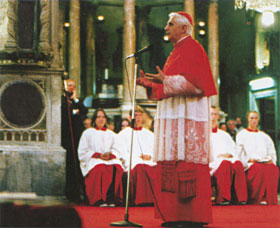
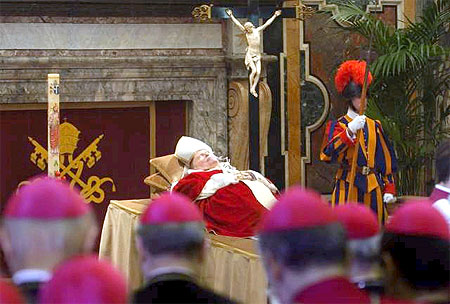
Here then-Cardinal Ratzinger, now Pope Benedict XVI, blesses the coffin of Pope John Paul the Great.


Here is a very good and brief bio on the new pope: Pope Benedict XVI. It is published by Ignatius Press and their on-line web magazine, Ignatius Insight:

As Pope John Paul II's chief doctrinal officer and key advisor, Joseph Cardinal Ratzinger has been Prefect of the Congregation for the Doctrine of the Faith since 1981. He is the most revered prelate, scholar, theologian, teacher and Catholic author of our time, under Pope John Paul II - having spoken on everything from sexual consumerism, private revelation and the "crisis of faith," to human rights, roles of men and women today, marriage, the priesthood, and the future of the world.

Yet, the depth, candor and humble servitude of this highest-ranking Cardinal will likely be his lasting hallmark, as he is most engaging in God and the World (Ignatius, 2002), perhaps even more than in previous writings.Ratzinger was born in Germany (Bavaria) on Holy Saturday, April 16, 1927, and baptized that same day. He has said of his early baptism, "To be the first person baptized with the new water was seen as a significant act of Providence. I have always been filled with thanksgiving for having had my life immersed in this way in the Easter Mystery…".

His father worked as a rural policeman, which kept his family continually moving from town to town. In his memoirs about his early life (prior to his appointment as Archbishop of Munich), Milestones: Memoirs 1927 - 1977 (Ignatius, 1999), Ratzinger depicts his family life as quite happy. Family and Church were, for him, inseparable - and he clearly saw Hitler and the Third Reich as the enemy to both. He has said of his father, "…He saw that a victory of Hitler would not be a victory for Germany but a victory of the Antichrist…".

Following his father's retirement while Joseph Ratzinger was a teenager, the younger Ratzinger initiated study of classical languages, and in 1939, entered the minor seminary in Traunstein. In 1943 while still in seminary, he was drafted at age 16 into the German anti-aircraft corps. (Though he was opposed to the Nazis, he was forced to join at a young age.) Ratzinger then trained in the German infantry, but a subsequent illness precluded him from the usual rigors of military duty. As the Allied front drew closer to his post in 1945, he escaped from the Nazis and returned to his family's home in Traunstein, just as American troops established their headquarters in the Ratzinger household. As a German soldier, he was put in a POW camp but was released a few months later at the end of the War in summer 1945. He re-entered the seminary, along with his brother Georg, in November of that year.

Ratzinger and his brother Georg were ordained to the priesthood on June 29, 1951, in the Cathedral of Freising on the Feast of Saints Peter and Paul.He received his doctorate in theology in 1953 from the University of Munich. Beginning in 1959, he taught theology at the University of Bonn.

Ratzinger became more widely known when, during the Second Vatican Council and at the age of 35, he was appointed chief theological advisor for the Archbishop of Cologne, Cardinal Joseph Frings, for the four-year duration of the Council. After continuing his teaching at several German universities, Ratzinger was appointed by Pope Paul VI in March 1977 as Archbishop of Munich and Freising. In June 1977, he was elevated to Cardinal.

Pope John Paul II summoned Cardinal Ratzinger to Rome in November 1981, and named him Prefect of the Congregation for the Doctrine of the Faith, President of the Pontifical Biblical Commission, and President of the International Theological Commission. He has published several best-selling books which clarify faith practice and Catholic doctrine for today's Catholic and Christian: The Ratzinger Report (1985); Salt of the Earth (1996); The Spirit of the Liturgy (2000); God and the World (2002), and the recently published God Is Near Us: The Eucharist, The Heart of Life (2003).

Additionally, he worked with some 40 collaborators and over a thousand bishops to produce the 900+ page Catechism of the Catholic Church.Ratzinger works more closely with Pope John Paul II than perhaps anyone else. On Tuesdays, Ratzinger and members of the Congregation meet with the Pope for an hour-and-a-half lunch meeting. Then Ratzinger meets alone with the Pope every Friday evening to discuss critical problems facing the Church and the deliberations of the Congregation. "Then the Pope decides," says Ratzinger.

Ratzinger has wielded spiritual influence and worldwide respect even from those who don't hold to the Catholic faith. As papal biographer for John Paul II, George Weigel, has said, "…not even his [Ratzinger's] implacable enemies ever questioned Joseph Ratzinger's erudition: his encyclopedic knowledge of theology; his command of biblical, patristic, scholastic, and contemporary sources; his elegance as a thinker and writer."


Posted by Hello

Pope Benedict XVI: His First Message


Habemus Papam!

We have a Pope!

Here is the text of Pope Benedict XVI's first message:

Dear brothers and sisters,

After the Great Pope John Paul II, the cardinals have elected me, a simple, humble worker in the Lord’s vineyard.

I am comforted by the fact that the Lord knows how to work and act even with insufficient instruments. And above all, I entrust myself to your prayers.

With the joy of the risen Lord and confidence in his constant help, we will go forward. The Lord will help us, and Mary his most holy mother will be alongside us.

Thank you.


Posted by Hello

Homily from Conclave Mass


Then-Cardinal Ratzinger preaching.

On April 18, Cardinal Ratzinger delivered the homily during the Mass to begin the Conclave.
Here is the text of his homily, which is one that echoes many themes he has stressed over the years and one that is sure to be remembered, especially now that he is Pope Benedict XVI.

Cardinal Ratzinger's Homily

The Dean of the Sacred College was the chief-celebrant at the Votive Mass for the Election of a New Pope. The following is the text of his homily.

At this hour of great responsibility, we hear with special consideration what the Lord says to us in his own words. From the three readings I would like to examine just a few passages which concern us directly at this time.

The first reading gives us a prophetic depiction of the person of the Messiah - a depiction which takes all its meaning from the moment Jesus reads the text in the synagogue in Nazareth, when he says: "Today this scripture passage is fulfilled in your hearing" (Lk 4,21). At the core of the prophetic text we find a word which seems contradictory, at least at first sight. The Messiah, speaking of himself, says that he was sent "To announce a year of favor from the Lord and a day of vindication by our God" (Is 61,2). We hear with joy the news of a year of favor: divine mercy puts a limit on evil - the Holy Father told us. Jesus Christ is divine mercy in person: encountering Christ means encountering the mercy of God. Christ's mandate has become our mandate through priestly anointing. We are called to proclaim - not only with our words, but with our lives, and through the valuable signs of the sacraments, the "year of favor from the Lord". But what does the prophet Isaiah mean when he announces the "day of vindication by our God"? In Nazareth, Jesus did not pronounce these words in his reading of the prophet's text - Jesus concluded by announcing the year of favor. Was this, perhaps, the reason for the scandal which took place after his sermon? We do not know. In any case, the Lord gave a genuine commentary on these words by being put to death on the cross. Saint Peter says: "He himself bore our sins in his body upon the cross" (1 Pe 2,24). And Saint Paul writes in his letter to the Galatians: "Christ ransomed us from the curse of the law by becoming a curse for us, for it is written, 'Cursed be everyone who hangs on a tree', that the blessing of Abraham might be extended to the Gentiles through Christ Jesus, so that we might receive the promise of the Spirit through faith." (Gal 3, 13s).

The mercy of Christ is not a cheap grace; it does not presume a trivialization of evil. Christ carries in his body and on his soul all the weight of evil, and all its destructive force. He burns and transforms evil through suffering, in the fire of his suffering love. The day of vindication and the year of favor meet in the paschal mystery, in Christ died and risen. This is the vindication of God: he himself, in the person of the Son, suffers for us. The more we are touched by the mercy of the Lord, the more we draw closer in solidarity with his suffering - and become willing to bear in our flesh "what is lacking in the afflictions of Christ" (Col 1, 24).

In the second reading, the letter to the Ephesians, we see basically three aspects: first, the ministries and charisms in the Church, as gifts of the Lord risen and ascended into heaven. Then there is the maturing of faith and knowledge of the Son of God, as a condition and essence of unity in the body of Christ. Finally, there is the common participation in the growth of the body of Christ - of the transformation of the world into communion with the Lord.

Let us dwell on only two points. The first is the journey towards "the maturity of Christ" as it is said in the Italian text, simplifying it a bit. More precisely, according to the Greek text, we should speak of the "measure of the fullness of Christ", to which we are called to reach in order to be true adults in the faith. We should not remain infants in faith, in a state of minority. And what does it mean to be an infant in faith? Saint Paul answers: it means "tossed by waves and swept along by every wind of teaching arising from human trickery" (Eph 4, 14). This description is very relevant today!

How many winds of doctrine we have known in recent decades, how many ideological currents, how many ways of thinking... The small boat of thought of many Christians has often been tossed about by these waves - thrown from one extreme to the other: from Marxism to liberalism, even to libertinism; from collectivism to radical individualism; from atheism to a vague religious mysticism; from agnosticism to syncretism, and so forth. Every day new sects are created and what Saint Paul says about human trickery comes true, with cunning which tries to draw those into error (cf Eph 4, 14). Having a clear faith, based on the Creed of the Church, is often labeled today as a fundamentalism. Whereas, relativism, which is letting oneself be tossed and "swept along by every wind of teaching", looks like the only attitude (acceptable) to today's standards. We are moving towards a dictatorship of relativism which does not recognize anything as for certain and which has as its highest goal one's own ego and one's own desires.

However, we have a different goal: the Son of God, true man. He is the measure of true humanism. Being an "Adult" means having a faith which does not follow the waves of today's fashions or the latest novelties. A faith which is deeply rooted in friendship with Christ is adult and mature. It is this friendship which opens us up to all that is good and gives us the knowledge to judge true from false, and deceit from truth. We must become mature in this adult faith; we must guide the flock of Christ to this faith. And it is this faith - only faith - which creates unity and takes form in love. On this theme, Saint Paul offers us some beautiful words - in contrast to the continual ups and downs of those were are like infants, tossed about by the waves: (he says) make truth in love, as the basic formula of Christian existence. In Christ, truth and love coincide. To the extent that we draw near to Christ, in our own life, truth and love merge. Love without truth would be blind; truth without love would be like "a resounding gong or a clashing cymbal" (1 Cor 13,1).

Looking now at the richness of the Gospel reading, I would like to make only two small observations. The Lord addresses to us these wonderful words: "I no longer call you slaves...I have called you friends" (Jn 15,15). So many times we feel like, and it is true, that we are only useless servants. (cf Lk 17,10). And despite this, the Lord calls us friends, he makes us his friends, he gives us his friendship. The Lord defines friendship in a dual way. There are no secrets among friends: Christ tells us all everything he hears from the Father; he gives us his full trust, and with that, also knowledge. He reveals his face and his heart to us. He shows us his tenderness for us, his passionate love that goes to the madness of the cross. He entrusts us, he gives us power to speak in his name: "this is my body...", "I forgive you...". He entrusts us with his body, the Church. He entrusts our weak minds and our weak hands with his truth - the mystery of God the Father, Son and Holy Spirit; the mystery of God who "so loved the world that he gave his only begotten Son" (Jn 3, 16). He made us his friends - and how do we respond?

The second element with which Jesus defines friendship is the communion of wills. For the Romans "Idem velle - idem nolle", (same desires, same dislikes ) was also the definition of friendship. "You are my friends if you do what I command you." (Jn 15, 14). Friendship with Christ coincides with what is said in the third request of the Our Father: "Thy will be done on earth as it is in heaven". At the hour in the Garden of Gethsemane, Jesus transformed our rebellious human will in a will shaped and united to the divine will. He suffered the whole experience of our autonomy - and precisely bringing our will into the hands of God, he gave us true freedom: "Not my will, but your will be done". In this communion of wills our redemption takes place: being friends of Jesus to become friends of God. How much more we love Jesus, how much more we know him, how much more our true freedom grows as well as our joy in being redeemed. Thank you, Jesus, for your friendship!

The other element of the Gospel to which I would like to refer is the teaching of Jesus on bearing fruit: "I who chose you and appointed you to go and bear fruit that will remain" (Jn 15, 16). It is here that is expressed the dynamic existence of the Christian, the apostle: I chose you to go and bear fruit...". We must be inspired by a holy restlessness: restlessness to bring to everyone the gift of faith, of friendship with Christ. In truth, the love and friendship of God was given to us so that it would also be shared with others. We have received the faith to give it to others - we are priests meant to serve others. And we must bring a fruit that will remain. All people want to leave a mark which lasts. But what remains? Money does not. Buildings do not, nor books. After a certain amount of time, whether long or short, all these things disappear. The only thing which remains forever is the human soul, the human person created by God for eternity. The fruit which remains then is that which we have sowed in human souls - love, knowledge, a gesture capable of touching the heart, words which open the soul to joy in the Lord. Let us then go to the Lord and pray to him, so that he may help us bear fruit which remains. Only in this way will the earth be changed from a valley of tears to a garden of God.

In conclusion, returning again to the letter to the Ephesians, which says with words from Psalm 68 that Christ, ascending into heaven, "gave gifts to men" (Eph 4,8). The victor offers gifts. And these gifts are apostles, prophets, evangelists, pastors and teachers. Our ministry is a gift of Christ to humankind, to build up his body - the new world. We live out our ministry in this way, as a gift of Christ to humanity! But at this time, above all, we pray with insistence to the Lord, so that after the great gift of Pope John Paul II, he again gives us a pastor according to his own heart, a pastor who guides us to knowledge in Christ, to his love and to true joy. Amen.

Posted by Hello

Habemus Papam!


Habemus Papam!


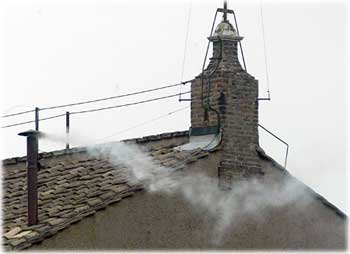
The suspense builds.

Posted by Hello

Sunday, April 10, 2005

The Pope's Outlook on Youth


"There is something in man which never changes ...."

"As a young priest and pastor I came to this way of looking at young people and at youth, and it has remained constant all these years. It is an outlook which also allows me to meet young people wherever I go. ... [A]nywhere the Pope goes, he seeks out the young and the young seek him out."

"We need the enthusiasm of the young. We need their joie de vivre. In it is reflected something of the original joy God had in creating man. ... The young know how to express this joy in their own special way."

"Even though he [the Pope] is getting older, they [the young] urge him to be young, they do not permit him to forget his experience, his discovery of youth and its great importance for the life of every man."


Pope John Paul the Great,
Crossing the Threshold of Hope, "Is There Really Hope in the Young?"


Posted by Hello

Wednesday, April 06, 2005

The Pope's Humanity and a Jewish Girl

In one of the most moving stories I have read about Pope John Paul the Great, his humanity and Christ-like love shine forth ... once again. Thank you, Martin, for sending this my way.


The Polish Seminary Student and the Jewish Girl He Saved

By ROGER COHEN
Published: April 6, 2005

International Herald Tribune

Here is a family story of Pope John Paul II, an intimate tale of his humanity.

During the summer of 1942, two women in Krakow, Poland, were denounced as Jews, taken to the city's prison, held there for a few months and then sent to the Belzec death camp, where in October they were killed in primitive Nazi gas chambers by carbon monoxide from diesel engines.

Their names were Frimeta Gelband and Salomea Zierer; they were sisters. As it happens, Frimeta was my wife's grandmother. Salomea - known as Salla - had two daughters, one of whom survived the war and one of whom did not.

The elder of these daughters was Edith Zierer. In January 1945, at age 13, she emerged from a Nazi labor camp in Czestochowa, Poland, a waif on the verge of death. Separated from her family, unaware that her mother had been killed by the Germans, she could scarcely walk.

But walk she did, to a train station, where she climbed onto a coal wagon. The train moved slowly, the wind cut through her. When the cold became too much to bear, she got down at a village called Jedrzejow. In a corner of the station, she sat. Nobody looked at her, a girl in the striped and numbered uniform of a prisoner, late in a terrible war. Unable to move, Edith waited.

Death was approaching, but a young man approached first, "very good looking," as she recalled, and vigorous. He wore a long robe and appeared to be a priest. "Why are you here?" he asked. "What are you doing?" Edith said she was trying to get to Krakow to find her parents.

The man disappeared. He came back with a cup of tea. Edith drank. He said he could help her get to Krakow. Again the mysterious benefactor went away, returning with bread and cheese. They talked about the advancing Soviet Army. Edith said she believed that her parents and younger sister, Judith, were alive.

"Try to stand," the man said. Edith tried and failed. He carried her to another village, where he put her in the cattle car of a train bound for Krakow. Another family was there. The man got in beside Edith, covered her with his cloak and made a small fire.

His name, he told Edith, was Karol Wojtyla. Although she took him for a priest, he was still a seminarian who would not be ordained until the next year. Thirty-three more years would pass before he became Pope John Paul II and embarked on a papacy that would help break the Communist hold on Central Europe and so transform the world.

What moved this young seminarian to save the life of a lost Jewish girl cannot be known. But it is clear that his was an act of humanity made as the two great mass movements of the 20th century, the twin totalitarianisms of Fascism and Communism, bore down on his nation, Poland.

Here were two people in a ravaged land, a 24-year-old Catholic and a 13-year-old Jew. The future pope had already lost his mother, father and brother. Edith, although she did not know it yet, had already lost her mother at Belzec, her father at Maidanek and her little sister at Auschwitz. They could not have been more alone.

Pope John Paul II is widely viewed as having been a man of unshakable convictions that some found old-fashioned or rigid. But perhaps he offered his truth with the same simplicity and directness he showed in proffering tea and bread and shelter from cold to an abandoned Jewish girl in 1945, when nobody was watching.

It was based in the belief that, as he once put it, "a degradation, indeed a pulverization, of the fundamental uniqueness of each human being" was at the root of the mass movements of the 20th century, Communism and Fascism.

Stalin once contemptuously asked, "How many divisions has the pope?" Starting with his 1979 visit to Poland, John Paul gave an answer.

Perhaps the strength that enabled him to play a central role in ending Communism and the strength that led him to save Edith Zierer did not differ fundamentally. Like his healing ecumenism, those acts required the courage born of a core certitude.

Edith fled from Karol Wojtyla when they arrived at Krakow in 1945. The family on the train, also Jews, had warned her that he might take her off to "the cloisters." She recalls him calling out, "Edyta, Edyta!" - the Polish form of her name - as she hid behind large containers of milk.

But hiding was not forgetting. She wrote his name in a diary, her savior, and in 1978, when she read in a copy of Paris-Match that he had become pope, she broke into tears. By then Edith Zierer was in Haifa, Israel, where she now lives.

Letters to him went unanswered. But at last, in 1997, she received a letter from the Vatican in which the pope recalled their meeting. A year later they met again at the Vatican. Edith thanked the pope for saving her. He put one hand on her head, another hand in hers, and blessed her. As she parted, he said, "Come back, my child."

Monday, April 04, 2005

Future Pope and Some JP II Rememberances


As a bishop when this photo was taken, the future Pope is here visiting the Parthenon (Greece) in 1963.


Following are excerpts of some articles/rememberances I have enjoyed. Click on title to see whole article. For a whole list of them, go to this special collection of articles prepared by RealClear Politics.


Mourning and Remembrance

by George Weigel


He once described his high-school years as a time in which he was "completely absorbed" by a passion for the theater. So it was fitting that Karol Jozef Wojtyla lived a very dramatic life. As a young man, he risked summary execution by leading clandestine acts of cultural resistance to the Nazi occupation of Poland. As a fledgling priest, he adopted a Stalin-era nom de guerre--Wujek, "uncle"--while creating zones of intellectual and spiritual freedom for college students; those students, now older men and women themselves, called him Wujek to the end. As archbishop of Krakow, he successfully fought the attempt by Poland's communist overseers to erase the
nation's cultural memory. As Pope John Paul II, he came back to Poland in June 1979; and over nine days during which the history of the 20th century pivoted, he ignited a revolution of conscience that helped make possible the collapse of European communism a decade later.

The Power of Faith

By Charles Krauthammer


It was Stalin who gave us the most famous formulation of that cynical (and today quite fashionable) philosophy known as "realism" -- the idea that all that ultimately matters in the relations among nations is power: "The pope? How many divisions does he have?"

Stalin could have said that only because he never met John Paul II. We have just lost the man whose life was the ultimate refutation of "realism." Within 10 years of his elevation to the papacy, John Paul II had given his answer to Stalin and to the ages: More than you have. More than you can imagine.

History will remember many of the achievements of John Paul II, particularly his zealous guarding of the church's traditional belief in the sanctity of life, not permitting it to be unmoored by the fashionable currents of thought about abortion, euthanasia and "quality of life." But above all, he will be remembered for having sparked, tended and fanned the flames of freedom in Poland and the rest of Eastern Europe, leading ultimately and astonishingly to the total collapse of the Soviet empire.

I am not much of a believer, but I find it hard not to suspect some providential hand at play when the white smoke went up at the Vatican 27 years ago and the Polish cardinal was chosen to lead the Catholic Church. Precisely at the moment that the West most desperately needed it, we were sent a champion. It is hard to remember now how dark those days were. The 15 months following the pope's elevation marked the high tide of Soviet communism and the nadir of the free world's post-Vietnam collapse.

It was a time of one defeat after another. Vietnam invaded Cambodia, consolidating Soviet hegemony over all of Indochina. The Khomeini revolution swept away America's strategic anchor in the Middle East. Nicaragua fell to the Sandinistas, the first Soviet-allied regime on the mainland of the Western Hemisphere. (As an unnoticed but ironic coda, Marxists came to power in Grenada too.) Then, finally, the Soviets invaded Afghanistan.

And yet precisely at the time of this free-world retreat and disarray, a miracle happens. The Catholic Church, breaking nearly 500 years of tradition, puts itself in the hands of an obscure non-Italian -- a Pole who, deeply understanding the East European predicament, rose to become, along with Roosevelt, Churchill and Reagan, one of the great liberators of the 20th century.

John Paul II's first great mission was to reclaim his native Eastern Europe for civilization. It began with his visit to Poland in 1979, symbolizing and embodying a spiritual humanism that was the antithesis of the soulless materialism and decay of late Marxist-Leninism. As millions gathered to hear him and worship with him, they began to feel their own power and to find the institutional structure -- the vibrant Polish church -- around which to mobilize.

And mobilize they did. It is no accident that Solidarity, the leading edge of the East European revolution, was born just a year after the pope's first visit. Deploying a brilliantly subtle diplomacy that never openly challenged the Soviet system but nurtured and justified every oppositional trend, often within the bosom of the local church, John Paul II became the pivotal figure of the people power revolutions of Eastern Europe.
The Poet and the Revolutionary

by Lorenzo Albacete

This piece, first published in 1998, on the eve of John Paul II’s historic
visit to Cuba, examines one of the Pope’s many missions, and his unexpected
relationship with Fidel Castro. The author, Monsignor Lorenzo Albacete, is a
professor of theology at St. Joseph’s Seminary, in New York.

The first time I went to Cuba, in February of 1989, I felt that I was on a secret mission. My “cover” (which, undramatically, was also one of my real-life jobs) was that of theological adviser to the Northeast Hispanic Catholic Center: I was helping to chaperon a pilgrimage. Among the center’s other activities, it arranges for groups of Latino parishioners to travel to their countries of origin, and that year we had finally won approval from the Cuban government to send a group of visitors. The center’s director and I were warned, however, that any religious objects we might bring would have to be for personal use only. The Cuban authorities frowned upon the importing of Bibles, rosaries, or pious books with intent to distribute.

My “secret” was related to this prohibition: we were bringing with us parts of an apparatus that makes the Communion wafers used in the Catholic Mass.
Apparently, most of this machine had already been carried into Cuba, and our
group was bringing in the last parts, which would finally allow the contraption
to work. We were to deliver the parts to a particular group of cloistered nuns,
who supported their order by supplying wafers to Catholic parishes.

...

Now it is apparent that Fidel Castro and Pope John Paul II sense some common purpose as well. Over the past two decades, they have been making fitful progress toward their historic public encounter this week in Havana. There have been frequent breakdowns, to be sure, along the way. (One Cuban friend of mine
compared the process to the island’s traditional danzón, in which dancers approach each other, then step back or turn away, only to approach again.) Yet the underlying impetus for this meeting has been strong enough to overcome all obstacles. The collapse of the Soviet Union gave it a new urgency and, by the same token, mooted Cold War objections to it. John Paul II, having helped destabilize the Communist governments of Eastern Europe, is dismayed by the corrosive materialism that has now taken hold there. One friend who has had meetings with Castro told me recently that Fidel regards himself and the Pope as the only world leaders willing to condemn the triumphalist neoliberal capitalism that both believe is widening the gap between rich and poor, especially in developing countries. To be sure, the superstructure of Castro’s anticapitalism is Communist, historical materialist, and secularist, whereas that of John Paul II is anti-Communist, spiritual, and formally religious. These are not trivial differences. But, with Communism dead as a global model and capitalism sweeping everything before it—even in Cuba—both men can afford to pay attention to the points where their views and interests converge. Both men, after all, are visionaries, and both, as a matter of philosophical belief, reject the free market’s implicit view of mankind as the sum of its material wants.

Can the transcendent social vision of the Revolution be squared with the transcendent spiritual vision of the Church? One of the Pope’s favorite quotations is from St. John of the Cross: “At the sunset of our lives, we shall be tested in love.” As Castro and John Paul consider what they will leave behind when darkness falls, these two masters of symbolism see great value in standing together against what both see, in different but overlapping ways, as the forces that threaten to undo the work of their lives. They believe, each for his own reasons, that this gesture may have a profound effect on the future of Cuba and of Latin America.

WhenI returned to Cuba, last month, I again accompanied the director of the Northeast Hispanic Catholic Center, but this time, in anticipation of the Pope’s visit, our group carried enough liturgical vessels, vestments, medals, and altar books to staff a parish. The Cuban customs official waved our cargo through with a smile.

John Paul the Great

By RICHARD JOHN NEUHAUS

IN the nearly two millennia of the Church's history, only two popes are known as "The Great": Leo the Great and Gregory the Great, in the fifth and sixth centuries respectively. I fully expect that in the not distant future John Paul II will regularly be referred to as John Paul the Great.

That is not a controversial suggestion, although there is considerable controversy over the reasons why he is generally recognized as one of the greatest of the 264 successors to the apostle Peter — to whom Jesus said, speaking of his faith and his person, "You are Peter, and upon this rock I will build my Church."

Political historians will undoubtedly focus on John Paul's role in bringing down what it is no longer controversial to call the "evil empire" of Soviet communism. Having lived for years under Nazism and for many more years under communism, Karol Wojtyla, who would later become John Paul II, had no illusions about totalitarian tyranny.

He was among the few who was not taken in by the belief that the best we could hope for is "coexistence" between freedom and tyranny. That conviction was informed by his understanding of human dignity and the way in which we human beings are, so to speak, hard-wired for freedom and responsibility, both of which communism denied.

...

In his very first sermon after becoming pope, John Paul chose the theme, "Be not afraid." That was the greeting of the resurrected Jesus to his frightened disciples, and those words were repeated like a triphammer throughout the more than 26 years of John Paul's extraordinary pontificate.

He was telling people behind the Iron Curtain to be not afraid, but, in a deeper sense, he was telling all of humanity to be not afraid.

John Paul Was a Man of His Times

BY CARDINAL FRANCIS GEORGE

Karol Wojtyla, actor on the world stage, Pope John Paul II, Bishop of Rome, successor of Peter and Vicar of Christ, has died.

Pope John Paul was a man of apostolic faith, of constant prayer, of dedication to the church's mission in the world. He saw his work as Bishop of Rome to be the implementation of the goals and decrees of the Second Vatican Council (1962-1965). The council was called not to change the church in order to "catch up" with modern times but to plan changes so that the church could convert modern times to Christ. No matter how Pope John Paul II is judged now or in the future, what is certain was his fidelity to that vision and, behind it, to Christ himself.

The pope is dead. There will be another, as there has been for the last 2,000 years. The office is more important than its holder, for our faith is based on the office, not the person. Yet, Karol Wojtyla was a person who held the office of the papacy in a way that transformed it. Pastors of other Christian churches, leaders of other world religions, political officials and millions of ordinary people of good will who have met him personally or through the mass media have grown accustomed to his presence in ways that would have been unthinkable before Karol Wojtyla became pope. He was a man steeped in the tradition that unites us to Christ; he was also a man of his own time, our time, who understood contemporary experience even as he subjected it to criticisms which echoed Jesus' own criticisms of his society 2,000 years ago.

That critical voice gave hope, especially to young people. A girl who attended one of the World Youth Day celebrations commented, "The pope is the only strong person kids can look up to." A not-so-young Mikhail Gorbachev, when introducing his wife to Pope John Paul II, said, "Raisa, I should like to introduce His Holiness, who is the highest moral authority in the world."

“Theocrats” for Freedom: What’s faith got to do with it? Plenty.

by Rich Lowry

The word "theocrat" is a rapidly emerging swearword in American politics. If someone opposes gay marriage, or supports giving sustenance to Terri Schiavo, or has any strong moral convictions that inform his policy positions, he is a "theocrat" who secretly wishes to begin burning people at the stake. How odd, then, that this week we mourn the death and celebrate the life of a man, Pope John Paul II, who had "theocratic" trappings and convictions and yet is universally regarded as a great warrior for freedom.

Actually, it is not odd at all. Many of the great leaps of freedom in the West have come at the instigation of Christian believers. Their faith lends them an unbending belief in human dignity and an audacious hope in success against all odds that sweep aside excuses for inaction.

When the Quakers began agitating against slavery in 18th-century England, igniting a wave of moral revulsion against it, they didn't care that slavery was important economically to the country. They believed slavery was a violation of God's law — enough said. When Rev. Martin Luther King Jr. and his collection of (in secular terms) fellow religious fanatics began marching in the American South in the 1960s, even some pro-civil-rights liberals demurred, warning against "impatience." King responded that justice wouldn't wait. John Paul II acted in this tradition of Christian confrontation of evil in his titanic struggle against Communism in Eastern Europe.

His Gospel of Life: A Rabbi’s Eulogy of Pope John Paul II

By Rabbi Daniel Lapin

What meaningful eulogy can a rabbi possibly add to the many heartfelt tributes being paid to the Holy Father, Pope John Paul II?

Ancient Jewish wisdom advised that in this world a man is known by his father. Not only a man's last name, but much of his identity comes from his father. However, after the process of death transforms us to spirit, we look to our children and grandchildren for clues to our eternity. In the future world of the spirit where all is light and truth, Judaism teaches that each of us will be known by the actions of his children.

But children are not the only building blocks people leave behind. In the world to come we will be known by all our lasting accomplishments, including worthy children and powerful ideas.

Pope John Paul II is even now being warmly greeted in heaven as the father of a billion worthy children and the progenitor of one powerful idea.

We can condense the vast repertoire of courage and compassion, the dazzling virtuosity exhibited over decades by Pope John Paul II into one idea. This idea is so powerful that it welded the many facets of his life into one brilliant beam of clarity.
Pope John Paul II's singular coherence was the sanctity of life. His beam of clarity was the triumph of life over death. Terri Schiavo, clinging to life, alerted all Americans to the real distinction between the culture of death and that of life. Perhaps her final role was to herald on high, the imminent arrival of Karol Wojtyla.

Posted by Hello

Sunday, April 03, 2005

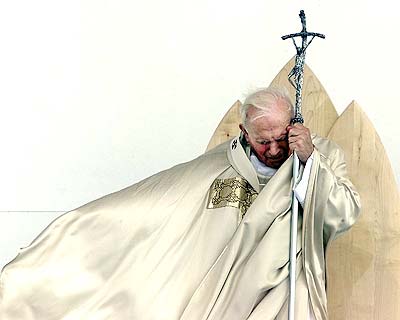
Radiating Christ -- Pope John Paul the Great


"Now I rejoice in my sufferings for your sake, and in my flesh I complete what is lacking in Christ's afflictions for the sake of his body, that is, the church, of which I became a minister according to the divine office which was given to me for you, to make the word of God fully known .... Christ .... Him we proclaim, warning every man and teaching every man in all wisdom, that we may present every man mature in Christ. For this I toil, striving with all the energy which he mightily inspires within me."

Colossians 1:24-29

Posted by Hello

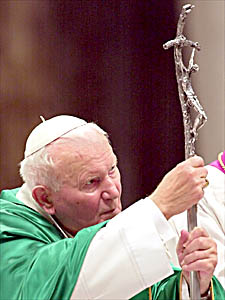
Pope John Paul the Great: Witness to Christ


"Suffering is, in fact, a vocation; it is a calling to accept the burden of pain in order to transform it into a sacrifice of purification and of reconciliation offered to the Father in Christ and with Christ, for one's own salvation and that of others."

Pope John Paul II, Insegnamenti, 5/6/83


"In order to hope for salvation from God, man must stop beneath Christ's Cross."

Pope John Paul II, Crossing the Threshold of Hope, p. 68


Posted by Hello

Requiescat in Pace


Requiescat in pace.

"O that you would kiss me with the kisses of your mouth!
For your love is better than wine,
your anointing oils are fragrant,
your name is oil poured out;
therefore the maidens love you.
Draw me after you, let us make haste.
The king has brought me into his chambers.
We will exult and rejoice in you;
we will extol your love more than wine;
rightly do they love you."

"My beloved speaks and says to me:
'Arise, my love, my fair one, and come away;
for lo, the winter is past,
the rain is over and gone.
The flowers appear on the earth,
the time of singing has come,
and the voice of the turtledove is heard in our land.'"

Song of Solomon, 1: 2-4; 2: 10-12


Posted by Hello

Friday, April 01, 2005


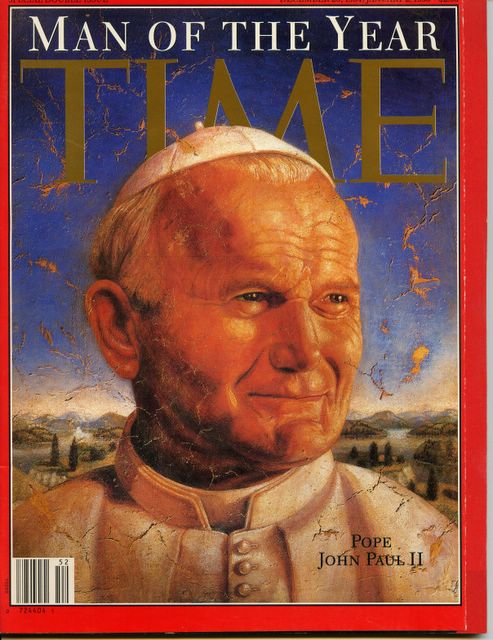
Should also have been "Man of the Century"!

History will vindicate Pope John Paul II the Great!

May his suffering be redemptive as a co-worker with Christ.

Posted by Hello

Pope John Paul the Great


In prayers. Seemed time to pull this out and recall all that he has done. "Totus tuus."

In one of the best
articles on JPII that I have read, George Weigel opens with dramatic intensity:


"At the height of Hollywood's infatuation with things Catholic, no screenwriter would have dared propose such a storyline: Months after his country regains its independence, a son is born to Polish parents in the small provincial own of Wadowice. His mother dies before he makes his First Communion. Raised by his father, a gentleman of the old school and a retired military officer of deep piety, the youngster is easily the best student in the town schools, an enthusiastic athlete, an amateur actor of note in a town that prides itself on its theatrical tradition. One of his close friends is the son of the leader of the local Jewish community.

"After moving to Krakow with his pensioner-father he enters the ancient Jagiellonian University, but his brilliant academic performance and his rapidly developing career as an actor in avant-garde theater are abruptly terminated by the Second World War.

"Amidst the brutalities of a Nazi occupation intended to eradicate Poland from history's map, he works as a quarryman, blaster, and manual laborer, often walking four kilometers to work in the freezing Polish winter, clad in jeans and wooden clogs, his face smeared with Vaseline to prevent his skin from freezing. At risk of his life he helps organize a resistance movement aimed at saving Polish culture through the power of the 'living word,' proclaimed in an underground theater; at the same time, he takes his first steps in Carmelite spirituality under the tutelage of a quirky lay mystic who forms young men into 'Living Rosary' groups after the priests of the local parish have been sent to Dachau.

"His father dies and the young man's vocational struggle intensifies: is his life to play itself out on the stage or in the sanctuary? When his decision to seek the priesthood matures, he enters a clandestine seminary run by the heroic archbishop of Krakow, who serves Hans Frank a meal of stale bread and acorn coffee when the haughty Nazi governor insists on being invited to dine at the episcopal manse. The surreptitious seminarian (one of whose classmates suddenly disappears, only to end up in front of a firing squad) studies philosophy and theology in the dim light of the chemical factory where he works the midnight shift; his books are pock-marked by the lime that splashes out of the water-purification machinery he tends.

"In the wake of the Warsaw Uprising, the Nazis try to forestall a similar eruption of resistance by arresting every young man in Krakow; our protagonist dodges Gestapo patrols, makes his way across town, and enters the bishop's residence where the clandestine seminary is reformed. He lives in a makeshift dormitory that was once the archbishop's drawing room; after Poland's 'liberation' by the Red Army in 1945, he engages a Soviet soldier in a long, earnest conversation about the possibility of God.

"After priestly ordination, graduate studies in Rome, and a sympathetic look at the worker-priest movement in France, he returns to Krakow and, after a year in a country parish, begins an intense ministry to university students at St. Florian's Church. While Stalinist orthodoxy is being ruthlessly enforced in Polish intellectual life, liturgical innovation, a pastoral strategy of 'accompaniment,' and thousands of hours in the confessional distinguish his approach to the university chaplaincy. Completing a second doctoral degree, he joins the faculty of the only Catholic university in the communist world; there, he and his philosophy department colleagues conduct a bold experiment aimed at nothing less than the reconfiguration of post-Cartesian intellectual life. While commuting back and forth by overnight train to his teaching position he continues his pastoral ministry in Krakow and works to develop a modern Catholic sexual ethic in conversation with his former parishioners, now preparing for marriage or starting their families.

"One of the last episcopal nominations of Pius XII, he is consecrated bishop at thirty-eight and within four years is elected administrator of the archdiocese when the incumbent ordinary dies and the Church and the government deadlock on a new appointment. One of the intellectual leaders of the Second Vatican Council, he makes crucial contributions to its Declaration on Religious Freedom and, above all, to its Pastoral Constitution on the Church in the Modern World. Proving that Providence has a wicked sense of humor, he is nominated archbishop of Krakow with the enthusiastic support of the communist government and is created cardinal at forty-seven.

"As archbishop he conducts the most extensive implementation of Vatican II of any diocese in the world, all the while refusing to behave as cardinals are supposed to behave: he skis, he kayaks, he vacations with lay people. A working intellectual, he continues to teach at the Catholic University of Lublin and spends two hours every day in his chapel, writing at a desk before the Blessed Sacrament. To the intense chagrin of the communist authorities, he pursues a relentless, sophisticated, and increasingly vocal defense of religious freedom: demanding church-building permits, defending youth movements, clandestinely ordaining underground priests for work in Czechoslovakia.

"Invited to preach the papal Lenten retreat in 1976, he prepares a series of meditations in which Holy Scripture, St. Augustine, and the German philosopher Heidegger are the first three references. Two years later he is elected the 264th bishop of Rome, the first non-Italian in 455 years, and the first Slavic pope ever. KGB leader Yuri Andropov warns the Politburo of grave troubles ahead, and is vindicated when the Polish pope returns to his homeland in June 1979 and sets in motion the revolution of conscience that eventually produces the nonviolent revolution of 1989, the collapse of European communism-and the end of the Soviet Union Andropov served.

"The Slav pope revamps the practice of the papacy through pastoral pilgrimages to every corner of the world and through a magisterium that addresses virtually every large question involved in the ongoing implementation of Vatican II, to whose completion he has pledged his pontificate. Surviving an assassination attempt, he redefines the Catholic encounter with Judaism, invites Orthodox and Protestant Christians to help conceive a papacy that could serve them, preaches to sixty thousand raptly attentive Muslim teenagers in a Casablanca stadium, and describes marital intimacy as an icon of the inner life of the Trinity.

"After a bout with cancer and sundry other medical difficulties, the world press pronounces him a dying has-been; within the next six months, he publishes an international bestseller translated into fifty-five languages and gathers the largest crowd in human history in Manila, shortly after changing the course of the Cairo World Conference on Population and Development. When he addresses the United Nations in October 1995, the world, whether it likes what it hears or not, knows that it is listening to its moral leader. Two days later, the irrepressible pontiff does a credible imitation of Jack Benny during Mass in Central Park and the preternaturally cynical New York media loves it....

"Man of the Century?"

"As I say, the story, as fiction, is simply too much. But it is not fiction. All of this really happened. But what does it mean? What truth about the human condition, the Church, the modern world, is disclosed by this extraordinary personal epic?

"It is difficult to imagine a twentieth-century life more fraught with dramatic tension than that of Karol Jozef Wojtyla, Pope John Paul II. Jonathan Kwitny, in a new biography, dubs the pope 'the man of the century' — and Kwitny is right about this, if wrong about many, many other things. But to grasp the kernel of Wojtyla's life and papal project (the two are intimately related), it has to be understood that John Paul II as 'man of the century' is not a matter of Catholic special pleading. John Paul II is not the man of the Catholic twentieth century; he is the man of the century, period."

For the rest of this captivating article, check it out here.

Posted by Hello

Monday, March 21, 2005

George's Thoughts on Schiavo

Recently, National Review interviewed Princeton professor of law Robert George, who is a member of the President's Council on Bioethics. He spoke to issues of justified killing and particularly to the issue of denying Terri Schiavo food and water. Here are some of his thoughts:

"It is pointless to ask whether Terri Schiavo had somehow formed a conditional intention to have herself starved to death if eventually she found herself in a brain-damaged condition. What's really going on here — and I don't think we can afford to kid ourselves about this — is that Terri's husband has decided that hers is a life not worth having. In his opinion, her continued existence is nothing but a burden — a burden to herself, to him, to society. He has presumed to decide that his wife is better off dead.

"Even if we were to credit Michael Schiavo's account of his conversation with Terri before her injury — which I am not inclined to do — it is a mistake to assume that people can make decisions in advance about whether to have themselves starved to death if they eventually find themselves disabled. That's why living wills have proven to be so often unreliable. One does not know how one will actually feel, or how one will feel about one's life and the prospect of death, or whether one will retain a desire to live despite a mental or physical disability, when one is not actually in that condition and when one is envisaging it from the perspective of more or less robust health.

"Consider the case of a beautiful young woman — an actress or fashion model perhaps — who is severely burned in a fire. Prior to actually finding herself in such a condition, she might have supposed — and even said, if the subject had come up in a conversation — that she would rather be dead than live with her face grotesquely disfigured. But no one would be surprised if in the actual event she did not try to kill herself by starvation or some other means, and did not want to die.

"In any event, it is clear that the only reason for Michael Schiavo's decision is that he considers Terri's quality of life to be so poor that he wants her to be dead. He claims that she would want that too, which I don't grant, but even if he's right about that, we should treat her like anyone else who wants to commit suicide. We rescue, we care. We affirm the inherent value of the life of every human being. Our governing principle should be always to care, never to kill."

In responding to the criticisms of intervention by the government, George said:

"The other thing that Congress is being accused of is interfering in a family decision. Now look: Terri Schiavo has been abandoned by her husband. Michael Schiavo took a vow to be faithful to Terri "in sickness and in health, forsaking all others, 'til death do us part." But he has not been faithful; he has not forsaken all others. He has set himself up in a marriage in all-but-name with someone else, a woman with whom he already has two children. He has disrespected Terri and, indeed, forsaken her. Now he is seeking to bring about her death by starvation. Notice something wrong with this picture? Terri's parents and siblings, by contrast, have never abandoned her. They are prepared to shoulder all the burdens, including the financial burdens, of caring for her. They want to provide the therapy that many medical people who have observed Terri, whether at the bedside or by videotape, believe can help her. No one expects a full recovery, but it may be possible for her to make genuine progress. That possibility will be foreclosed, however, if she is killed by deliberate starvation before it can begin."

Saturday, March 19, 2005

Terri Schiavo and Christ's Passion

Yesterday was a sad day for America. Terri Schiavo's killing began. And it began partly because of a judge.

A court in this once-great land issued a death warrant, an order to kill, and since she is an innocent person, an order to murder. To take away food and water, basic goods, from someone who has not verifiably expressed such a wish is to violate her basic rights. Added to that is the fact that there are so many questionable "facts" and issues related to her case only makes the request on behalf of her husband all the more suspect. She has not even had the appropriate testing done to see if she is in a persistent vegetative state (pvs). The judge will not listen to reputable doctors who disagree with the husband and the judge's own death-oriented views.

It is no coincidence either that this happened on the Friday before Holy Week. As Terri is starved, she will undergo increased pain and suffering. She will truly be walking with Christ as Good Friday approaches. And if she dies as expected, if her murder happens when they think it will, she will have been killed on or around not only the day we remember the death of Christ but ... appropriately enough ... the Resurrection of Christ. May she be comforted in His Grace as she is slowly murdered and may her suffering and eventual death be redemptive. Her family ... or I should say her "loved ones" because not all her family is apparently loving her ... will need the comfort of this to persevere through the mayhem that continues in their lives.

I recently read the above letter to the editor in The Tidings (March 11), the newspaper of the Catholic Archdiocese of Los Angeles, that utterly misrepresented the Ten Commandments and Christian moral tradition.

Well, here are my thoughts (which The Tidings chose not to publish ... for whatever reason):

Letter writer Mike Wisniewski (March 11) betrays his own ignorance of the Ten Commandments as he tries to criticize other Catholics for what turns out to be their deeper and more accurate understanding of God's Word. Wisniewski says "there are no exceptions listed with" the fifth commandment. However, what he apparently does not understand is that the commandment to "not kill" literally says "Thou shall not murder." (Check your Hebrew.) Since there is a difference between murdering and killing, i.e., since not all killing is murder, this commandment actually does suggest an exception to killing. This commandment says one should not murder, and thus allows for continued and justified forms of killing. For proof of this, check out the second command God gives in the Bible, a command before he has formed the people of Israel (and thus not one subject to claims that it only applies then and to them): Genesis 9:6 says "If anyone sheds the blood of man, by man shall his blood be shed for in His (God's) image did God make man." God actually commands humanity to put to death those who murder. This is one reason why the Church will never condemn outright the moral justification of the death penalty, however limited she says its use should be.

Now, I am not saying that the death penalty is perfect nor am I saying that we should not find other forms to punish and keep murderers from the rest of society. The only point is that advocating the death penalty is not "hypocritical" for Catholics, for as things turn out these proponents actually have a strong case, both biblical and moral, for advocating such a measure, however limited they would like to see its application.

As well, Wisniewski suggests that war is counter to the fifth commandment. Well, since not all killing is proscribed, resort to war may still be justified. When we look at the evil of the Nazis, what other measure does Wisniewski suggest to stop the atrocious terror committed by a strong and morally-bankrupt regime like Hitler's? With a name like his, Wisniewski should know better. War is not the answer? Well, sometimes it is. Sometimes it is the only thing that will stop evil men from continuing to pillage, rape, murder, and torture innocents around the world. Sometimes it is the only thing that will stop genocide. War is sometimes the answer, and therefore killing is sometimes justified. It is only too sad that people like Wisniewski not only are ignorant about the Word of God and their alleged faith (especially when they are public about it) but that they also apparently have no gratitude for the sacrifice of thousands of men and women who have died fighting so that others could be free and live in relative peace and safety. As Mill said, yes, war is ugly, but what is uglier is the "decayed and degraded state of moral and patriotic feeling which thinks that nothing is worth war .... The person who has nothing for which he is willing to fight, nothing which is more important than his own personal safety, is a miserable creature and has no chance of being free unless made and kept so by the exertions of better men than himself." I thank God for these men (and those who continue such sacrifices). Without them, if we survived, we would all be speaking German! Posted by Hello

Saturday, March 12, 2005

Jesuits and False Teaching?

In a recent article in First Things about his entrance into the Catholic Church, R. R. Reno recalls one of the problems with Catholic universities, and education in general (at least in the sense of common sense and any positing or even honest consideration of an objective morality and for lack of a better word "traditional" or conservative political thought):

"The Catholic Church did not deliver me from apostasy and false teaching. I teach at a Jesuit university [enough said?!], so I am not naive about just how insouciant about orthodoxy priests can be."

Friday, March 11, 2005

Terrorists amongst Us

In an interview with National Review, Barbara Newman, a senior fellow at the Foundation for the Defense of Democracies, reveals some startling info about the continued threat of terrorism, this time not so much from al-Qaeda as from Hezbollah, the group responsible for murdering 241 U.S. Marines in Beirut back in 1983 all through one "suicide" bomber. She is the co-author of the new book Lightening Out of Lebanon: Hezbollah Terrorists on American Soil.

Some of Barbara Newman's responses:

"I almost lost my breakfast Thursday, which luckily I hadn't eaten yet, when I saw the New York Times page-one report today that Kofi Annan is encouraging the acceptance of Hezbollah as the preponderant power in Lebanon and the United States is thinking of yielding to this and France's pressure to do just that.

"But the unvarnished truth is that Hezbollah is the most dangerous terrorist group in the world. It has about 25,000 armed members and as we saw in the pro-Syrian march in Beirut, it can muster a million in the streets.

"The Iranian Revolutionary Guards started training what became Hezbollah in Baalbeck in the Bekaa Valley in Lebanon in 1979, right after Khomeini came to power in Iran. Iran supports Hezbollah with about $100 million a year but Hezbollah has enough businesses and is a powerful fundraiser in its own right. Iran helps Hezbollah by putting at its disposal its diplomatic prerogatives, letting Hezbollah use its security apparatus for communications and shipping of equipment.

"How can we forget the fact that in 1983 a Hezbollah suicide driver crashed a one-thousand-pound bomb into the Marine Barracks in Beirut and killed 241 of our best and brightest? What about the hostages they took and tortured? What about the CIA Beirut station chief William Buckley who they kidnapped and slowly drowned to death by forcing a pipe down his throat and flooding him with water? They made tapes of his agony and sent it to the CIA. I'm told that former CIA Director William Casey almost went crazy when he heard them, and this propelled him to Iran-Contra, to try to free the hostages.

"Hezbollah has been operating inside the United States. Since the 1980s, the FBI has deported hundreds of members and had dozens of cases. Mostly, in these years, the Hezbollah cells were busted for criminal activity such as insurance fraud, credit-card fraud, counterfeiting clothes such as Levi jeans, phony marriages which they arranged to get green cards, and cigarette smuggling. Though these are sort of under-the-radar crimes, they raised millions of dollars which were sent to Hezbollah coffers in Beirut and in some cases used to buy highly sophisticated 'dual-use' equipment in Canada such as very sophisticated computers, cell phones hooked up electronically to be capable of remotely controlled explosions, and intelligence drones.

"They have not hit us here but the FBI and CIA thinks if we push them to the wall, cut off their ability to raise funds, get tough with them in Lebanon, they easily could hit us here.

"Remember, they are very tough and sophisticated. Their soldiers don't do solo operations. Think of them as a pistol aimed at our head, which can be shot at will."

Wednesday, February 23, 2005

What Daniel Pipes Says They're Saying

Just found this from the website of Daniel Pipes:


Caught My Eye An occasional series of noteworthy quotes, in reverse chronological order.

__
Victor Davis Hanson: "Imagine a world in which there was no United States during the last 15 years. Iraq, Iran, and Libya would now have nukes. Afghanistan would remain a seventh-century Islamic terrorist haven sending out the minions of Zarqawi and Bin Laden worldwide. The lieutenants of Noriega, Milosevic, Mullah Omar, Saddam, and Moammar Khaddafi would no doubt be adjudicating human rights at the United Nations. The Ortega Brothers and Fidel Castro, not democracy, would be the exemplars of Latin America. Bosnia and Kosovo would be national graveyards like Pol Pot's Cambodia. Add in Kurdistan as well - the periodic laboratory for Saddam's latest varieties of gas. Saddam himself, of course, would have statues throughout the Gulf attesting to his control of half the world's oil reservoirs." ("The Disenchanted American," National Review Online, January 9, 2005)


Josef Joffe: "Imagine that Israel never existed. Would the economic malaise and political repression that drive angry young men to become suicide bombers vanish? Would the Palestinians have an independent state? Would the United States, freed of its burdensome ally, suddenly find itself beloved throughout the Muslim world? Wishful thinking. Far from creating tensions, Israel actually contains more antagonisms than it causes." ("A World Without Israel," Foreign Policy, January/February 2005)


Natan Sharansky, ex-Soviet dissident and Israeli politician, describing his November 2004 meeting with George W. Bush: "I told the President, ‘You don't look like a politician. You look like a real dissident, because politicians always look at what polls say, but you believe in democracy and freedom… Even when your colleagues in Europe tell you that democracy is impossible, you go ahead with it. You are a real dissident'." ("Peace Will Only Come after Freedom and Democracy," Middle East Quarterly, Winter 2005)


George Jonas, columnist: "Attempts to spread Western values around the world haven't been entirely unsuccessful [but] … in the realm of values, the balance of trade hasn't favoured the West. … We haven't exported tolerance nearly as often as we've imported intolerance. We haven't strengthened individual liberties in other regions nearly as much as we've reduced them at home. Today, we're less free to speak, associate, do business, choose pastimes or lifestyles than we were 50 ago (except in matters having to do with promiscuity or sexual preference)." ("Exporting freedom, importing intolerance," National Post, Dec. 27, 2004)


David Kershner, Los Angeles, in a letter to the editor: "Since when did it become the civil-rights lobby's mandate to preclude me and my loved ones from having every precaution taken to ensure our safety? … My suggestion is that the civil libertarians license their own airline, where no security check is required, no identification needed, and the pilot and airline are absolved from legal responsibility for any catastrophe resulting from a terrorist incident (understanding that the plane will be shot down if it deviates unannounced from its pre-determined flight path). The rest of us will provide fingerprints, driver's licenses and any other proof to lessen the risk of being blown to bits." ("Civil Liberties Zealots Need Their Own Airline," The Wall Street Journal, Dec. 13, 2004)


Muhammad Shahrour, a Syrian writer on Islam: "When you take the political Islam, you see only killing, assassination, poisoning, intrigue, conspiracy and civil war, but Islam as a message is very human, sensible and just." (Neil MacFarquhar, "Muslim Scholars Increasingly Debate Unholy War," The New York Times, Dec. 10, 2004)


Maria Margaronis: From London, "the most frightening thing about Bush's victory is the prospect of a world divided between warring fundamentalisms, with Europe in the middle struggling to hold on to its Enlightenment legacy." ("Fears of a World Divided," The Nation, Nov. 22, 2004)


Stephen H. Balch, president of the National Association of Scholars: "Our colleges have become less marketplaces of ideas than churches in which you have to be a true believer to get a seat in the pews. We've drifted to a secular version of 19th-century denominational colleges, in which the university's mission is to crusade against sin and make the country a morally better place." (Quoted in John Tierney, "Republicans Outnumbered In Academia, Studies Find," The New York Times, Nov, 18, 2004)


Jonathan S. Tobin: With the death of Yasir Arafat, "the policy wonks at the State Department, the Council on Foreign Relations and the ‘Middle East experts' at major American newspapers (The New York Times' Thomas L. Friedman, The Philadelphia Inquirer's Trudy Rubin, etc.) are commemorating Arafat's passing in the way they have reacted to virtually every piece of news that comes out of the region: calling for more U.S. pressure on Israel to revive the peace process." ("Conventional Wisdom Rides Again: Arafat is buried, but the usual foolish policies rise from the dead," Jewish Exponent, Nov. 18, 2004)


Max Boot: Colin Powell "traveled less than any secretary of State in 30 years. It was not entirely a coincidence that the U.S. image in the world sank to new lows while Powell busied himself at Foggy Bottom. Telephone calls and meetings with foreign ministers in New York and Washington are fine, but they're not enough to win the battle for hearts and minds. We need a secretary of State who travels incessantly to explain and defend American policies. In the age of satellite television, no nation can afford to have striped-pants diplomats whose activities are limited to cocktail parties. The model should be Oprah Winfrey, not Dean Acheson." ("Dearth of a Salesman," Los Angeles Times, Nov. 18, 2004)


Simon Henderson: "A new seven-star hotel is nearing completion in Abu Dhabi, only the second such rated hotel in the world; the other is in Dubai." ("The UAE after Sheikh Zayed: Tensions between Tribe and State," PolicyWatch, Nov. 12, 2004)


Gal Luft, executive director of the Institute for the Analysis of Global Security: "the U.S. finds itself in the position of financially supporting both itself and its enemies in the ‘War on Terror.' … Every time an American goes to a gas station, he is sending money to America's enemies." ("Ending America's Dependence on Middle East Oil," Middle East Forum Wire, Oct. 27, 2004)

Institute on Religion and Democracy report on U.S. liberal Protestant church activities: "for every one criticism [by the churches] of any other nation in the world, one criticism would also be made of the United States and one would be made of Israel." (Erik R. Nelson and Alan F.H. Wisdom, Human Rights Advocacy in the Mainline Protestant Churches (2000-2003) Sept. 27, 2004)


James at outsidethebelway.com, responding to the unmasking of Dan Rather's use of false documents on CBS: "Individually, any of the major press outlets have a big advantage over any blog in covering the news. They've got more resources, more access, more manpower, and so forth. But, collectively, the blogosphere simply overwhelms the MSM [mainstream media]. We've got thousands of law professors, former military officers, political scientists, historians, and so forth looking at things through the lenses of our vast combined experience. There's simply no way a traditional media outlet could be expected to compete." ("60 Minutes Bush National Guard Docs Forged?" Sept. 9, 2004) This goes far to explain the James O'Shea quote below, at Aug. 24, 2004.


A news item in the Jerusalem Post: "Prime Minister Ariel Sharon was left home alone Tuesday when his entourage, including a large Secret Service security dispatch, left his residence for the Knesset without him. Sharon's Shin Bet guards had assumed the Prime Minister was present in one of the cars of the motorcade. Sharon, who had stopped off at his Jerusalem residence on Balfour Street on his way from his Sycamore Ranch home, was left behind with a small group of personal bodyguards. Not before the convoy reached the Knesset was the omission noticed." ("Secret Service forgets PM at home," Sept. 2, 2004)


James O'Shea, managing editor of the Chicago Tribune: "There are too many places for people to get information." (Quoted in Joe Strupp, "Editors Grapple With How to Cover Swift Boat Controversy," Editor & Publisher, Aug. 24, 2004)


John Micklethwait and Adrian Wooldridge: "Most Americans do not realise how extraordinary their brand of conservatism is. The American left — unions, academics, public-sector workers — have their equivalents overseas; but [its young, activist conservatives], Focus on the Family, the angry taxpayers and the militant gun-owners are distinctly American. ("America's revolution," The Sunday Times (London), Aug. 22, 2004)


Edward Bernard Glick: "Events in both Israel and Iraq prove that the winning-hearts-and-minds approach to ending wars and insurrections has the same success rate as getting rain by praying for it. If it were indeed the key to victory, armies would have exchanged their weapons for public relations kits ages ago." ("Crush or be crushed," The Jerusalem Post, Aug. 3, 2004)


Christopher Caldwell: "There are few societies in which the veil and the cocktail dress coexist for long. One usually drives the other out." ("The Turkey Paradox," The Weekly Standard, July 26, 2004)


Mark Steyn, columnist, on John Kerry: "His default position is the conventional wisdom of the Massachusetts Left: on foreign policy, foreigners know best; on trade, the labour unions know best; on government, bureaucrats know best; on defence, graying ponytailed nuclear-freeze reflex anti-militarists know best; on the wine list, he knows best." (The Daily Telegraph, "He was complacent, arrogant and humourless. How they loved him," Aug. 1, 2004)


Alex Saleh, an Arab-American attorney from Michigan who says he was a conservative Republican before the 2000 presidential election, but "after four years of Bush, I now consider myself a very liberal Democrat." (Alex Barker, "Arab-Americans turn against the president," July 16, 2004)


James Bennet: "Private investment has all but vanished [from the Palestinian Authority]. But donors stepped in, doubling their contributions, to a billion dollars a year, an amount equal to one-third the Palestinian gross national product last year of $3.1 billion. That works out to roughly $310 a person, more aid per capita than any country has received since World War II" – or, more aid per capita ever. ("A People Adrift: In Chaos, Palestinians Struggle for a Way Out," July 15, 2004)


Mohsen al-Awaji, a Saudi lawyer who says he has abandoned his extremist past and considers himself a moderate Muslim, has an original plan for dealing with Saudi terrorists: if they do not want to lay down arms, the authorities should instruct them that "there are lots of occupied territories that require resistance," such as Afghanistan, Iraq, the Palestinian Authority and Chechnya. "If someone decides to go, we wish him luck. He's going to die anyway, so let him die there while achieving something, not die here and kill innocents with him." Aren't we glad al-Awaji is a moderate? (Donna Abu-Nasr, "Terror Wave Persists in Saudi Arabia," Associated Press, June 1, 2004)


Larry Bird, a basketball star, commenting on the spectacular performance in a championship game in 1986 by his arch-rival Michael Jordan, right after Bird's team beat Jackson's: "That was God disguised as Michael Jordan." (Michael Mandelbaum, The Meaning of Sports, New York: PublicAffairs, 2004, p. 268)


Daniel Johnson of The Daily Telegraph, reflecting on his neighbor, the notorious Islamist Abu Hamza al-Masri, finally being arrested by the British police: "The fact that he has remained at liberty is a testimony to the almost impossibly high standards of proof required by our courts before they will incarcerate even a man who is alleged to have declared war on everything Britain has ever stood for." ("Living next door to Abu Hamza," May 28, 2004)


Specialist Jennifer Marie Bencze, a U.S. soldier in Iraq: "Our mission is to rebuild this country, but the thing is, the bad guys won't let us do. At the same time we've got engineers rebuilding schools, fixing roads, doing all the humanitarian projects, we've got infantry fighting the bad guys. So the mission is really confused." (Edward Wong, "Divided Mission in Iraq Tempers Views of G.I.'s," The New York Times, May 17, 2004)


Thomas Donnelly, a resident fellow at the American Enterprise Institute: "of the more than 2.5 million personnel nominally under arms in Europe, at most 3 percent are deployable. Roughly 85 percent of U.S. forces are deployable—and sustainable—at any moment." ("Learning to Live without Europe," May 2004)


Maj. Gen. James N. Mattis, the commander of the First Marine Division, addressing his troops after they left Fallujah without any fighting: "We did not come here to fight these people, we came here to free them." (John Kifner, "The Marines Enter Falluja, With Peace Their Aim," New York Times, May 11, 2004)


Film star Fernando Poe Jr., a high-school dropout turned movie idol of the poor, a man of 64 who has never held public office, is the chosen candidate of Imelda Marcos and her cronies from an era when the Philippines was more a private fiefdom than a country. Says Marcos about him: "You can trust him because not only has he the heart but the soul as well. If a man has soul then that's all that matters." (Michael Sheridan, "Al-Qaeda threat casts shadow over Philippine election," Sunday Times (London), May 9, 2004)


In an article on the tensions in Hamtramck, Mich., as large numbers of immigrants arrive and retain their customs, Bob Golen, 68, asks: "Why are you in the United States of America if you don't want to become an American?" (Stephanie Simon "Muslim Call to Prayer Stirs a Midwest Town," Los Angeles Times, May 6, 2004)


Ibrahim Moiz, a friend of Army Capt. James Yee, the chaplain who was arrested on spy charges but then released: "You can't be a true American and a Muslim at once." (Geneive Abdo and E.A. Torriero, "Spy charges dropped, but fear remains," Chicago Tribune, May 3, 2004)


Did I read this right? As part of a diplomatic offensive to shore up its reputation for concern for the Palestinians, national security adviser Condoleezza Rice "last week called some Arab countries that were behind in making payments to shore up the Palestinian Authority." (Glenn Kessler, "Gamble on Sharon Goes Awry for Bush," Washington Post, May 3, 2004)


Phillip Longman: "Today, the average woman in the world bears half as many children as did her counterpart in 1972." ("The Global Baby Bust," Foreign Affairs, May/June 2004.)

"In its propaganda war Israel has spread many lies particularly using Palestinian children, and it is amazing how gullible some Western media are when it comes to Israel over and over again. … their latest invention is that Palestinians are using their children to carry explosives and commit suicide bombings." (Ali Kazak, "Palestinian children and Jewish state," Khaleej Times, April 27, 2004)


"Lt. Col. Ayed Al-Luqmani, commander of the [Saudi] Passports Department's patrol officers, … said that it was very important to have women officers in order to make sure that those in women's clothes are indeed women." (Mahmoud Ahmad, "Terrorists Take to Abayas to Escape Dragnet," Arab News, April 26, 2004)


Abdelaziz Raikhan, a maintenance man for the Saudi security forces, surveying the damage – abandoned shops, blasted apartment buildings, twisted cars, chunks of rubble – from the suicide bombing of a police headquarters that killed at least 5 people and wounded 148 on April 21: "They're mentally ill. … There's not one American in this entire area. Not one! What kind of jihad is this?" (Megan K. Stack, "Jihad Hits Home in Saudi Arabia," Los Angeles Times, April 25, 2004)


According to "one gentleman playing backgammon at a coffee shop in Old Cairo": "The difference between the Arabs and the rest of the world is that we don't go around randomly killing innocent people." (Yasmine El-Rashidi, "Scent of despair," Al-Ahram, April 22, 2004)


Tom Wolfe: "Very little of what [Sigmund] Freud had to say has survived the scientific scrutiny of the past half-century. In hindsight, we can see that he was a brilliant philosopher of the old school who happened to live in an age in which only science was accepted as gospel truth. So by night he led his philosophical speculations in through the back door of his clinic, and in the morning he marched them out the front door as scientific findings." ("McLuhan's New World," The Wilson Quarterly, Spring 2004)


Khaled Abu Toameh: "Following the missile strike [by which Israeli forces killed Abdel Aziz Rantisi], Hamas spokesmen were too busy issuing threats to avenge the killing of than to discuss the issue of who would succeed him as Hamas leader in the Gaza Strip." ("Funeral of slain Hamas chief Rantisi sets out in Gaza," The Jerusalem Post, April 18, 2004)


Dick Polman: "They just can't let it go. The front-line soldiers of Florida politics remain so fixated on the 2000 postelection imbroglio that they're starting to sound like those Northern Ireland Catholics and Protestants who still haven't gotten over the 1690 Battle of the Boyne." ("Fla. parties, stung by ‘00, obsess over next time," The Philadelphia Inquirer. April 18, 2004)


George Will: "The United States government is not a speed reader, but after 37 years of reading U.N. Resolution 242, the government finally read it accurately on Wednesday. The government saw what is not there—the missing definite article, ‘the.'" ("Mapping Survival," The Washington Post, April 18, 2004)
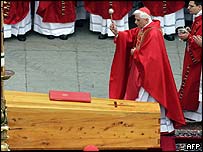
Saturday, February 12, 2005

Interpreting the "Silent" Gadamer

"... reflecting on Gadamer’s epigraph to his own academic memoir of 1977, Philosophical Apprenticeships: 'De nobis ipsis silemus'—about oneself one must keep silent. Perhaps there was more to that than just modesty."


From First Things journal some time ago, a generous take on the philosopher Hans-Georg Gadamer:

"It is reasonable to be dubious about biographies of philosophers, even when they are good. For what, after all, is the life of a philosopher? How much a novelist lived the events he or she wrote about (did Dostoevsky know a Zosima?) seems a natural point of curiosity, irrelevant though it may be to the novels. But could you wonder that about a philosopher? Philosophy concerns ideas, and do ideas have an obscure connection to everyday life? What, for example, can the life of the fellow with the wool ties and Teutonic humor tell us about what was most vital and central to Hans-Georg Gadamer, the German philosopher who died almost two years ago, on March 14, 2002, at the remarkable age of 102. As Gadamer himself noted, philosophers 'are thinkers and their identity is to be found in the continuity of their thought'—'biography' is thus 'marginal.'"

"Gadamer dubbed his work 'philosophical hermeneutics' to distinguish it from hermeneutics proper: that is, biblical exegesis and, in a broader sense, interpretation itself (as opposed to reflection upon it). But philosophy was not its point; philosophy was its means. The point was life, always the affair at which Gadamer’s hermeneutics was aimed. Though you cannot gather it from his academic style, life is the stage for Gadamer’s work the way life looms behind the music of Gustav Mahler (of whom Gadamer was fond). A Mahler symphony seems to want to guide you through birth, death, joy, melancholy, and illness in an altered frame of mind. Gadamer doesn’t offer that guidance: only the voice of Being can give it. But you have to hear that voice, and Gadamer wants to help you to hear it. 'What I am describing is the mode of the whole human experience of the world. I call this experience hermeneutical.' But there has been 'a fateful change in the relationship of humans to the world.' We have become masters. 'We are not at all ready to hear things in their own being.' That deafness means we cannot find our way home; it means a fundamental 'homelessness.' Awakening us to the voice of Being was the issue of all Gadamer’s work."

Friday, February 04, 2005


United Nations ... as usual ... while genocide continues. Posted by Hello

Democracy in Action. Posted by Hello

More Iraqi Fingers, More Iraqi Voters Posted by Hello

The Finger Posted by Hello

Many Women, Many Votes Posted by Hello

One Woman, One Vote Posted by Hello

Democratic Victory! Posted by Hello

Happy Iraqis Posted by Hello